Sourdough Bread Without a Dutch Oven
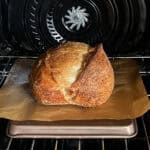
Here is a foolproof sourdough bread recipe without a Dutch oven. This open bake method uses a baking steel or stone with a steam pot filled with hot water placed beneath the loaf.
- Prep Time: 17 hours
- Cook Time: 40 minutes
- Total Time: 17 hours, 40 minutes
- Yield: 1 loaf 1x
- Method: Baking
- Cuisine: American
Ingredients
Scale
- 500 g bread flour
- 350 g water
- 100 g levain or active starter (at peak)
- 10 g sea salt
10 g white rice flour (optional, for dusting)
Instructions
- Autolyse: Combine the measured flour and water in a large mixing bowl. Mix with your hands or a dough whisk until the dough looks rough and shaggy. Cover the bowl with plastic wrap or a damp kitchen towel and let it rest for about 30 minutes.
- Mix the dough: Add the levain at its peak and sea salt. Mix everything by hand for 3-10 minutes based on your schedule and the desired level of gluten development. A longer mix will strengthen the dough. After mixing, cover the bowl again and let it rest for 30 minutes. This marks the beginning of bulk fermentation.
- Fold the dough: Perform two sets of stretch and folds, spaced about 30 minutes apart, followed by two sets of coil folds, also separated by 30-minute intervals. During each fold, stretch the dough in four directions. After each set, take the dough temperature and record it in a baking log. Keep the bowl covered during rest periods between folds.
- Continue bulk fermentation: Let the dough ferment on the counter for a few more hours. Check the temperature every 30 minutes and monitor its rise. Bulk fermentation ends when the dough reaches the target percentage, which varies depending on the dough temperature. It’s ready when bubbles appear on the surface and sides of the dough (especially if the bowl is transparent), the edges appear slightly domed, and the dough gives a gentle jiggle when the bowl is moved.
- Preshape the dough into a round form and let it rest uncovered on the counter for 15 to 20 minutes.
- Shape the dough: Dust your work surface lightly with rice flour. Flip the dough onto the floured surface and form it into a boule or batard. Prepare a banneton or a substitute, like a small bowl lined with a tea towel, and coat it generously with rice flour. Place your shaped dough seam side up into the prepared basket or bowl.
- Proof the dough: Cover the banneton or place it inside a plastic bag and refrigerate it. Let the dough proof in the fridge for 12 to 16 hours, although it can rest for up to 48 hours, depending on the flavor you want. The longer it proofs, the more tangy the result.
- Score the dough: Remove the dough from the fridge and gently invert it onto a sheet of parchment paper. Dust off any excess flour with a pastry brush. Score the dough with a bread lame. If you're starting, try a simple slash or an X. If you're feeling creative, go for a decorative pattern.
- Bake the bread: Preheat the oven to 500°F (260°C) with a baking stone or pizza steel in the center and a heatproof pot on a lower rack for 30–60 minutes. Boil water while the oven heats. Wearing oven mitts and safety goggles, slide the dough with a pizza peel onto the hot surface. Pour about 350 ml (1 1/2 to 2 cups) of boiling water into the pot below to create steam (be careful!). Lower the temperature to 430°F (220°C) and bake for 20 minutes. Then, remove the steam pot and continue baking for an additional 17 to 20 minutes, or until the desired color is achieved.
- Cool the bread: Once baked, transfer the bread to a wire rack and let it cool for at least 2 hours before slicing.
Notes
- Storage and freezing: Store sourdough bread for 3-5 days. Freeze individual slices for up to 1-2 weeks, a whole loaf for 1-2 months.
- Safety tip: Always use oven mitts or silicone gloves when handling hot pans.
- Check for doneness: Your bread is fully baked when the internal temperature reaches 205–210°F (96–99°C). Use a digital probe thermometer to check.
- Need help getting started? Check out my beginner's sourdough bread guide to learn sourdough basics first.
- Note: Nutritional information does not include the white rice flour used for dusting.
Nutrition
- Calories: 2002
- Sugar: 1.5g
- Sodium: 3923mg
- Fat: 5.4g
- Saturated Fat: 0.9g
- Carbohydrates: 419.7g
- Fiber: 14.9g
- Protein: 56.8g
- Cholesterol: 0mg