Beginner Sourdough Starter Recipe
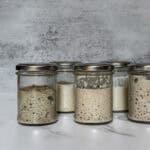
Learn how to make sourdough starter from scratch with this beginner recipe. It includes easy steps to grow a healthy starter for baking sourdough bread.
- Prep Time: 5 minutes
- Total Time: 10 days
- Yield: 70g 1x
- Method: No-Cook
- Cuisine: American
Ingredients
Scale
- 86 grams rye flour, divided (Bob's Red Mill brand)
- 480 grams unbleached white bread flour, divided (King Arthur brand)
- 576 grams water, divided (non-chlorinated tap water, filtered or spring water)
Instructions
- Check the photos and instructions earlier in the post for reference before you start.
- Day 1: Weigh the empty clean jar and write its weight on the bottom with a marker. Mix 50 grams of rye flour with 60 grams of lukewarm water at 75-78°F (24-26°C) and stir vigorously until smooth, using a spatula to clean the sides of the jar. The mixture should resemble thick pancake batter and be lump-free. Cover the jar loosely with a lid to allow airflow. Place the jar in a warm spot (75-79°F or 24-26°C), a consistent environment, away from direct sunlight and drafts, for 24 hours.
- Day 2: Take 25g of the existing "starter" mixture and place it in a second clean, empty jar. Add 18g rye flour, 18g strong white bread flour, and 36g lukewarm water. Stir well, cover loosely with a lid, and leave it in the same warm spot for another 24 hours.
- Day 3: Take 25g of the starter and place it in a second clean, empty jar. Add 18g rye flour, 18g strong white bread flour, and 36g lukewarm water. Stir vigorously, cover loosely with a lid, and leave it in the same warm spot for another 24 hours.
- Day 4: Starting today, place a rubber band around the jar or use a washable glass marker to indicate the initial level of the starter after each feeding. Take 25g of the starter and place it in a second clean, empty jar. Add 36g strong white bread flour and 36g lukewarm water. Stir well until lump-free and smooth. Place the lid on top loosely and keep in a warm place for 12 hours. Repeat the same discard and feeding in 12 hours.
- Day 5: Follow the same feeding method as on Day 4 (twice a day) with a single feeding of 25g starter, 36g white bread flour, and 36g water.
- Days 6-7: Keep feeding your starter as you did on Day 5 twice daily today. But if your starter has doubled and deflated within less than 12 hours after feeding, it indicates hunger. So, starting today, consider changing the feeding ratio to 1:3:3. Take 10g of the starter and place it in a second clean, empty jar. Add 30g strong white bread flour and 30g lukewarm water. Stir well until all flour is well incorporated. Place the lid on top and a rubber band around the jar, and let it sit for 12 hours in the same warm place. Then, repeat the discard and feeding process every 12 hours.
- Days 8-10: Continue feeding your starter at a 1:3:3 ratio (10g starter, 30g white bread flour, 30g water) twice a day. You can switch to room-temperature water.
- By Day 10, your starter could be ready for baking bread or require additional fermentation time. Your starter will reach some level of maturity by Day 14, although it will continue to develop over the next few weeks.
Notes
- Weigh the starter, flour, and water using a digital scale, as the feeding ratios rely on weight, not volume.
- Add water to the starter before incorporating the flour for effective mixing. This ensures an even water distribution to hydrate the flour properly and promote better rising.
- After each feeding, remember to scrape the sides of the jar with a rubber spatula and wipe the rim clean with a paper towel.
- Starting on Day 6, you will find the need to increase the feeding ratio. Start with a 1:3:3 ratio twice daily, progressing to 1:4:4 if needed.
- Wait until Day 10 (or, for some bakers, Day 7) before using or baking with the discard.
- Your starter is ready for baking if it doubles in volume in 4-7 hours after the feeding at a temperature of about 76–80°F (24–27°C). Read about when your starter is ready to bake.
Find it online: https://sourdoughtalk.com/how-to-make-sourdough-starter-recipe/