How To Rehydrate Sourdough Starter
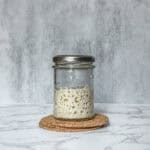
Easily rehydrate sourdough starter with this step-by-step guide to revive dried starter and get it ready for baking bread.
- Total Time: 5 days
- Yield: 35g 1x
- Method: No-Cook
- Cuisine: American
Ingredients
Scale
- 10 grams dried sourdough starter
- 109 grams unbleached bread flour, divided (King Arthur brand)
- 105 grams water, divided (non-chlorinated tap water, filtered or spring water
Instructions
- Check the photos and instructions earlier in the post for reference before you start.
- Day 1 morning: Place 10 grams of dried sourdough starter in a clean jar. Add 15 grams of lukewarm water at 75-78°F (24-26°C) and stir until well combined. Let the mixture sit in a warm spot (around 78-80°F or 25.5-27°C) for 20 to 30 minutes, allowing the starter powder to dissolve. If your starter is in flakes, let it soak for 1 to 3 hours. Stir and check each hour until the flakes are almost completely dissolved.
- Once dissolved, add 10 grams of unbleached bread flour and mix with a rubber or wooden spatula until well combined. Cover the jar loosely and leave it in a warm, draft-free place (72-75°F or 22-24°C) for 24 hours.
- Day 2 morning: Do not discard the starter yet. Just mix it and add 10 grams of lukewarm water, stir, and mix in 12 grams of bread flour. The mixture should feel like thick pancake batter. Mark the starter level on the side of the jar with a rubber band or a washable glass marker to track its growth. Cover with a loose lid and leave it in a warm, draft-free place (72-75°F or 22-24°C) for 24 hours.
- Day 3 morning: Do not discard the starter yet. Just mix it and add 5 grams of lukewarm water, stir, and mix in 12 grams of bread flour. The mixture should feel like a very thick pancake batter, but it will loosen over time. Mark the starter level on the side of the jar with a rubber band or a washable glass marker to track its growth. Cover with a loose lid and leave it in a warm, draft-free place (72-75°F or 22-24°C) for 24 hours.
- Day 4 morning: Mix your starter and remove all but 25 grams (transfer it to a clean jar if you prefer). Add 25 grams of lukewarm water, stir, then add 25 grams of bread flour. Mix well with a jar spatula. Mark the starter level on the side of the jar with a rubber band or a washable glass marker to track its growth. Cover with a loose lid and leave it in a warm, draft-free place (72-75°F or 22-24°C) for 12 hours.
- Day 4 evening: If there is little activity, skip this evening’s feeding and keep it in a warm (72-75°F or 22-24°C) draft-free place for another 12 hours. If the starter has doubled in size, feed it. Mix it and remove all but 10 grams (transfer it to a clean jar if you prefer). Add 20 grams of lukewarm water, stir, then add 20 grams of bread flour. Mix well with a jar spatula. Mark the starter level on the side of the jar with a rubber band or a washable glass marker to track its growth. Cover with a loose lid and leave it in a warm, draft-free place (72-75°F or 22-24°C) for 12 hours.
- Day 5 and beyond: Mix your starter and remove all but 5 grams. Start feeding it twice a day using a 1:3:3 ratio (5 grams starter, 15 grams flour, 15 grams water). Room-temperature water works fine at this stage. Over the next three to five days, keep an eye on it. Look for steady bubbles, a pleasantly tangy smell, and consistent growth—doubling or even tripling in just a few hours after each feeding. When it regularly reaches its peak, your starter is ready to bake sourdough bread.
Notes
- Temperature: Keep the starter warm between 75°F and 80°F (24 °C and 27°C). If your kitchen is cold, place the jar in an oven with just the light on, but check the temperature with a thermometer to avoid overheating.
- Consistency: Weigh your ingredients with a kitchen scale at each feeding and log your starter's progress daily.
Find it online: https://sourdoughtalk.com/how-to-rehydrate-sourdough-starter/