Feeding Sourdough Starter (Step-by-Step Recipe)
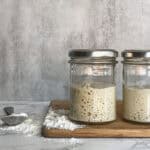
Learn how to feed sourdough starter, whether you feed it once or twice a day, and keep it strong, active, and ready for baking.
- Prep Time: 5 hours
- Total Time: 5 hours
- Yield: 55g 1x
- Method: No-Cook
- Cuisine: American
- Diet: Vegetarian
Ingredients
Scale
- 5 g sourdough starter
- 25 g bread flour (or all-purpose flour)
- 25 g water (filtered, spring, or non-chlorinated tap water)
Instructions
- Prepare your jar: Start with a clean, empty jar. Weigh the jar (in grams) using a kitchen scale and write the weight of the empty jar in your sourdough log or on the bottom of the jar.
- Transfer the starter: Stir your existing sourdough starter with a jar spatula. Then, transfer 5g of starter into the clean jar. Record the weight of the jar with 5g of starter (base weight) and highlight it in your log.
- Feed the starter: Add 25g of water and stir until the mixture is well combined. Then, add 25g of flour and stir until fully combined. Cover the jar loosely and place it in a warm location, at a temperature of 75-79°F (24-26°C). Remember to mark the starter's level with a rubber band to track its rise.
- Let it rise: Check the starter periodically for signs of activity, such as bubbles and increased volume, usually visible within a few hours. Record the time it takes to reach its peak in a starter log.
- Repeat daily: After 24 hours, continue feeding your starter daily using a 1:5:5 ratio (one part starter, five parts flour, and five parts water).
Notes
- Once-daily feeding: Use a ratio of at least 1:5:5, with one part starter, five parts flour, and five parts water.
- Twice-daily feeding: If you prefer to feed your starter twice daily (morning and evening), consider using a 1:2:2 ratio (one part starter, two parts flour, and two parts water) instead.
- Low-maintenance storage: If baking only once a week, consider storing your starter in the fridge and feeding it once a week.
- Flour: Use unbleached bread or all-purpose flour. Organic flour is a great choice.
- Water: Use filtered, spring, or non-chlorinated water at room temperature. Avoid tap water with chlorine. To dechlorinate your water, leave it in an open container on the counter overnight.
- Clean your jar every week to prevent mold growth in the starter.
- Starter jar: Read about how to choose the best sourdough starter jar.
-
Find it online: https://sourdoughtalk.com/feeding-sourdough-starter-guide/