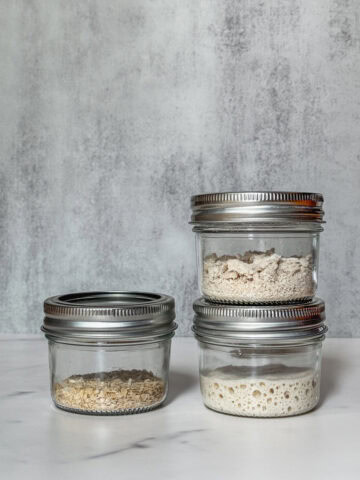


Quick Summary: To feed a sourdough starter, keep a small amount (about 5g), discard the rest, then add fresh flour and water by weight and let it rise in a warm spot until bubbly and peaked. Feed at peak or early collapse, judging by how the starter looks and smells, not by the clock.
For active baking, keep it at room temperature and feed once or twice a day. If you bake less often, store it in the fridge and feed it weekly. The amount of flour and water you add is determined by your feeding ratio (a common starting point is 1:5:5 once a day or 1:3:3 twice a day).
In this guide, I will show you how to feed your starter for the optimal balance of wild yeast and lactic acid bacteria.
Once your starter is active and established, whether you made it yourself or rehydrated a dried one, you will begin a regular feeding routine. Don't forget to print my Sourdough Starter Feeding Log to keep track of its progress.
And if you don't have a starter yet, start with my Beginner Sourdough Starter Recipe.

Jump to:
- What is an active sourdough starter?
- What does feeding a sourdough starter mean?
- Ingredients & tools for feeding your starter
- How to feed sourdough starter step-by-step
- Why does a sourdough starter rise and fall?
- Active feeding vs. paused fermentation: what's the difference?
- When should you feed sourdough starter?
- How often should you feed sourdough starter?
- How much should you feed your starter?
- What is a hungry starter?
- Sourdough starter maintenance tips
- FAQs
- Let's talk sourdough
- Ready to keep learning?
- Recipe
- Comments
What is an active sourdough starter?
An active sourdough starter is an established colony of wild yeast and lactic acid bacteria. These microorganisms are responsible for making sourdough bread rise and give it a tangy, unique flavor.
The wild yeast in the starter consumes the natural sugars in the flour and produces carbon dioxide, which drives the fermentation.
If you are starting from scratch, it may take approximately 3 to 4 months for the starter to mature. While you can begin baking earlier, the quality of your bread might vary. A healthy sourdough starter should double or even triple in volume before the next feeding.
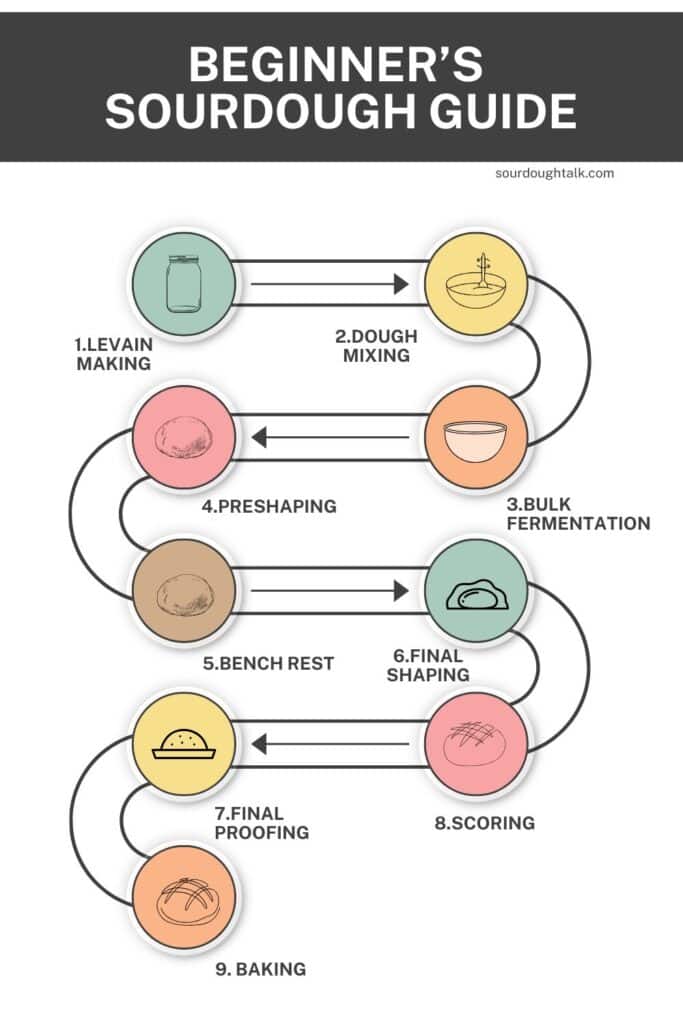
Your Beginner's Guide to Sourdough
This post is part of a series that walks you through every step, from feeding your starter to pulling the loaf from the oven.
What does feeding a sourdough starter mean?
Feeding a sourdough starter means removing most of it (discarding), then adding fresh flour and water. But this isn't just topping it up. Each feeding resets the balance of the culture.
Adding fresh flour and water dilutes the acids already in the starter, temporarily lowering the acidity. As a result, the pH rises from a very acidic level (around 3.7-4.0) to a more neutral range (around 5.8-6.0).
This is completely normal and actually important. The higher pH gives the yeast a better chance to reproduce more efficiently, while the acid-producing bacteria temporarily slow down. Over time, as the starter ferments, the acidity gradually builds up again.
That reset is why, when you feed, it matters as much as when and how: feed at peak or early, before the starter over-acidifies.
Ingredients & tools for feeding your starter
- Sourdough starter
- Sourdough starter container with a lid: I usually keep my starter in a repurposed jar. Read more about the best sourdough starter jar.
- Kitchen scale: This is my favorite gram scale for feeding my starter.
- Flour: Use unbleached bread or all-purpose flour. Organic flour is a great choice. I use King Arthur Organic Bread Flour.
- Water: Use filtered, spring, or non-chlorinated water at room temperature. Avoid tap water with chlorine. To dechlorinate your water, leave it in an open container on the counter overnight.
- Jar spatula: This is my favorite jar spatula that fits perfectly in a 6-oz. sourdough jar.
How to feed sourdough starter step-by-step
Feeding your sourdough starter includes three basic steps:
- Discard: Remove a portion of your starter.
- Feed: Add fresh flour and water to nourish your starter.
- Let it rise: Look for bubbling, rising, and a pleasant aroma.
Step-by-step starter feeding routine
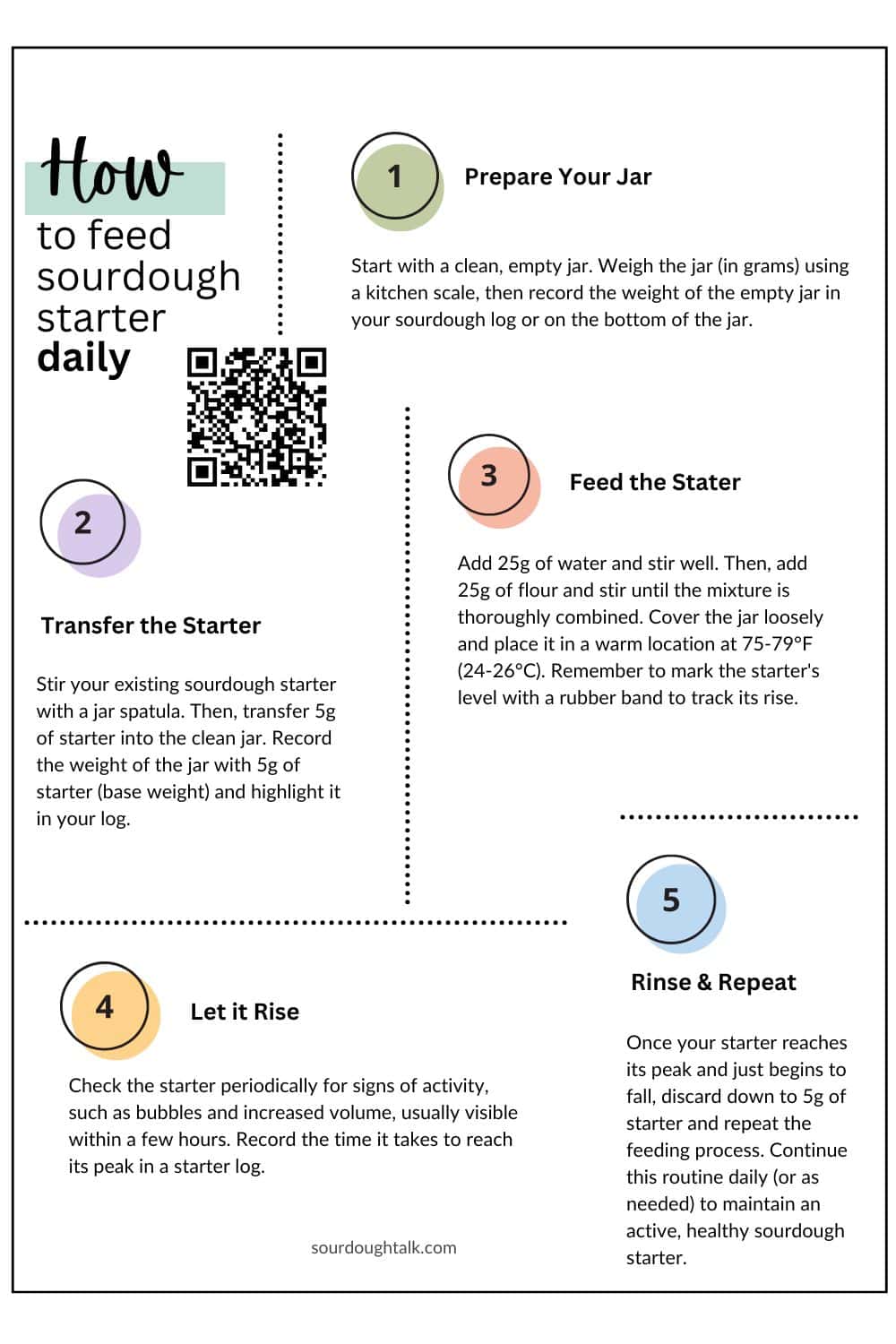
- Prepare your jar: Start with a clean, empty jar. Weigh the jar (in grams) using a kitchen scale, then record the weight of the empty jar in your sourdough log or on the bottom of the jar.
- Transfer the starter: Stir your existing sourdough starter with a jar spatula. Then, transfer 5g of starter into the clean jar. Record the weight of the jar with 5g of starter (base weight) and highlight it in your log.
- Feed the starter: Add 25g of water and stir well. Then, add 25g of flour and stir until the mixture is thoroughly combined. Cover the jar loosely and place it in a warm location at 75-79°F (24-26°C). Remember to mark the starter's level with a rubber band to track its rise.
- Let it rise: Check the starter periodically for signs of activity, such as bubbles and increased volume, usually visible within a few hours. Record the time it takes to reach its peak in a sourdough starter feeding log.
Why does a sourdough starter rise and fall?
Every healthy sourdough starter naturally goes through a feeding cycle (one complete loop) where it rises, reaches its highest point (peak), and falls. This process occurs because the wild yeast and bacteria in the starter work.
When you feed the starter, you provide it with fresh flour and water, which supply the yeast and bacteria with sugar and starch to eat.
As they eat, they produce carbon dioxide gas, which creates bubbles inside the starter. Over time, acidity builds as sugars are consumed, and the starter eventually reaches its maximum volume, called the sourdough starter peak.
However, once the yeast and bacteria have eaten all the food, yeast activity slows, acidity continues to rise, and the structure begins to weaken. The starter then collapses, signaling the end of that feeding cycle.
Active feeding vs. paused fermentation: what's the difference?
There are two ways to maintain a starter: active feeding and paused fermentation.
Active feeding means keeping your starter at room temperature and letting it rise and peak before each feed. This is what you do when you are baking regularly.
A room-temperature starter usually needs feeding once or twice a day, and how much you feed depends on your feeding ratio.
Top tip: You don't need to change jars with every feeding. But cleaning your jar at least once a week helps keep unwanted bacteria from affecting your starter (see my guide to bad sourdough starter).
Paused fermentation means feeding the starter, then deliberately slowing it down, usually by moving it to the fridge. This is what you do when you bake less often and feed weekly.
Problems arise when you accidentally mix the two approaches. My guide on how to store sourdough starter explains whether yours should stay active or be paused, which helps prevent a weak, acidic starter.
When should you feed sourdough starter?
Starter fermentation speed depends on room temperature, flour type, hydration, and starter strength. Two starters fed at the same time will peak hours apart, even when treated the same.
Key guideline: Feed your starter at peak or early collapse (does not need to fully collapse). This timing keeps the yeast active, sugars are mostly consumed, and acidity hasn't become excessive.
Once ready to feed your starter, pay attention to what the starter is doing:
- Has it risen significantly?
- Is the surface domed or starting to flatten?
- Does it smell mildly tangy or sharply acidic?
- Has it begun to collapse?
Avoid feeding too early, while the starter is still rising. Repeated interruptions weaken the starter and create imbalances. Think of it like letting your starter finish its "meal" before giving it more food (see my guide on overfeeding sourdough starter).
Sourdough starter peak is the maximum height the starter reaches. At this point, sugars are nearly consumed, and acidity is higher. Many mature starters peak around pH 3.8-3.9, which is normal and healthy.
Early collapse begins when the starter starts to fall. It is still a safe feeding window.
How often should you feed sourdough starter?
As a Cottage baker, I feed my starter twice daily to keep it strong and active, and I use a Brod & Taylor Sourdough Home to maintain a steady 75°F (24°C) so I don't have to adjust my feeding ratios for the seasons.
If you want to bake show-stopping loaves or grow your skills to sell sourdough bread, consider feeding your starter twice a day, once in the morning and again in the evening.
If you don't bake often, store your starter in the fridge. This way, you only need to feed it once a week to keep it healthy and ready when you need it.
How much should you feed your starter?
The amounts of flour and water you add are set by your feeding ratio, written as starter:flour:water (for example, 1:5:5 means one part starter, five parts flour, and five parts water, all by weight).
A quick rule of thumb: feed 1:5:5 once a day, or 1:3:3 twice a day, at room temperature, then adjust based on how your starter behaves. Avoid relying on a 1:1:1 ratio for once-daily feeding. There is not enough food, which leads to a weak, overly acidic starter over time.
Choosing and adjusting the right ratio for your kitchen, temperature, and schedule is a topic in itself. For the full breakdown, the ratio-and-frequency chart, and how to fine-tune it, see my complete sourdough starter feeding ratios guide.
What is a hungry starter?
A hungry sourdough starter has run out of food, meaning the wild yeast and bacteria have consumed the available sugars in the flour. This is what happens when you feed your starter with a 1:1:1 ratio once or twice a day.
Before each feeding, check the so-called "snail trail" left by the starter on the sides of the jar. This mark is left behind as the starter rises and falls when it runs out of food.
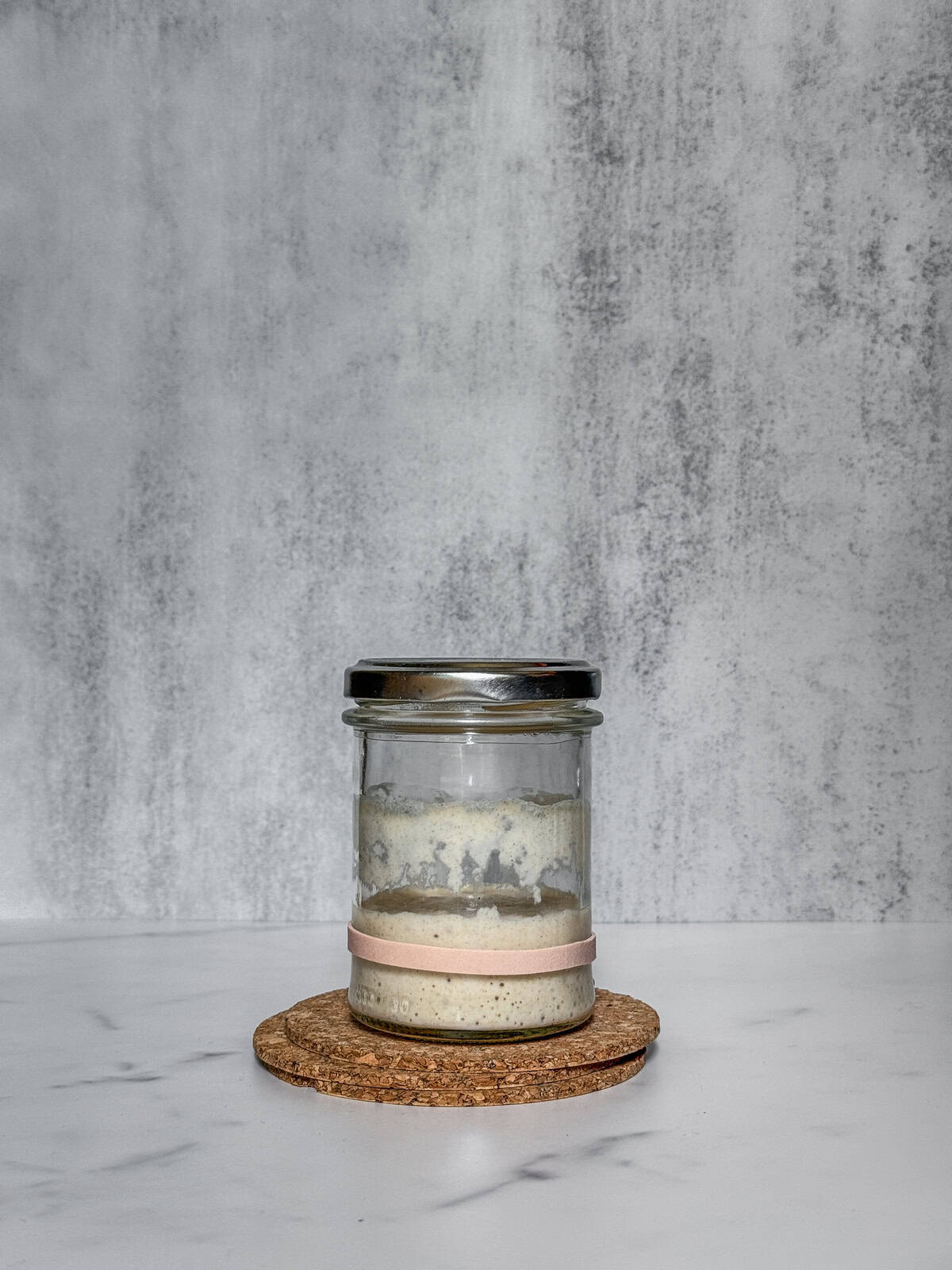
If the starter completely collapses by its next feeding time, it is time to adjust its feeding schedule or ratio. For example, if you are feeding it a 1:2:2 ratio twice a day and it still collapses before the next feeding, try increasing the ratio to 1:3:3.
Watch for the starter to peak, then only slightly deflate, forming a flat top instead of full collapse. If this is the case, stick with that feeding ratio. If it has not yet peaked by the feeding time, decrease the ratio to 1:2.5:2.5 and observe.
Other signs of a hungry starter, when neglected for a prolonged period, include a strong, sour smell that may be unpleasant and a thin layer of liquid on top, known as hooch.
Sourdough starter maintenance tips
- Smell your starter before each feeding. A strong acidic odor indicates excessive acidity, which can help you troubleshoot and prevent baking mishaps.
- Use a kitchen scale to accurately measure the starter, flour, and water, as feeding ratios are based on weight, not volume. It is important to note that volume and weight differ. One cup of flour doesn't weigh the same as one cup of water.
- Always feed the starter with at least the same amount of flour and water (a 1:1:1 ratio) as is already in the jar after discarding, or even more. Never feed it less flour and water than in the jar. In short, avoid using a 1:0.5:0.5 ratio when feeding your starter!
- Feed your starter either at peak or just after. Avoid feeding it before it reaches its peak, as this dilutes and weakens the yeast colony.
- Avoid neglecting your starter for too long. Otherwise, the acid will accumulate, and you will continue to pass it into your next feed. Over time, it will result in a weak, acidic starter.
- When maintaining your established starter, set aside the discard for use in discard recipes, or use a no-discard method to maintain your starter.
- If you choose to dispose of the sourdough discard, avoid pouring it down the drain to prevent potential clogs over time. Use a spatula to discard the excess in the trash or compost bin instead.
- Before washing, wipe down the spatula and the empty jar with a paper towel.
- You can use a fresh jar daily or stick with the same one for daily feedings, as many bakers prefer the continuity of using the same jar.
- For optimal mixing, add water to the starter first, then add the flour. This allows the water to distribute evenly and hydrate the flour.
- After each feeding, scrape down the sides of the jar with a jar spatula and wipe the rim clean with a paper towel.
- Make feeding your starter part of your daily routine, but if you miss a feeding occasionally, your starter will survive.
FAQs
Due to numerous questions about feeding and maintaining a sourdough starter, I wrote a dedicated post answering the most common sourdough starter FAQs. Here are a few more frequently asked questions and answers.
What if I forget to feed my starter? Don't worry, you almost certainly didn't ruin it. Sourdough starters are far more resilient than they look. Just resume feeding, keep it warm, and give it a couple of feedings to bounce back. If there is a layer of liquid (hooch) on top, stir it in or pour it off, then feed as usual.
How do I know my starter is ready to use? It is ready when it is at peak: roughly doubled (sometimes tripled), slightly flattened, and full of bubbles, with a pleasantly tangy smell. Mark the starter's level with a rubber band after feeding so you can see when it has risen.
My starter looks runny (or very thick). Is that normal? Yes, the starter's texture varies with your flour and the day. Aim for a thick pancake batter consistency. If it is too thick, add a little water. If it is too thin, add a little flour. The texture is always adjustable.
Can I use measuring cups instead of a scale? I highly recommend using a scale, because feeding ratios are by weight, and a cup of flour doesn't weigh the same as a cup of water. If you only have cups, you can still feed your starter, but you will likely need to adjust the texture to that thick-pancake-batter consistency.
What do I do with a gifted sourdough starter? If you don't know when it was last fed, feed it right away. You don't need to use all of it. Keep a small portion (for example, 5g) and feed it generously, at least a 1:5:5 ratio (5g starter, 25g flour, 25g water), so it has enough food to stay strong. Store the rest in the fridge as a backup.
What's the best feeding ratio for a beginner? Start simple: a 1:5:5 ratio once a day, or 1:3:3 twice a day, at room temperature, then adjust to how your starter behaves. There's no single "best" ratio, as it depends on your kitchen and schedule.
Why are there so many ways to maintain a starter, and which should I follow? It is because there is no single correct method. Choose what fits your routine. If you bake often, feed at room temperature once or twice a day. If you bake weekly, store your starter in the fridge and feed it once a week.
Let's talk sourdough
How often do you feed your sourdough starter? Have you tried different feeding schedules? I'd love to hear your experiences and tips in the comments below.
Ready to keep learning?
Now that you know how to feed your starter, let's take a closer look at what goes into it. Understanding the ingredients in sourdough starter is key to building a strong, bubbly culture.
PrintRecipe
Feeding Sourdough Starter (Step-by-Step Recipe)

Learn how to feed sourdough starter, whether you feed it once or twice a day, and keep it strong, active, and ready for baking.
- Prep Time: 5 hours
- Total Time: 5 hours
- Yield: 55g 1x
- Method: No-Cook
- Cuisine: American
- Diet: Vegetarian
Ingredients
- 5 g sourdough starter
- 25 g bread flour (or all-purpose flour)
- 25 g water (filtered, spring, or non-chlorinated tap water)
Instructions
- Prepare your jar: Start with a clean, empty jar. Weigh the jar (in grams) using a kitchen scale and write the weight of the empty jar in your sourdough log or on the bottom of the jar.
- Transfer the starter: Stir your existing sourdough starter with a jar spatula. Then, transfer 5g of starter into the clean jar. Record the weight of the jar with 5g of starter (base weight) and highlight it in your log.
- Feed the starter: Add 25g of water and stir until the mixture is well combined. Then, add 25g of flour and stir until fully combined. Cover the jar loosely and place it in a warm location, at a temperature of 75-79°F (24-26°C). Remember to mark the starter's level with a rubber band to track its rise.
- Let it rise: Check the starter periodically for signs of activity, such as bubbles and increased volume, usually visible within a few hours. Record the time it takes to reach its peak in a starter log.
- Repeat daily: After 24 hours, continue feeding your starter daily using a 1:5:5 ratio (one part starter, five parts flour, and five parts water).
Notes
- Once-daily feeding: Use a ratio of at least 1:5:5, with one part starter, five parts flour, and five parts water.
- Twice-daily feeding: If you prefer to feed your starter twice daily (morning and evening), consider using a 1:2:2 ratio (one part starter, two parts flour, and two parts water) instead.
- Low-maintenance storage: If baking only once a week, consider storing your starter in the fridge and feeding it once a week.
- Flour: Use unbleached bread or all-purpose flour. Organic flour is a great choice.
- Water: Use filtered, spring, or non-chlorinated water at room temperature. Avoid tap water with chlorine. To dechlorinate your water, leave it in an open container on the counter overnight.
- Clean your jar every week to prevent mold growth in the starter.
- Starter jar: Read about how to choose the best sourdough starter jar.
-