
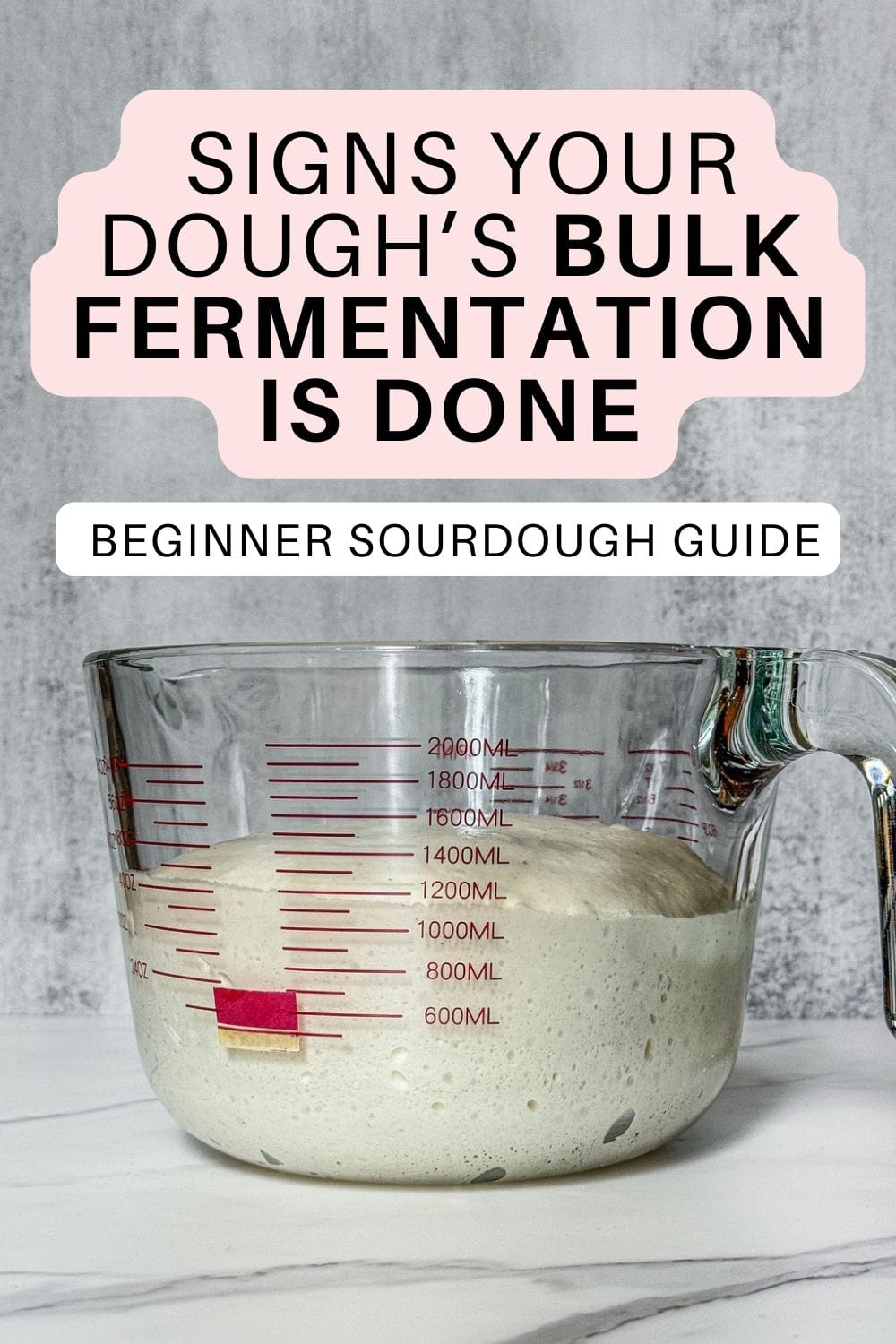
Want to know how to tell when bulk fermentation is done? In this guide, I will walk you through everything you need to know in a simple and beginner-friendly way.
If you are unfamiliar with sourdough terms, check out the sourdough glossary. To learn more about bulk fermentation, read through my complete guide.
What is bulk fermentation?
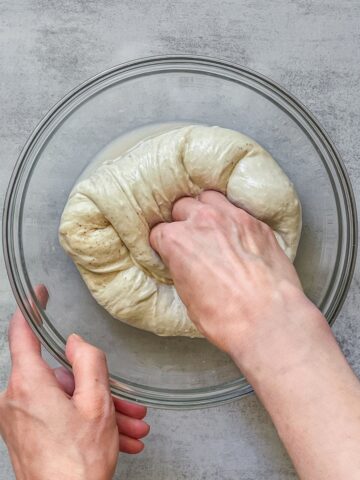
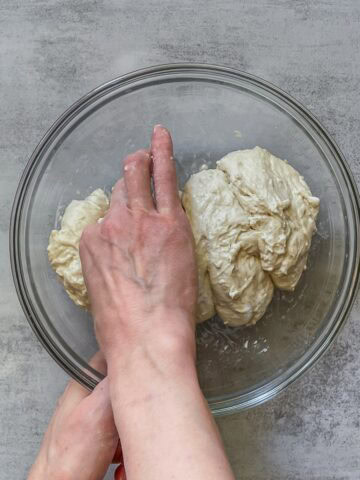
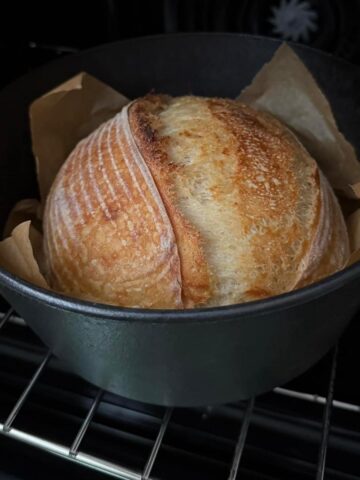
Bulk fermentation is the first rise that occurs after mixing the ingredients together. It is not just another step in sourdough baking. It is the most important phase in achieving the perfect sourdough bread loaf.
During this time, wild yeast and bacteria from your starter begin to ferment the dough, creating tiny bubbles of CO₂ gas that make your bread rise. The dough gains strength and grows in size.
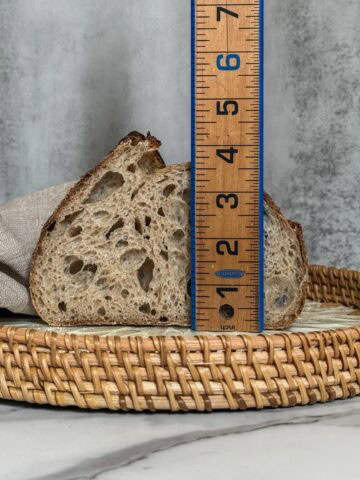
Getting this step right is the secret to baking better bread. If you cut bulk fermentation short, your bread may end up dense and tight. If you let it go too long, your dough can become over-proofed and collapse during baking.
When does bulk fermentation start and end?
Bulk fermentation starts as soon as the levain (active starter) is added. It happens when adding levain to flour and water for fermentolyse or when mixing all the bread ingredients at once.
Bulk fermentation ends when you divide and pre-shape the dough, or, if making one loaf, when you shape it (if you skip the preshaping step).
How do you know when bulk fermentation is done?
This is the big question!
Waiting for the dough to double in size to end bulk fermentation is the wrong approach unless you plan to do the final proof on the countertop, which can compensate for the fermentation mistake.
If you plan to cold-proof the dough in the fridge, where it will take about 10 hours to cool to 39°F (4°C), there is a chance that your dough will overproof. This will result in a flat and dense loaf of bread.
The key to knowing when bulk fermentation is finished is to monitor the dough temperature and percentage rise. This method comes from Tom Cucuzza, the author of The SECRET of Bulk Fermentation: Measuring Dough Temperature and Percentage Rise.
As the author writes, "When your dough reaches the target percentage rise, that is the end of bulk fermentation."
After years of experimentation, he developed a system that works for both warm bulk fermentation (dough temperatures of 75-80°F or 24-27°C) and cool bulk fermentation (below 75°F or 24°C).
If the dough temperature reaches 80°F (27°C) or higher, refer to the other seven criteria outlined in the Bulk-o-Matic Guide.
But Tom Cucuzza emphasizes that his guide is just a starting point for Chad Robertson's Tartine Bread recipe. You will still need to adjust bulk fermentation to suit your bread recipe and kitchen conditions.
How to monitor the dough percentage rise
To follow Tom Cucuzza's method, use a straight-sided container and mark the dough's starting volume at the beginning of bulk fermentation.
Measure the dough temperature every 30 minutes and compare it to the target rise percentage using the bulk fermentation chart. Mark the target percentage rise level on your container to monitor the dough's progress.
If the dough temperature changes during bulk fermentation, use the ending temperature to determine the target percentage rise. For dough fermented at 80°F (27°C) or higher, calculate the average temperature throughout bulk fermentation.
Once the dough reaches the target percentage rise, bulk fermentation is complete [almost complete].
Those using the aliquot jar method can combine it with Tom Cucuzza's approach. Once the dough in your aliquot jar reaches the target percentage rise, bulk fermentation is complete.
It is a simple and effective way to perfect your bulk fermentation. I use this combined method in my Master Sourdough Bread recipe.
How to measure the percentage rise during bulk fermentation
The best container for bulk fermentation is a clear, straight-sided one with milliliter markings. It should also be large enough for you to easily handle the dough for folding.
Why are milliliter markings important? Because dough rise is measured by volume, not weight.
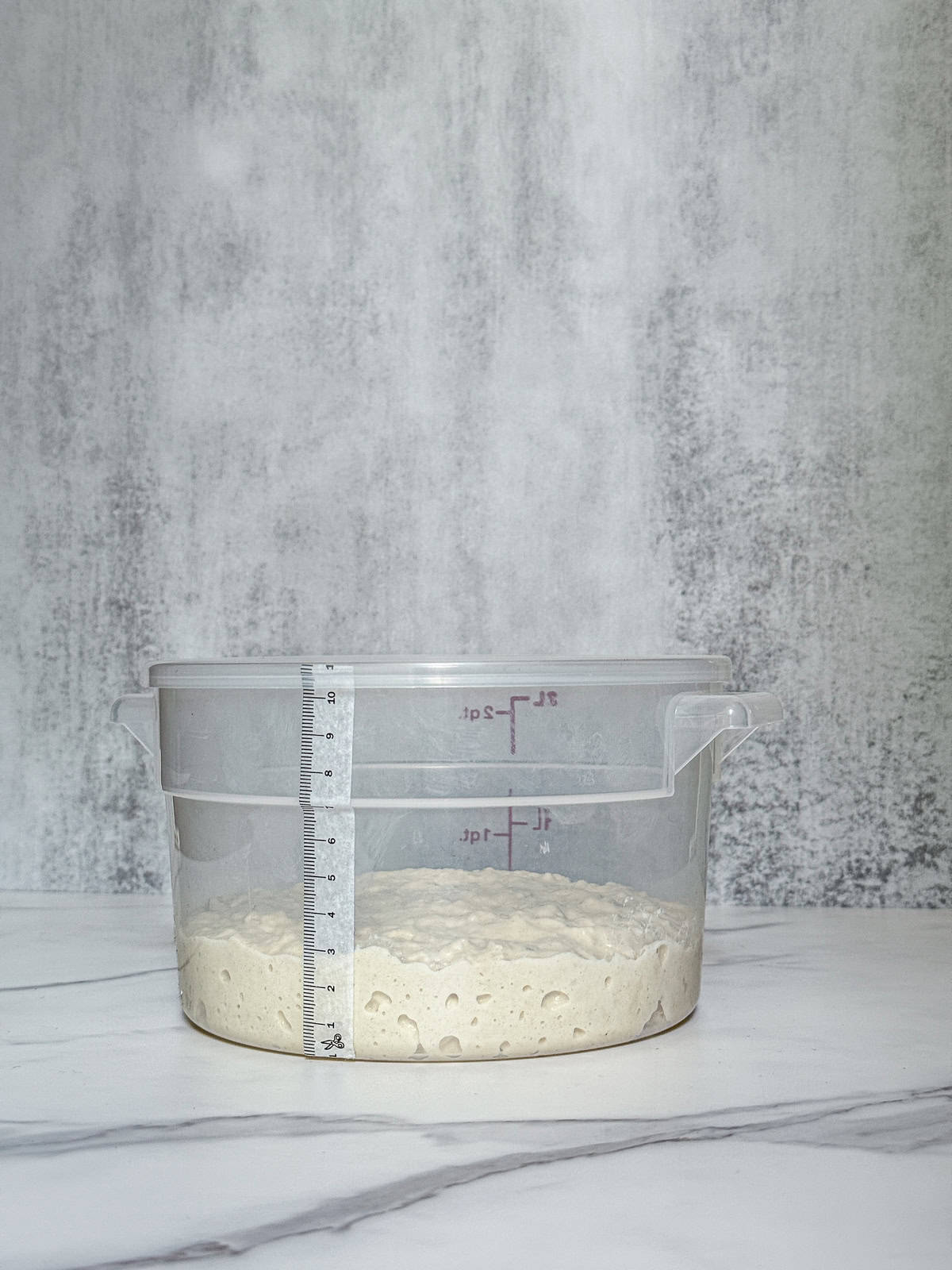
If you don't have a straight-sided container with milliliter markings, use a clear Cambro container, either round or square. A round container is better because the dough spreads easily without needing to push it into the corners. I recommend using a 4Q Cambro container for sourdough with 500-1000g of flour.
Most bakers don't measure exact milliliters with Cambro containers. Instead, they note the starting point and add their own markings using a washable marker or a measuring washi tape, estimating a 30%, 50%, or 75% rise by eye.
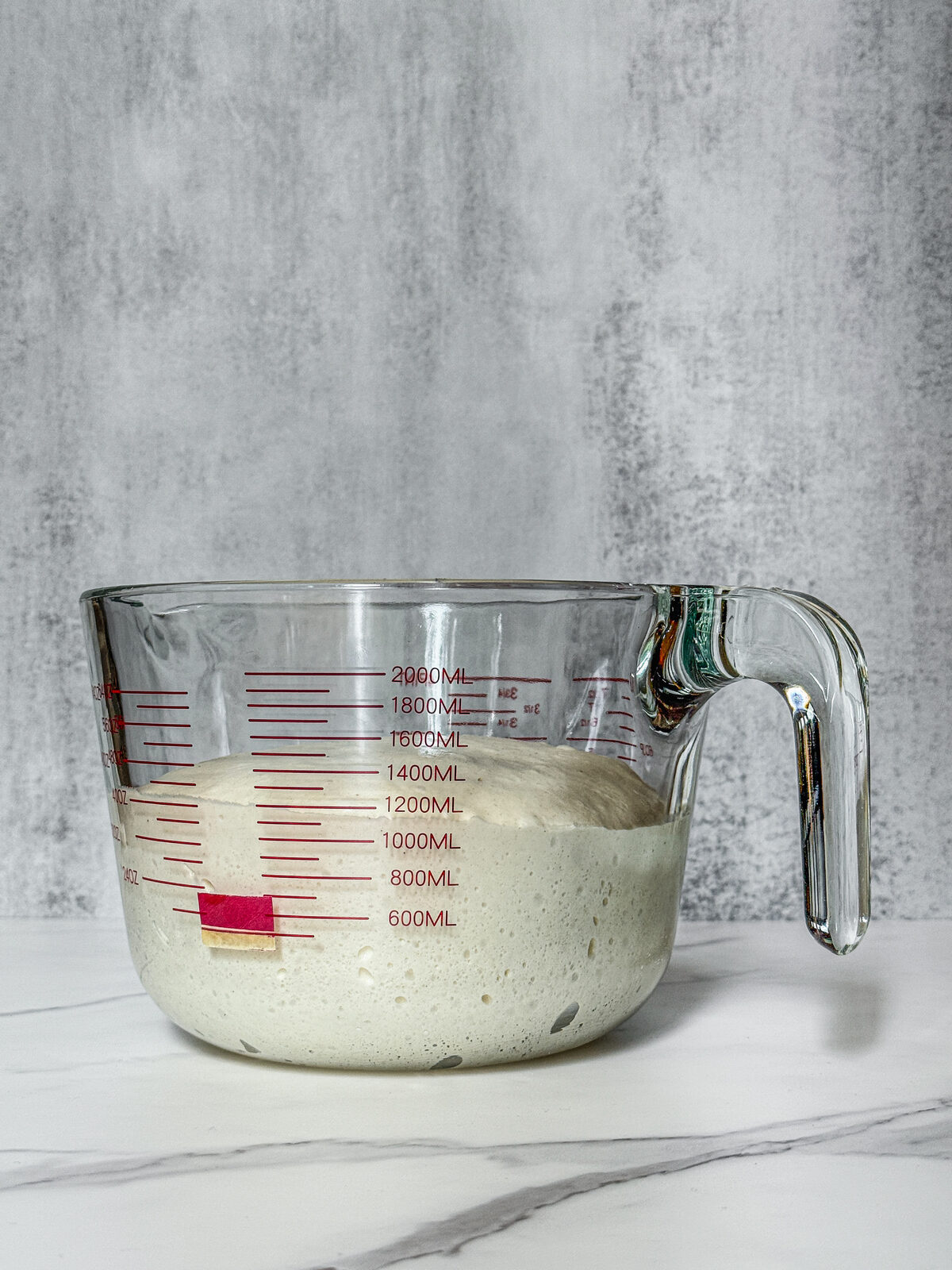
If you don't have a straight-walled container, you can also use something like a Pyrex glass measuring cup with milliliter markings. I recommend a 4-cup glass measuring cup for sourdough bread made with 500g of flour.
After mixing your dough, place it in the container and record the starting volume.
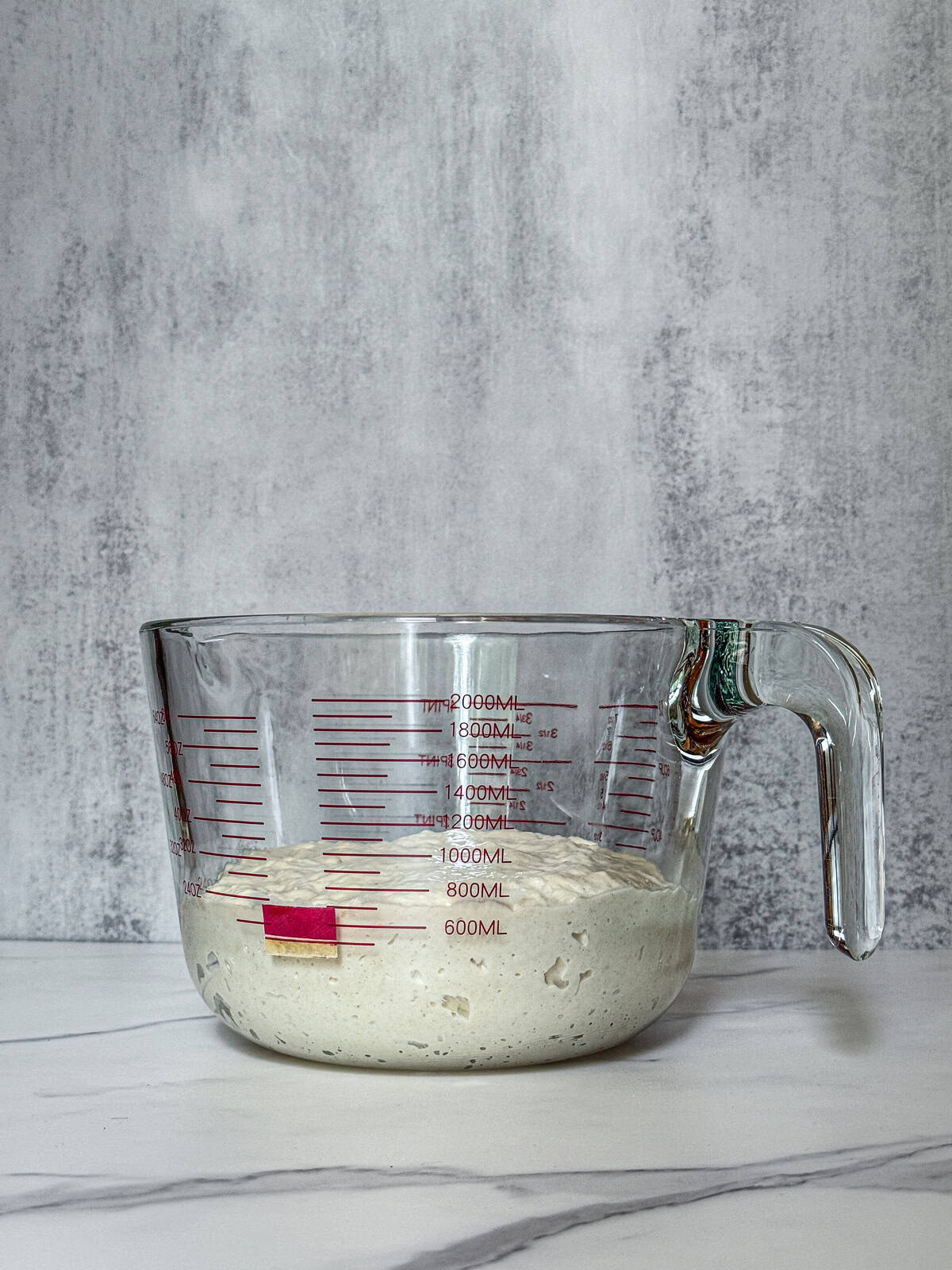
You can easily calculate the starting volume yourself. For example, if your dough starts at 750 mL, a 100% rise (doubling in volume) means the dough will reach 1,500 mL.
To make it even easier, divide your starting volume by 100 to find 1% of your dough rise (750 ÷ 100 = 7.5).
From there, you can easily calculate any rise you need. For example, if you want a 50% rise, multiply 7.5 (which is 1% of your dough rise) by 50 (the percent rise you want), then add your starting volume (750 mL in this case). So: 7.5 × 50 + 750 = 1,125 milliliters.
If your container doesn't have milliliter markings and has an uneven shape, you can easily add your own. Pour 100 mL of water into the container and mark the water level with a washable marker or tape.
Then add another 100 mL, mark the new level, and repeat the process. This way, you will have clear 100-mL marks to help you measure the dough rise during bulk fermentation.
Other signs that bulk fermentation is finished
Here are a few other indicators to help you know when your dough is ready:
- Volume increase: The dough should have increased in size by about 30-100%, depending on the target percentage rise.
- Wobble test: Gently shake the container. The dough should jiggle slightly and feel elastic.
- Surface appearance: The top of the dough should be domed and smooth, with a rounded "shoulder" where it touches the edges of the container.
- Bubbles: You should see small and large bubbles on the surface and smaller ones on the sides of a transparent container.
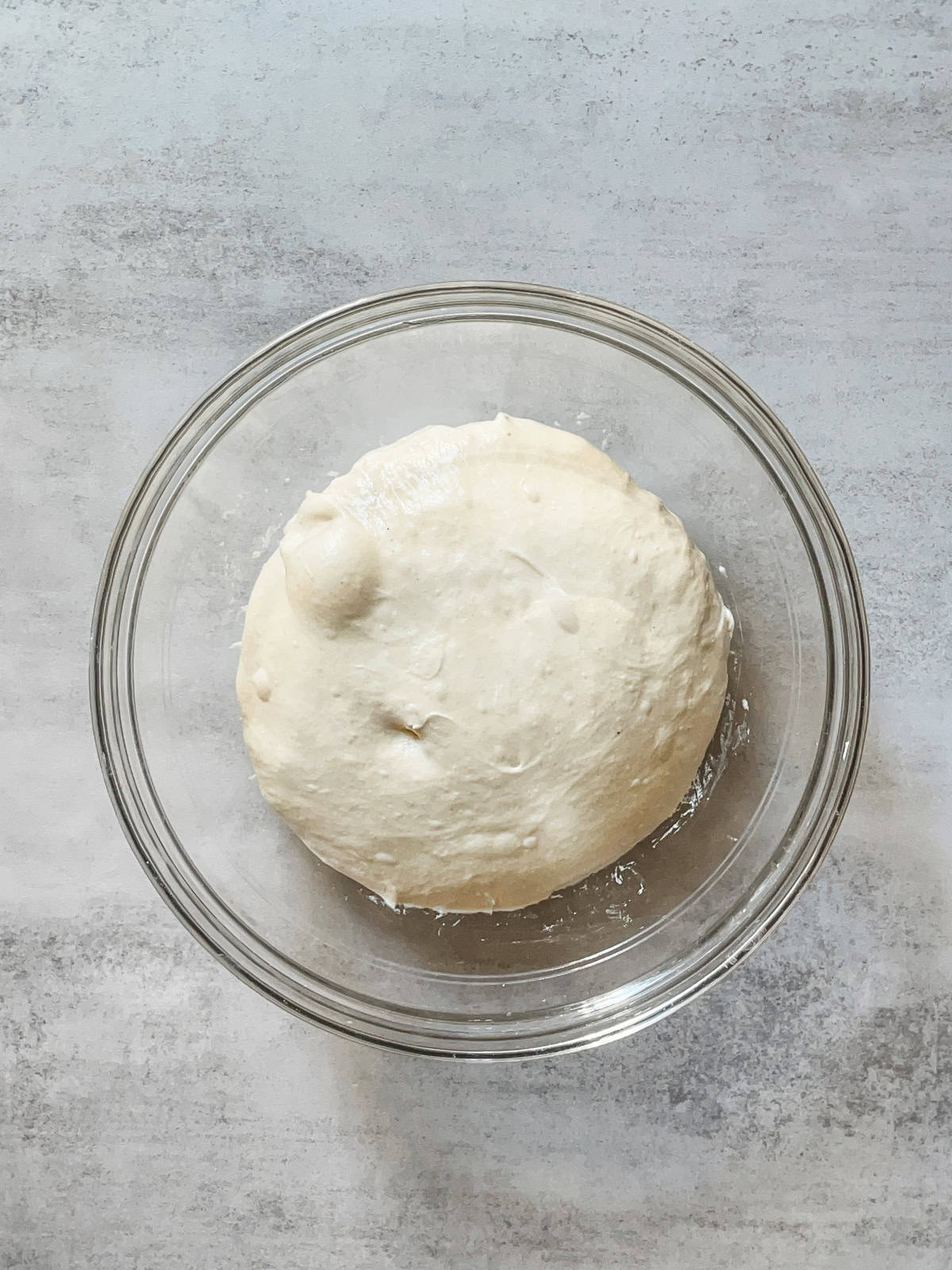
The top of the dough at the end of the bulk fermentations, showing large bubbles.
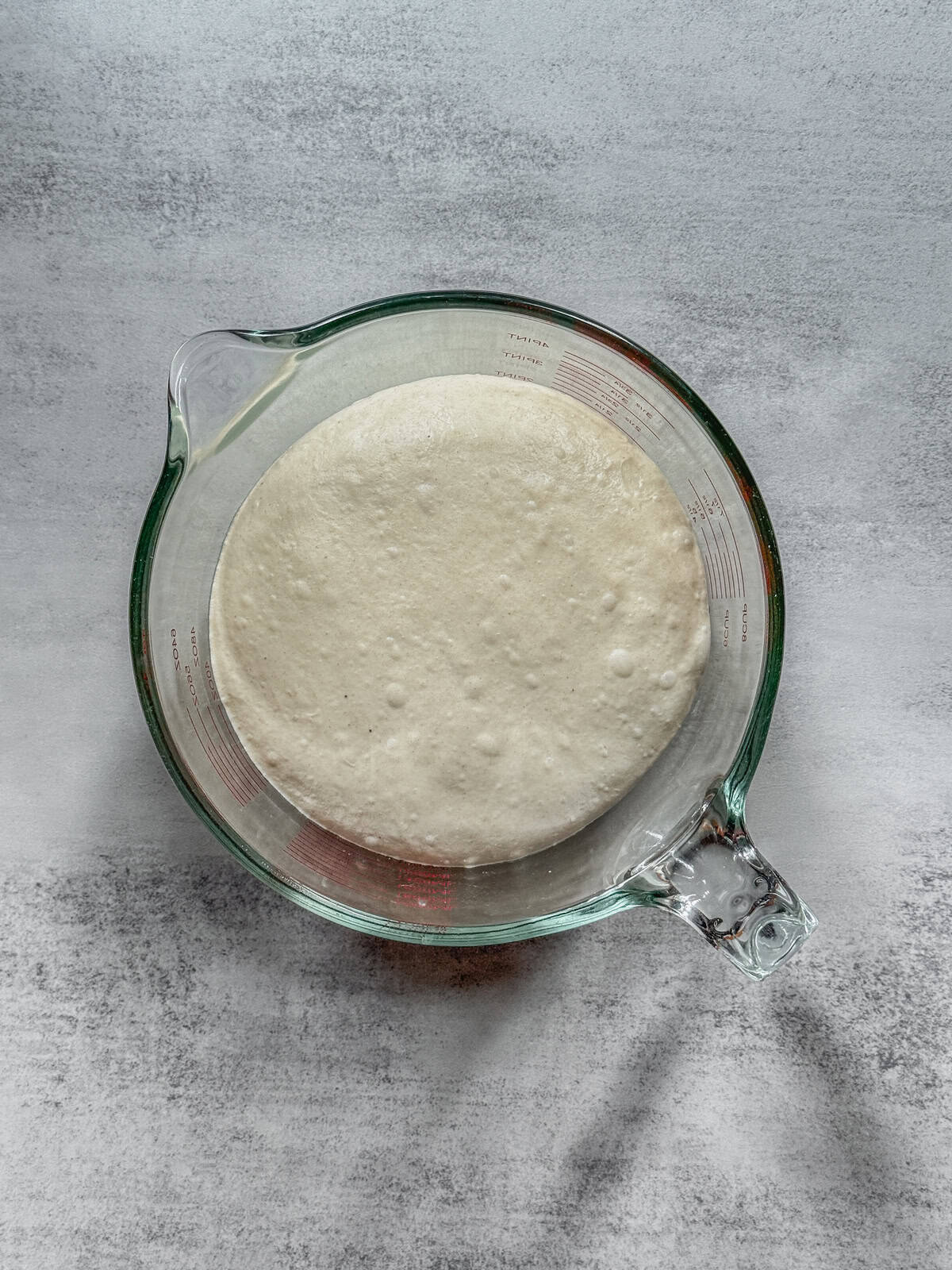
The top of the dough at the end of the bulk fermentation, showing smaller bubbles.
- Windowpane test: Stretch a small piece of dough. It should form a thin, translucent film without tearing.
- Touch test: Lightly press the dough's surface. If it no longer sticks to your finger, it is likely ready for the next step.
- Float test (optional sign): Some bakers rely on the float test during bulk fermentation. If a small piece of dough floats in water, it indicates that CO₂ gas is trapped in the dough's gluten structure, a good sign that bulk fermentation is nearly finished. However, remember that the float test is not always reliable. It is a tool to guide you in adjusting bulk fermentation next time.
Common mistakes during bulk fermentation
1. Waiting for a double in size
Many recipes say "wait until your dough doubles," but if you follow this rule blindly, you may end up overproofing it. Depending on your starter, flour, dough hydration, and room temperature, the dough may be ready at a 50%-75% rise, not necessarily a full double.
However, there are cases when you allow your dough to rise more than double. However, this depends on your kitchen conditions, the recipe, the type of flour, and the strength of the starter.
2. Judging by time alone
It is easy to think, "The recipe says 4 hours, so it must be done," but bulk fermentation doesn't follow the clock.
Your dough responds to its environment. Warmer kitchens speed up the process, while cooler kitchens slow it down. Always pay attention to how your dough looks and feels, rather than sticking strictly to a timer.
3. Ignoring dough temperature
Bulk fermentation speed is directly tied to the dough temperature, which in turn depends on the room temperature. A warmer dough (around 78°F/25°C) will ferment faster and need less time. A cooler dough (around 70°F/21°C or lower) will ferment more slowly and need more time.
Measuring the dough temperature with a simple probe thermometer is key to predicting and controlling bulk fermentation.
Top tips for mastering bulk fermentation
- Watch your dough, not the clock: Bulk fermentation times vary with your kitchen temperature.
- Control dough temperature: Aim for 75-78°F (24-26°C) as a beginner-friendly starting point.
- Use clear containers: This makes it easier to monitor your dough's percent rise and watch for bubbles.
- Trust your senses: Look, feel, and smell, and you will get better with each loaf.
- Practice: Bake as often as you can. Try a 30-day challenge, baking a loaf of bread every other day. You will learn a great deal and improve quickly.
What to do if you are unsure
Are you not 100% sure when the bulk fermentation has finished? That is normal. If you are a beginner, it is usually better to stop a little earlier than to wait too long.
If you stop bulk fermentation earlier, you will prevent your dough from overproofing. You will stay on the underproofed side, making the dough easier to shape, but it may result in a denser bread.
If you let bulk fermentation go too far, your dough can become overproofed. Although overproofed sourdough bread tastes better than underproofed, the overproofed dough feels weak, sticky, and hard to work with. The only ways to save your dough are to bake sourdough in a loaf pan or turn it into focaccia.
When you are unsure, it is safer to stop a bit earlier to avoid overproofing. As you get more experience, you will learn to read the dough and trust your instincts. That is called baker's intuition.
FAQ
Start measuring the dough's percent rise once all ingredients are mixed. If you add the salt last, begin tracking after the salt is incorporated.
It depends on the container size. If there is enough space, you can stretch and fold the dough inside it. If not, take the dough out, fold it, and return it to the container.
It is usually not necessary, but spraying the container with cooking spray can make it easier to release the dough.
If your dough is domed, find the low point at the sides and the high point at the top. Estimate the middle between the two for a reliable measurement of how much the dough has risen.
Not exactly. Bulk fermentation happens at room temperature. You can shorten it slightly (1-2 hours) and move the dough to the fridge for cold proofing. The dough will continue to ferment slowly in the fridge. To compensate, you may extend the cold proof for 12-48 hours, but some testing is required for best results.
Let's talk sourdough
How do you check if your dough is ready during bulk fermentation? Share your experience in the comments below.
Ready to keep learning?
When bulk fermentation is complete, it is time to give your dough some structure. My preshaping guide will help you prepare your loaves for the final shaping stage.