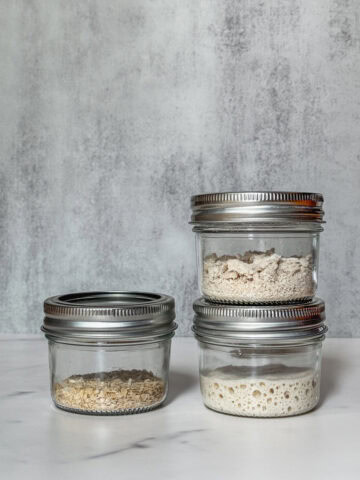

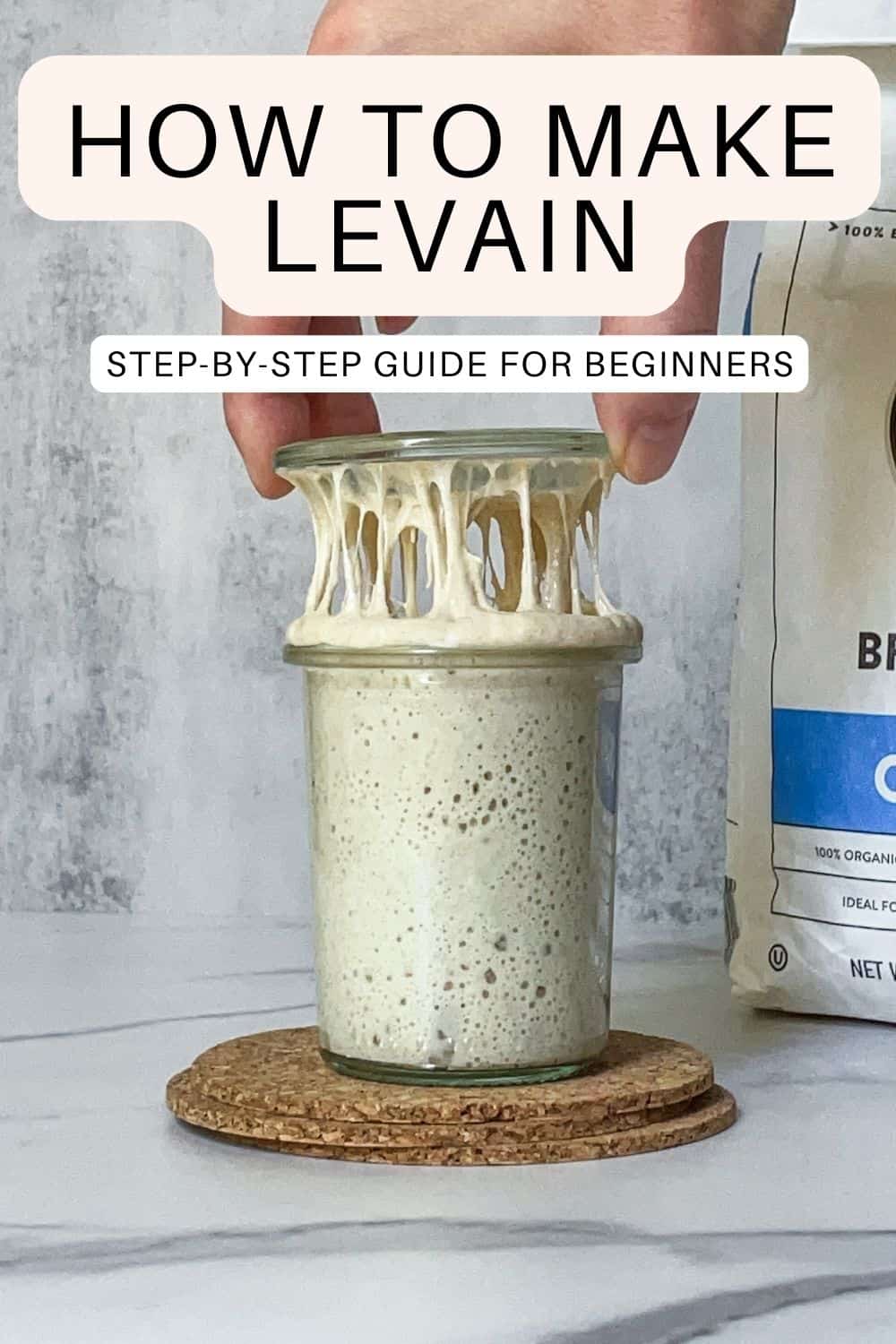
Quick Summary: A levain is a portion of your sourdough starter that you feed with fresh flour and water and let ferment, then mix into your bread dough. It is essentially an active, purpose-built "offshoot" of your starter, made fresh for a single bake.
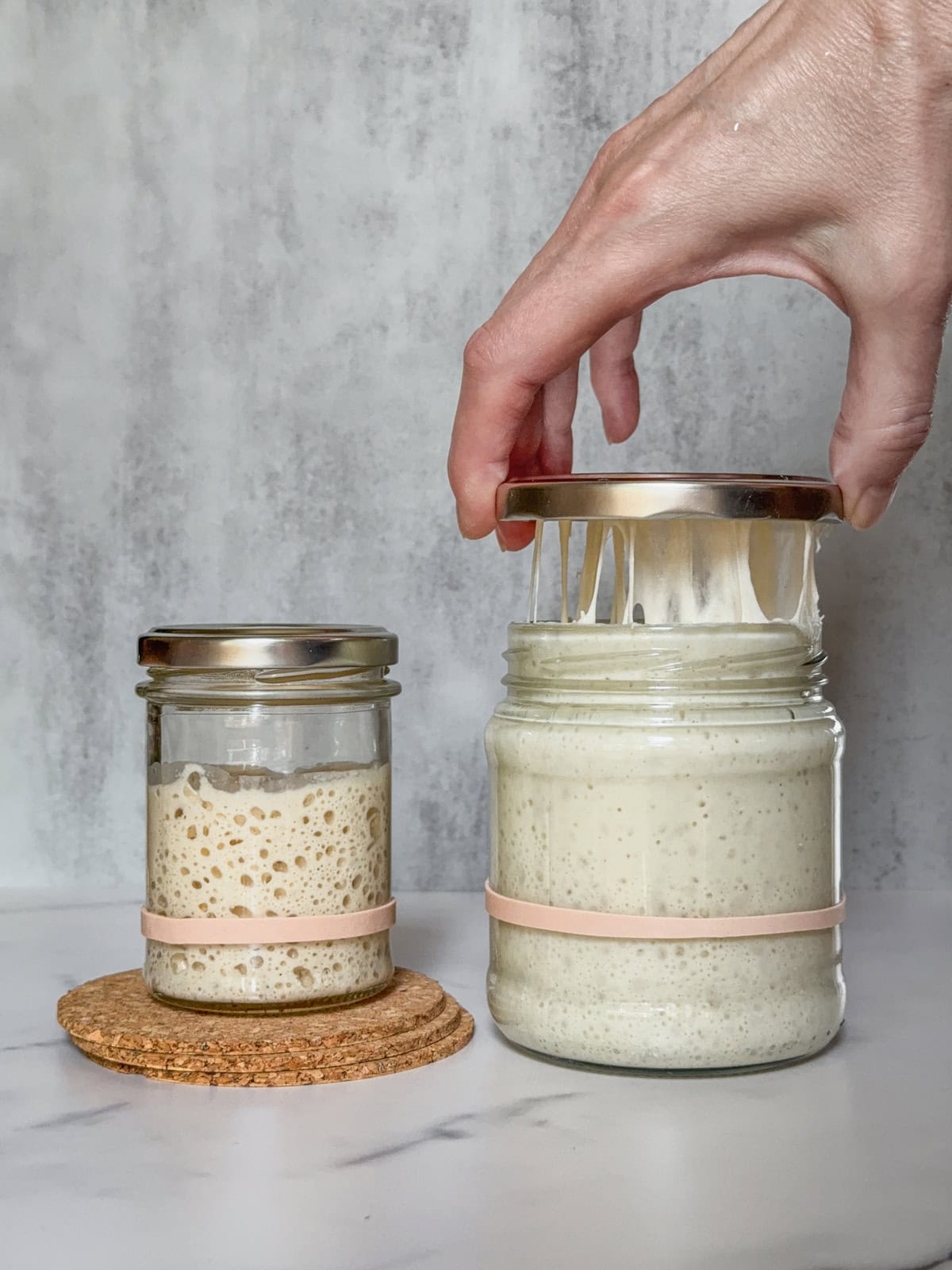
To make one, mix starter, flour, and water (a 1:1:1 ratio for same-day use, or a higher ratio like 1:5:5 overnight), and let it ripen until doubled and bubbly in a warm spot. The levain is ready when it is at peak: puffy, just starting to flatten with wrinkles on top, and full of bubbles.
Jump to:
- What is a levain (or sourdough levain)?
- How to make levain step-by-step
- Feeding ratios and timing
- How to build levain when your starter is stored in the fridge
- How to build levain for multiple loaves
- Can you use an active sourdough starter instead of a levain?
- Expert tips
- My routine
- Let's talk sourdough
- Ready to keep learning?
- Comments
What is a levain (or sourdough levain)?
A levain is an offshoot of your "mother" sourdough starter, made specifically for mixing into bread dough. You create it by taking a small amount of your starter, feeding it with fresh flour and water, and letting it ferment until it is active and bubbly. That ripe levain is what leavens your bread, giving it rise, flavor, and structure.
The word "levain" is simply French for "leaven." Some bakers call it an "active starter," a "preferment," or just "starter", and that is fine, as long as you understand it means a freshly fed, active portion of culture built for a specific bake.
Similarly, if a recipe calls for an "active starter," "bubbly sourdough," or "ripe starter," it often means using either a levain or a fully active, peaked starter.
Don't let the different terms confuse you. They all point to the same thing: a culture that is alive, bubbly, and at its peak, ready to leaven your dough.
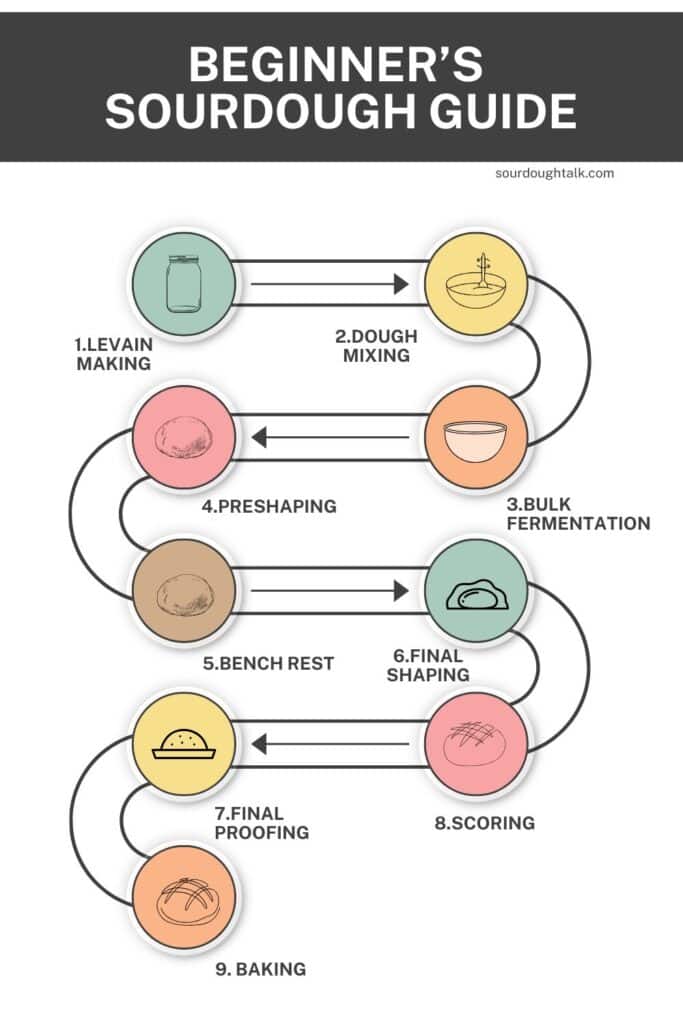
Your Beginner's Guide to Sourdough
This post is part of a series that walks you through every step, from feeding your starter to pulling the loaf from the oven.
How to make levain step-by-step
To make levain for one loaf of sourdough bread, you will need 100 grams of levain at 100% hydration. To build it, use a 1:1:1 feeding ratio, that is equal parts starter, flour, and water.
Note: This 1:1:1 ratio is for a same-day levain you will use at peak within 4-6 hours. It is not the ratio for maintaining your starter day to day.
- First, accurately measure 35g of your starter using a digital kitchen scale (I like this pocket gram scale) and place it in a clean glass jar.
- Next, add 35g of filtered room-temperature water to the starter and mix with a jar spatula.
- Finally, add 35g of unbleached flour (such as bread or all-purpose flour) and mix until no dry bits remain. Cover the jar loosely, mark the starting level with a rubber band, and place it in a warm spot at about 76-80°F (24-27°C).
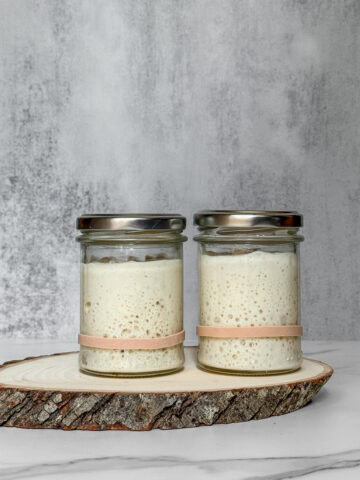
In about 4 to 6 hours, your levain will be ready. You will know it is done when it doubles in size, has bubbles throughout, and reaches sourdough peak.
Getting your levain to peak at the right time takes a little tracking. Download my free Sourdough Starter Tracker and get started.
You can also try the float test, where a small amount of levain floats in water. However, this test is not always 100% reliable.
Feeding ratios and timing
The starter feeding ratios and timing are key to a successful levain. The ratio depends on how much time you have to prepare.
Quick levain (daytime method)
This method works if you want to make levain and mix the dough on the same day. Use a lower feeding ratio, such as 1:1:1. Keep the levain warm to speed up the process, and it should be ready in approximately 4 to 6 hours.
To help with fermentation, use a seedling mat or a proofer (such as Brod & Taylor Sourdough Home). Without a proofer, I can wrap the starter jar in a kitchen towel heated in the microwave for 10-12 seconds, repeating this process a few times until it reaches its peak.
Overnight levain
For morning baking, prepare your levain the night before. Use a higher ratio, for example, 1:6:6. Experiment with different ratios, like 1:7:7 or 1:8:8, or even higher, to find the best timing for your baking schedule.
The cooler night temperatures will slow fermentation, so your levain will peak in about 9-10 hours or longer.
Building levain overnight helps reduce the starter's acidity. Maintain the usual feeding ratio and schedule for your starter, but if it appears acidic, consider using some of the overnight levain to help it recover.
This means taking the leftover levain and feeding it at the ratio you use to feed your starter. You can discard the "old" starter and use the refreshed one instead.
Whether you choose overnight or daytime levain, consider the temperature and feeding ratio to make sure it rises perfectly by the time you mix the dough.
How to build levain when your starter is stored in the fridge
If you keep your starter in the refrigerator, there are two ways to build levain for your sourdough bread.
1. The one-feed method
Take a portion of refrigerated starter, let it warm on the counter for 1-3 hours, feed it with fresh flour and water, and let it ferment until it is ready to use.
Feed the remaining starter at a 1:3:3 ratio, let it sit at room temperature for a couple of hours, and return it to the fridge.
You can use this method if your starter has been in the fridge for a week or less. If it has been stored longer, feed it two or three times before using it.
The number of feedings depends on your starter's activity after refrigeration. The longer it has been in the fridge, the longer it may take to regain full activity.
2. The two-feed method
This method creates a super-strong, active levain, perfect if your starter has been sitting in the fridge for a while. It also produces a milder, sweeter flavor in your bread.
- First feeding: Mix 5g of starter, 20g of water, and 20g of flour in a jar. Stir well, cover loosely, and let it rest in a warm spot at 76-80°F (24-27°C) for 4 hours.
- Second feeding: Add 45g of water and 45g of flour to the same jar, mix, cover loosely, and let it rest for another 4 hours.
After the second feeding, your levain should reach its peak and be ready to use for one loaf of bread.
How to build levain for multiple loaves
Imagine you want to bake multiple sourdough loaves at once. If one loaf needs 100 grams of levain, then 12 loaves will need about 1,200 grams of levain. Here is how you can get there.
Method 1: If you have enough starter
If your "mother" starter is big enough, you can build all the levain in one step. For example, use a 1:6:6 feeding ratio (starter:flour:water). That means:
- 93 g starter
- 558 g flour
- 558 g water
This yields approximately 1,200 g of levain overnight.
Method 2: If you keep only a small starter
What if your starter is small, say, only 40 grams? You can build it up in stages instead of all at once.
Step 1 - Morning: Feed 35 g of starter using a 1:1:1 ratio (equal parts starter, flour, and water). You will now have 105 g of starter.
Step 2 - Evening: Take 93 g of that starter and feed it using the 1:6:6 ratio:
- 93 g starter
- 558 g flour
- 558 g water
By the next morning, you will have about 1,209 g of levain, enough for 12 loaves. The extra 12 g leftover from the first feeding (105 g − 93 g) remains your "mother" starter, and you continue feeding it as usual.
But why build levain in steps?
If you tried to make 1,200 grams of levain in a single feeding, starting with just 35 grams of starter, you would have to feed it 595 grams of flour and 595 grams of water, for a huge 1:17:17 ratio. Plus, it would take a very long time to rise.
Can you use an active sourdough starter instead of a levain?
Yes, you can use an active starter instead of a levain, but I usually don't recommend it. The reason is about keeping the two concepts separate.
Imagine you pour your entire "mother" starter into the dough. You mix it… Even worse, imagine you wash the jar right after. And then you realize you forgot to save even a tiny bit to feed and keep your starter going. This happens more often than you think.
Now, you have to start over. That is why I never mix the two "ideas". I keep and feed my "mother" starter (I called it "Bubbly Girl") in its own jar. Then, when it is time to bake, I build a levain in a separate jar just for that loaf. This way, my starter continues its bubbly cycle, and the levain is built just for baking bread.
Once again, using your active starter directly works, but keeping them separate is safer and more reliable.
Expert tips
- Make 10% more levain than the recipe calls for to account for any loss during transfer. Use my sourdough calculator to create your bread recipe, which automatically includes this extra 10% when calculating the levain amount.
- Most bread recipes use levain with 100% hydration, meaning equal amounts of water and flour (by weight). To make your sourdough bread less sour, try using a stiffer levain with less water.
- The best time to use levain is when it reaches its peak. To make sourdough bread more sour, use levain after its peak. For a milder flavor, use it before it peaks.
My routine
This is the baking timeline I use for building levain. It fits into my daily routine, but yours will be unique to you and different from mine or any other baker's.
I usually like to build my levain overnight so it is ready first thing in the morning. For this, I don't use my Brod & Taylor Sourdough Home (I only keep my "mother" starter in there).
- In winter, I use a 1:6:6 feeding ratio (1 part starter, six parts flour, six parts water). At cooler temperatures, it takes approximately 9-10 hours to reach its peak.
- In summer, I switch to a 1:8:8 ratio because warmer weather speeds things up. This way, the levain still peaks in about 10 hours.
By doing this, I can wake up around 8-9 AM and start my "dough day" without waiting.
If I only need levain for one loaf and want to mix the dough the same day, I do a 1:1:1 feeding (35 g starter, 35 g flour, 35 g water) early in the morning. At 76-80°F (24- 27°C), it is ready in 4-6 hours.
FAQ
What is the difference between a starter and a levain? In short, your starter is the culture you keep long-term, and a levain is a fresh offshoot you build from it for a specific bake. For the full comparison, see my guide on sourdough starter vs. levain.
Can I use my starter instead of making a levain? Yes, an active starter at peak can be used directly. But building a separate levain keeps your mother starter safe (so you don't accidentally use it all) and lets you tailor the levain's flavor and timing to your bake.
How do I know when my levain is ready? It is ready at peak: doubled in size, just starting to flatten with wrinkles on top, and full of bubbles. Usually, it takes 4-6 hours in a warm spot with a 1:1:1 feed. You can also try the float test, though it is not always reliable.
What ratio should I use for a levain? Use 1:1:1 (equal parts starter, flour, water) for a same-day levain ready in 4-6 hours, or a higher ratio like 1:5:5 or 1:6:6 for an overnight levain. Higher ratios ferment more slowly, giving you a longer window.
Is levain the same as a sourdough starter? They are closely related but not identical. A levain is a freshly built, active portion made from your starter for a specific bake. Many bakers use the terms loosely, but technically, the starter is the long-term culture and the levain is the ready-to-bake offshoot.
Let's talk sourdough
Do you prefer to build your levain overnight or on the same day you bake? If you go the overnight route, what is your favorite feeding ratio? Share your experience in the comments.
Ready to keep learning?
With levain ready, the next step is mixing your dough. Discover the essential bread dough mixing techniques that create structure and texture in your loaves.