
Quick Summary: Bulk fermentation is the first rise in sourdough, from the moment you mix in levain or active sourdough starter until you pre-shape. It usually takes 3 to 9 hours, but there is no fixed time, because it is driven by dough temperature, not the clock.
Warmer dough (75 to 80°F / 24 to 27°C) ferments faster, cooler dough ferments more slowly. Rather than waiting for the dough to double, aim for a target percentage rise based on its temperature (roughly 75% at 70°F, 50% at 75°F, 30% at 80°F), then pre-shape.
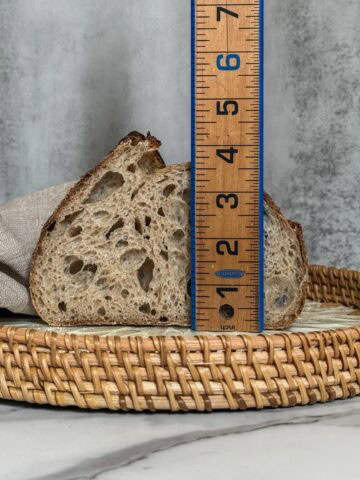
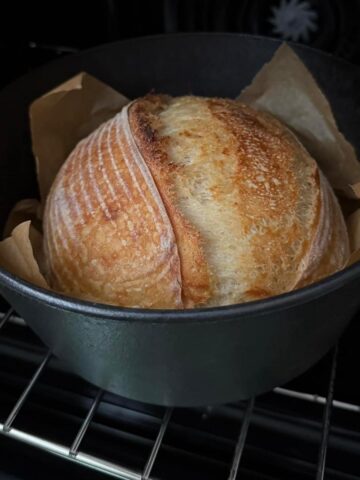
Bulk fermentation is one of the most misunderstood steps in sourdough baking, but it is also one of the most important, and getting it right is what separates a dense, flat loaf from an open, well-risen one. When it goes wrong, the results are the classic failures in my bread troubleshooting guides: dense crumb, flat loaves, gummy centers.
Jump to:
- What is bulk fermentation in sourdough?
- When does bulk fermentation start and end?
- How long does bulk fermentation take?
- What is the best temperature for bulk fermentation?
- How dough temperature affects bulk fermentation
- How to adjust bulk fermentation for your recipe
- What is the Bulk-o-Matic guide?
- How much should sourdough rise during bulk fermentation?
- What is the best proofing container for bulk fermentation
- Top tips for perfecting bulk fermentation
- Common bulk fermentation mistakes
- FAQ
- Let's talk sourdough
- Ready to keep learning?
- Comments
What is bulk fermentation in sourdough?
Bulk fermentation is the first rise in sourdough bread-making, which happens after mixing and before preshaping.
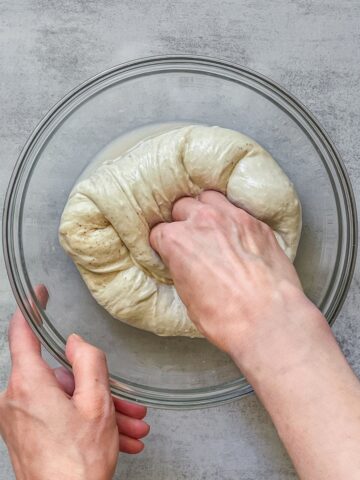
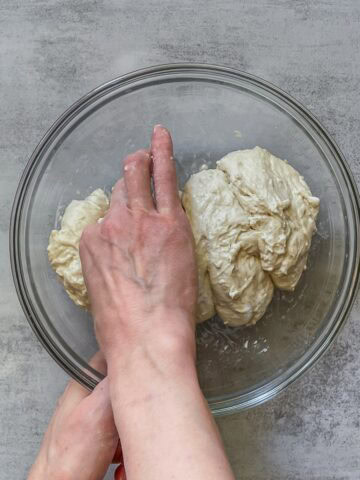
During this phase, gluten strengthens and traps carbon dioxide gas, causing the dough to rise. Stretch and folds and coil folds help align gluten strands, improving the dough's elasticity and its ability to hold gas.
At the same time, lactic acid bacteria ferment the sugars in the flour, creating a sourdough signature tang.
Bulk fermentation happens at room temperature, and comes in two forms: warm bulk, with dough at 75-80°F (24-27°C), and cool bulk, with dough below 75°F (24°C).
Both are room-temperature fermentation, just in a warmer or cooler spot. Don't confuse cool bulk with cold proofing, which is a separate, later step in the fridge at around 39°F (4°C).
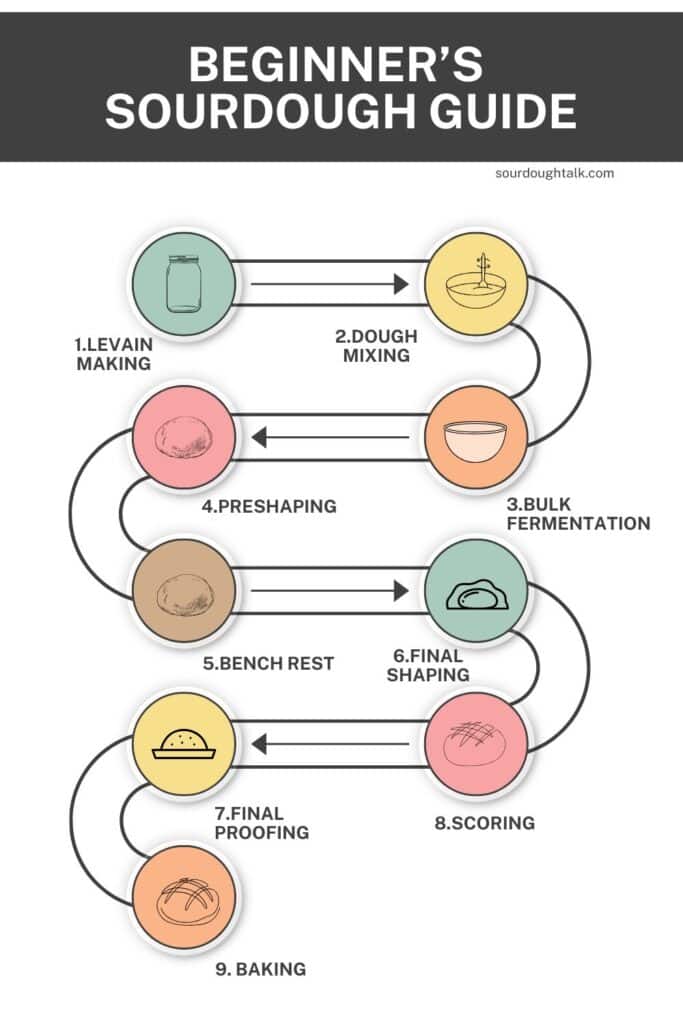
Your Beginner's Guide to Sourdough
This post is part of a series that walks you through every step, from feeding your starter to pulling the loaf from the oven.
When does bulk fermentation start and end?
Bulk fermentation starts when you mix the preferment (levain or active starter) into the dough and continues until the dough is pre-shaped.
If you add salt as the last ingredient, bulk fermentation starts once all ingredients are mixed together.
Although bulk fermentation ends when the dough is pre-shaped, the fermentation process continues through bench rest, shaping, final proofing, scoring, and even a few minutes of baking.
How long does bulk fermentation take?
Bulk fermentation usually takes between 3 and 9 hours (sometimes longer), depending on several factors. There is no fixed time because fermentation time varies from one kitchen to another and from one dough to the next.
Here is what affects how long bulk fermentation takes:
- Dough temperature: The single biggest factor, the warmer it is, the faster it is.
- Starter strength: A well-fed, active starter will speed up fermentation. A sluggish one will slow it down.
- Flour type: Whole-grain flours ferment faster than white flours due to their higher enzyme and nutrient content.
- Dough hydration: Higher-hydration doughs tend to ferment more quickly (see my guide on high vs. low sourdough hydration).
Due to these variables, the length of bulk fermentation cannot be directly copied from a recipe. Even if a recipe says "bulk ferment for 4 hours," that is based on the author's conditions.
Your kitchen may be warmer or cooler, which can affect the actual fermentation time. For example, at room temperatures of 68°F (20°C) and 75°F (24°C), the bulk fermentation speed and duration will be different.
Instead of relying on a set number of hours, pay attention to dough temperature and how much the dough has risen. This, with visual signs, will give you the most accurate picture of when bulk fermentation is truly complete.
What is the best temperature for bulk fermentation?
There is no single best temperature for bulk fermentation. It depends on your kitchen temperature. A warmer environment speeds up fermentation, while a cooler environment slows it down (see my guide on how temperature affects sourdough).
The dough temperature can range anywhere from 60°F (15°C) to 90°F (32°C), but it ferments best between 75°F and 80°F (24°C to 27°C). At this temperature, bulk fermentation is active without becoming difficult to manage.
If you are a beginner, try to keep your dough temperature below 80°F (27°C). Above that, bulk fermentation speeds up, and the window before overproofing gets narrower. So measure your dough temperature and watch the rise closely rather than trusting the clock.
As you become more experienced, you will find that starting with your target dough temperature is one of the best ways to bake consistently. Use my desired dough temperature calculator to determine the right water temperature.
Keep in mind that bulk fermentation changes with the seasons. Learn how to handle sourdough baking in summer and how to proof bread dough in a cold kitchen.
How dough temperature affects bulk fermentation
Bulk fermentation is all about dough temperature and percentage rise. The time it takes for the dough to ferment depends on how fast it rises, which in turn depends on the dough temperature.
Warmer dough (above 75°F / 24°C) will ferment more quickly, requiring less time to reach the desired rise. Cooler dough (below 70°F / 21°C) will slow down the process. Room temperature alone is not a good guide. You should always measure the dough temperature, not the air.
An excellent bulk fermentation method was developed by Tom Cucuzza (The Sourdough Journey), who created a chart linking dough temperature to the target rise percentage for the end of bulk fermentation. In this method, the dough temperature determines the fermentation time, not the clock.
This dough-temperature and percentage-rise method is designed for a Tartine-style recipe (90% bread flour with 12.5% protein, 10% whole wheat, 75% hydration, 20% starter, 2% salt) with a long cold final proof at 39°F (4°C).
Use this chart to match your dough's temperature to its target rise before shaping and cold-proofing, but treat it as a starting point, not a rule.
According to the chart, the warm dough around 80°F might be ready at roughly a 30% rise; at 75°, at roughly 50%; at 70°F-75 %, while cool dough around 65°F may need to roughly double.
How to adjust bulk fermentation for your recipe
Tom Cucuzza's chart is calibrated for the classic Tartine Country Bread recipe, so you will need to adjust if your flour, hydration, starter amount, or method differs.
Whole grains and higher hydration ferment faster. Stiff dough ferments more slowly, and a strong starter at peak speeds things up. For the full breakdown, see my guide on adjusting bulk fermentation for your recipe.
If you need help building the formula, my free sourdough hydration calculator does the math for you. All you need to do is plug in your numbers.
What is the Bulk-o-Matic guide?
The Bulk-o-Matic Guide is a free printable tool created by Tom Cucuzza of The Sourdough Journey to help beginners judge when bulk fermentation is finished.
Rather than relying on a single number, it walks you through about nine signs together, from dough temperature, time, and percentage rise to visual and tactile cues like doming, bubbles, the wobble test, the windowpane test, and smell, so you learn to read the dough as a whole.
You can download Tom Cucuzza's Bulk-o-Matic Guide here.
How much should sourdough rise during bulk fermentation?
There is no single number, because the right rise depends on your dough temperature. As a rule, the warmer the dough, the less it should rise before you shape and chill it, anywhere from about 30% at 80°F to 75% at 70°F (see the chart above).
Instead of marking your whole container, you can take a small sample of dough and ferment it in a clear jar alongside the main batch. When the sample hits your target rise, the whole batch is ready. It is an easy, accurate way to read bulk fermentation (see my guide on the aliquot jar method).
Avoid the common "let it double" advice. Instead of aiming for the dough to double in size, target a specific percentage rise based on your dough temperature.
If you stop bulk fermentation too early, you risk underproofed sourdough. If you let it ferment too long, especially before an overnight cold proof, you risk overproofed sourdough, as the dough will continue to rise in the refrigerator.
What is the best proofing container for bulk fermentation
The best proofing container is clear, straight-sided, smooth, and food-safe to prevent any reactions with the dough.
For smaller batches (around 500g of flour), choose a 2-quart Cambro container with clear markings and a lid. You can also use a 4-cup glass measuring cup or a 120-ounce large glass container with an airtight lid. If you make two loaves (500g of flour each), consider a 4-quart Cambro container.
Round containers are preferable over square ones, as they allow the dough to rise more evenly, without getting stuck in corners.
Those using the aliquot jar method (measuring dough rise with a small sample) use a 4-quart glass bowl for a single loaf of bread.
For batch baking, you can use commercial bus tubs or stainless-steel bowls to manage larger quantities of dough. If you own a Brod & Taylor folding proofer, a 2.75-gallon Rubbermaid tub is a perfect fit and can hold up to 8 kg of dough.
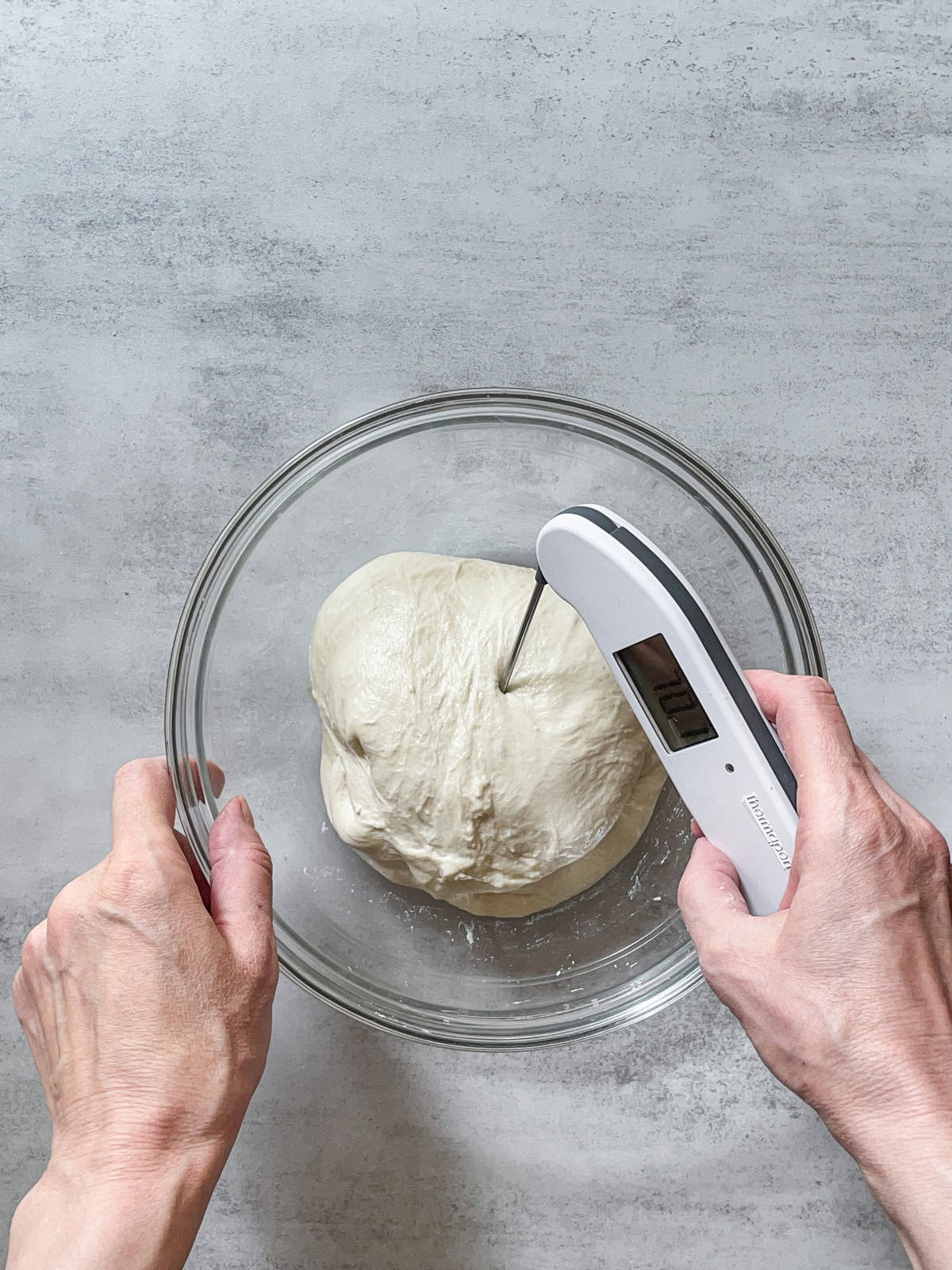
Another important tool is a digital probe thermometer. This tool helps you accurately check the dough temperature. Avoid infrared thermometers, which only measure the surface temperature, not the dough's core.
Top tips for perfecting bulk fermentation
- Use Tom Cucuzza's bulk fermentation chart as a guide, not a strict rule. Adjust fermentation to suit your kitchen conditions, starter, and recipe ingredients.
- Don't rely solely on recipe times. Bulk fermentation varies due to many factors. Instead, pay attention to your dough's rise and visual cues.
- Measure dough temperature after performing folds, not before. This provides a more accurate temperature reading. Then, continue checking the dough temperature every 30-40 minutes.
- Learn to read the dough. Over time, you will develop a sense of when your dough is ready by visual cues.
- Keep a Sourdough Baking Log to track each baking session (download and print it out). By reviewing your notes, you will fine-tune your process and adapt to changing kitchen conditions.
Common bulk fermentation mistakes
- Measuring the air instead of the dough: Room temperature isn't dough temperature. Check the dough temperature with a probe thermometer after each fold, then every 30-40 minutes.
- Following the recipe's clock: "Bulk for 4 hours" worked in the author's kitchen, not necessarily yours. Let the rise, not the timer, tell you when it is ready.
- Using the wrong container: Tapered or rounded containers make it hard to judge the rise accurately. Choose a clear, straight-sided container for a true reading.
- Pressing the dough down after folds: It compresses the dough, making it difficult to judge how much it has actually risen. Let it settle on its own.
- Waiting for it to double. That is one of the most common sourdough myths. If you are doing an overnight cold proof, doubling often means overproofing because fermentation continues in the fridge. Aim for the right percentage rise based on the dough temperature instead.
FAQ
Should you cover the dough during bulk fermentation? Yes, cover your dough with a lid, plastic wrap, or a damp kitchen towel to prevent it from drying out and forming a crust.
Should you oil the bulk fermentation container? You can lightly coat the container with oil or spray it with nonstick cooking spray to prevent sticking.
Can you use a dough proofer for bulk fermentation? Yes, a dough proofer, like a Brod & Taylor folding proofer, is a helpful tool for maintaining a consistent temperature, allowing the dough to ferment evenly and predictably.
My proofer is set to 78°F, but my dough is only 72°F. Which temperature do I use for the chart? Use the dough's actual temperature, not the proofer's air setting, because the chart is based on dough temperature. The better fix is to get the dough to your target temperature from the very start by adjusting your water temperature with a desired dough temperature (DDT) calculator, then keep it in the proofer the whole time so it holds steady.
What's the difference between bulk fermentation and proofing? Bulk fermentation is the first rise, from mixing until you pre-shape. The final proof is the rise after shaping, before baking, often a long, cold proof in the fridge. They are different stages, though fermentation quietly continues through both.
Can you bulk ferment sourdough in the fridge? Not really. The fridge (around 39°F / 4°C) is for the final cold proof, not bulk fermentation. A cool room-temperature bulk (below 75°F) runs slower, but fridge temperatures are too cold for the dough to complete its first rise. Bulk ferment at room temperature, then cold proof after shaping.
Let's talk sourdough
How do you track bulk fermentation? Do you go by time, dough volume, texture, or a combination of factors? Share your method in the comments.
Ready to keep learning?
Bulk fermentation is key, but how do you know when it is done? Learn how to tell when to end bulk fermentation so your dough is ready for shaping.