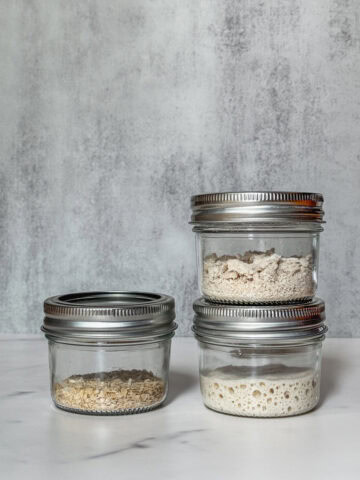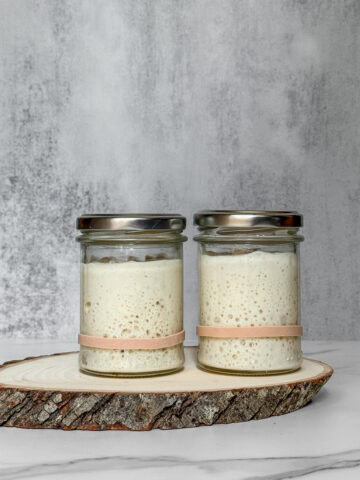


Quick Summary: A sourdough feeding ratio is the proportion of starter to flour to water, written as starter:flour:water. A 1:1:1 ratio feeds equal weights. Higher ratios like 1:5:5 add more food, so the starter ferments more slowly and lasts longer before the next feed.
For once-a-day feeding at room temperature, use a 1:5:5 ratio; for twice-a-day feeding, use a 1:3:3 ratio. Smaller ratios peak faster, while larger ratios peak slower, so the ratio is really a tool to fit your starter to your schedule.
This article is built on the guide to feeding sourdough starter. If you haven't read it yet, start there first. It will give you the essential foundation to understand everything in this post.
Jump to:
- What is a sourdough feeding ratio?
- Sourdough starter feeding ratio chart
- What does a feeding ratio actually control?
- Sourdough starter feeding ratios
- How often should you feed your starter?
- What feeding ratio should you use?
- How do you adjust feeding ratios?
- My routine
- FAQ
- Let's talk sourdough
- Ready to keep learning?
- Comments
What is a sourdough feeding ratio?
A sourdough feeding ratio is the proportion of flour and water used relative to the starter. It is a simple way to measure the amount of flour and water you need to add to your starter.
Ratios like 1:1:1 or 1:3:3 represent the proportions of starter, flour, and water, respectively.
In any feeding ratio, the first number always represents the starter, the second the flour, and the third the water.
For instance, a 1:1:1 ratio means you will use equal parts starter, flour, and water. If you have 10 grams of starter, you will add 10 grams of flour and 10 grams of water.
On the other hand, a 1:3:3 ratio means you will use 1 part starter, 3 parts flour, and 3 parts water. With 10 grams of starter, you would add 30 grams of flour and 30 grams of water.
By using these ratios, your starter receives the correct amounts of starter ingredients (flour and water) to remain active and grow.
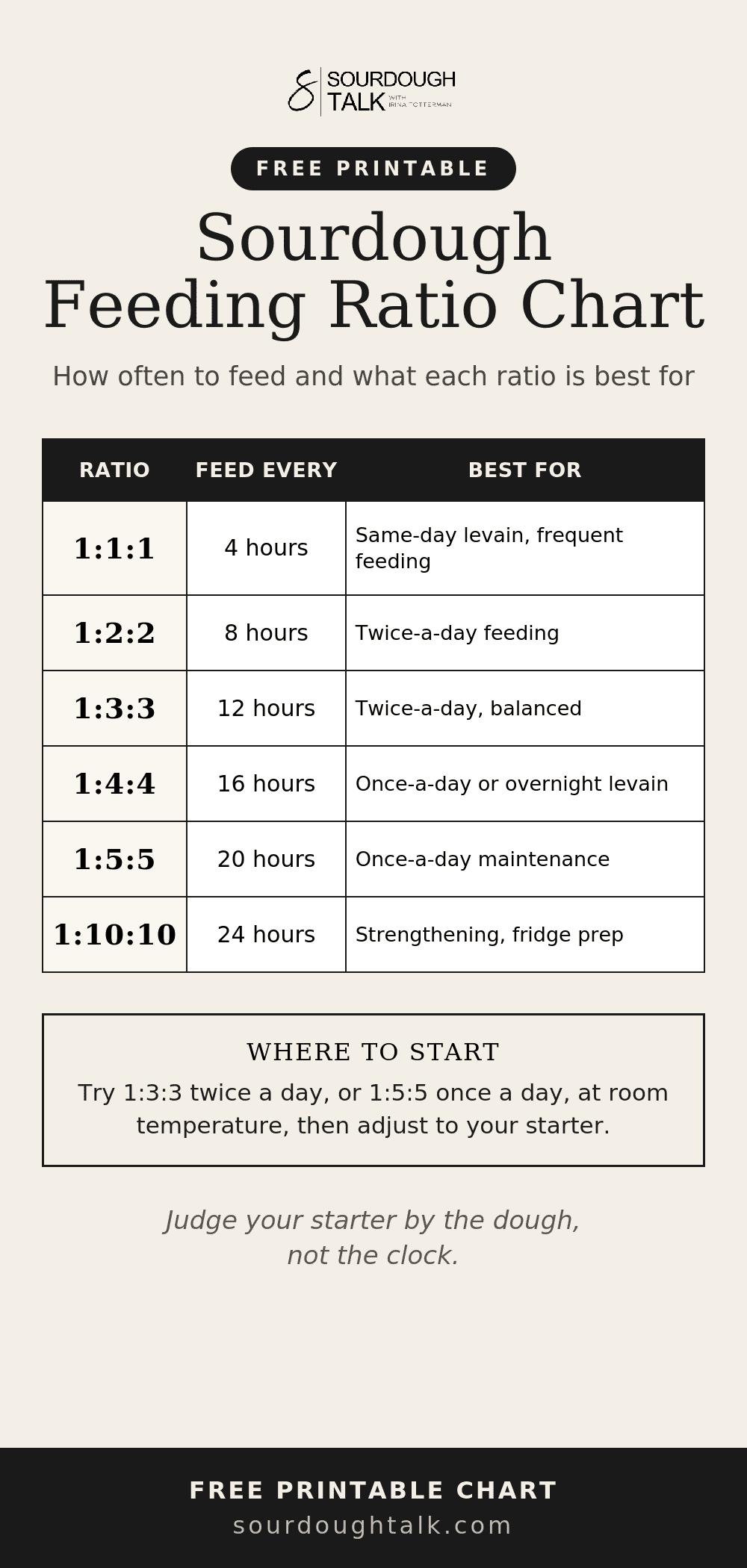
Sourdough starter feeding ratio chart
Each starter is different, and factors such as water temperature, flour type, room temperature, and humidity affect fermentation. Use the ratios below as guidelines to adjust your own starter:
| Ratio | Feeding Frequency | Example (starter:flour:water) | Best for |
| 1:1:1 | Every 4 hours | 10g : 10g : 10g | Same-day levain, frequent feeding |
| 1:2:2 | Every 8 hours | 10g : 20g : 20g | Twice-a-day feeding |
| 1:3:3 | Every 12 hours | 10g : 30g : 30g | Twice-a-day, balanced |
| 1:4:4 | Every 16 hours | 10g : 40g : 40g | Once-a-day or overnight levain |
| 1:5:5 | Every 20 hours | 10g : 50g : 50g | Once-a-day maintenance |
| 1:10:10 | About 24 hours | 10g : 100g : 100g | Strengthening, fridge preparation |
Want this chart where you can actually use it, by your starter jar or in your baking binder? Grab the free printable version below.
What does a feeding ratio actually control?
A feeding ratio controls three things: fermentation speed, acidity development, and how long the starter can go before the next feed. A common misconception is that feeding ratios directly "make a starter acidic."
In reality, acidity depends on how long fermentation continues after feeding, not on the ratio alone.
Smaller feeds ferment faster and reach peak sooner. Larger feeds ferment more slowly and keep acidity lower for longer.
Sourdough starter feeding ratios
Most feeding ratios range from 1:1:1 to 1:6:6 (starter:flour:water), but some bakers use even higher ratios, such as 1:10:10 and higher.
The ratio you choose depends on how quickly you want your starter to grow and how often you plan to feed it.
Small feeding ratios
Feeding ratios such as 1:1:1 are not "bad," but they need to be used properly. With small feeds, a sourdough starter runs out of food quickly. Yeast activity slows first, while lactic acid bacteria continue producing acid. As a result, the pH drops rapidly, often reaching 3.7-3.8 by the time of the starter peak activity.
Because smaller ratios provide less food, fermentation happens faster. When feeding at 1:1:1, a starter will usually peak within 4-6 hours at 76-80°F (24-27°C) as it quickly consumes the available sugars.
If you feed only once a day, the starter spends many hours after peak without fresh food. During this time, acidity continues to rise, yeast activity declines, and the starter begins to smell sharp, peak too early, or struggle to leaven dough effectively. This results in a weak and overly acidic sourdough starter.
A 1:1:1 ratio works best for making levain when you plan to mix the dough the same day, for very frequent feedings (typically every 4-6 hours), or for short-term revival. It is not well-suited for long-term, once-daily maintenance.
Medium feeding ratios
Ratios like 1:2:2 or 1:3:3 are ideal for most home bakers. They allow the starter to complete a full fermentation cycle, produce balanced acidity, support strong yeast growth, and peak predictably (usually 6-10 hours at room temperature).
If you keep your starter on the counter, the ratio 1:3:3 twice a day is one of the safest and most stable ratios to start with, then adjust as needed.
Large feeding ratios
There is a common myth that feeding a starter at 1:5:5 or 1:10:10 will eventually make it too acidic. This is not true.
Large feeding ratios dilute the existing acids, resetting the pH closer to 5.8-6.0. This creates a more favorable environment for yeast, slows fermentation, and results in a milder, more balanced bread flavor. Because larger feeds provide more food, the starter ferments longer before it needs to be fed again.
You can use a 1:5:5 ratio or higher to feed your starter once a day. Higher ratios, such as 1:10:10 or higher, are used to strengthen a starter or give it extra time to ferment without becoming overly acidic.
These larger ratios are also commonly used when building a levain overnight, so it reaches peak activity in the morning.
In addition, they are used to prepare a starter for fridge storage, as the extra food helps support the microbes during longer periods of inactivity (see the guide on how to store sourdough starter).

How often should you feed your starter?
Feeding frequency, ratios, and room temperature are closely related. The following feeding ratios are meant as suggestions, not strict rules.
Here is the starter feeding schedule suggested by James Bridges:
At 68-70°F (20-21°C):
- Feed once a day: 1:5:5 (starter:flour:water)
- Or feed twice a day: 1:1:1 or 1:2:2
At 72-75°F (22-24°C):
- Feed twice a day: 1:2:2 or 1:3:3
At 75-78°F (24-26°C):
- Feed twice a day: 1:4:4 or 1:5:5
At 80-85°F (27-29°C):
- Feed three times a day: 1:2:2 or 1:3:3
- Or consider using the refrigerator protocol for more stable fermentation (see my guide to storing sourdough starter)
What feeding ratio should you use?
There is no simple answer to this question. Each sourdough starter is unique, so you will need to adjust the feeding ratio according to the type of flour, water, and room temperature.
A common feeding ratio is 1:3:3, measured by weight twice a day. If you only feed your starter once a day, use 1:5:5 or 1:6:6 to keep it healthy and strong. These ratios work best when your starter is kept on the counter at 68-72°F (20-22°C).
As a beginner, start with these feeding ratios and adjust them as you go.
How do you adjust feeding ratios?
Adjust your starter's feeding ratio based on its behavior. For example, if you are using a 1:5:5 ratio once a day and your starter hasn't peaked by the next feeding, reduce the ratio to 1:4:4 to speed up fermentation.
On the other hand, if the starter collapses before it is time to feed again, increase the ratio to 1:6:6 to give it more food and extend its activity.
Climate also plays a role. In a very warm home or hot climate (regularly above 82°F / 28°C), you will want to slightly reduce starter hydration to slow fermentation and prevent the starter from peaking too quickly. Learn how temperatures affect sourdough.
Seasonal changes also affect the feeding ratios. During summer baking, use higher feeding ratios to help keep your starter balanced, while in winter, smaller ratios work better to match slower fermentation.
My routine
When I began my sourdough journey, I discovered that feeding my starter once a day with a 1:5:5 ratio (one part starter, five parts flour, and five parts water) consistently made good bread.
However, I started to wonder if the temperature changes in my home were stressing my starter. During the day, we maintain a temperature of around 73°F (23°C), but at night, it drops to 69°F (21°C). This back-and-forth seemed to be affecting my starter's performance.
To solve this, I bought a Brod & Taylor Sourdough Home, which maintains a steady temperature throughout the day. This helps my starter stay active and healthy without needing adjustments for colder or warmer weather.
Now, I keep my starter at a constant 75°F (24°C) and feed it twice daily using a 1:4:4 ratio (one part starter, four parts flour, four parts water). Just a note: I use 100% hydration sourdough starter and feed it with 100% King Arthur bread flour.
FAQ
What is the best sourdough starter feeding ratio? There is no single best ratio. For once-a-day feeding at room temperature, use 1:5:5; for twice-a-day feeding, use 1:3:3. Smaller ratios peak faster, larger ones slower, so choose based on your schedule and kitchen temperature.
Does the feeding ratio change how my bread tastes? Indirectly. The feeding ratio mainly affects how quickly your starter peaks and how much acidity develops before the next feeding. Larger feeding ratios tend to keep the starter milder for longer, while smaller ratios allow acidity to build more quickly, which can contribute to a tangier loaf.
What's the difference between a 100% hydration starter and a feeding ratio?
They describe two different things. 100% hydration means equal amounts of flour and water by weight in the starter. The feeding ratio (e.g., 1:4:4) is the ratio of starter, flour, and water you combine at each feed. As long as flour and water are equal, the starter stays 100% hydration at any ratio.
Can I measure feeding ratios with cups instead of a scale? No, Sourdough feeding ratios are based on weight, not volume. A cup of flour weighs much less than a cup of water, so measuring with cups changes the ratio and can affect your starter's performance. A kitchen scale is the most accurate way to feed a sourdough starter.
Let's talk sourdough
What's your go-to feeding ratio for your starter? Have you experimented with different amounts or timings, and what did you notice? Let's compare notes in the comments.
Ready to keep learning?
Feeding your starter correctly is important, but you also need to discard part of it. Let's learn why you must discard when feeding your starter and why it is a smart move for your sourdough's health.