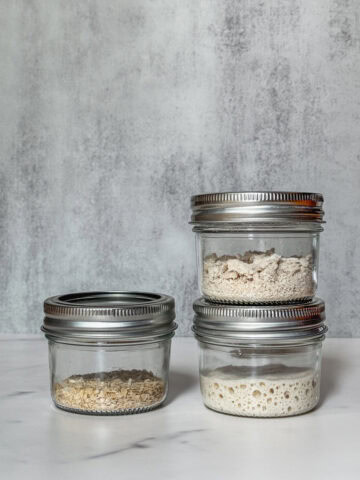

Now, it is time to learn how to store a sourdough starter. Nothing complicated, but it is important information to know, whether you plan to bake every day, take a week off, or even pause for several months.
This guide will help you keep your starter in good shape when storing it on the counter, in the fridge, or drying it for long-term storage. You will also learn how to revive it when you are ready to bake again.
Remember, these tips are for a mature sourdough starter at least six to eight weeks old. If you have recently created a sourdough starter from scratch, it needs some time to develop before it is ready for storage.
About 80% of sourdough success comes from a strong, healthy starter. It's the key to great bread.
At a Glance
- Best for: Beginner and intermediate bakers who want to store their sourdough starter properly between baking sessions.
- What you'll learn: How to store a starter at room temperature or in the refrigerator, how often to feed it, and how to revive it when you're ready to bake.
- Skill level: Beginner
- Time commitment: About 5-10 minutes for feeding and storing, plus 1-3 days to refresh a refrigerated starter before baking.
- Key techniques: Refrigerating a starter, maintaining room-temperature feedings, refreshing before baking, and adjusting storage based on your baking schedule.
- Optional steps: Create a dehydrated backup starter or keep a smaller starter to reduce flour waste and simplify maintenance.
- Main takeaway: The best storage method depends on how often you bake, but regular feedings and proper storage keep your starter healthy and ready to use.
- Next step: Refresh your stored starter until it's active and doubling reliably, then try a Beginner's Sourdough Bread Recipe.
Jump to:
- At a Glance
- The best ways to store sourdough starter
- How to store sourdough starter on the counter
- How to store your starter in the fridge
- How to crumble sourdough starter into the flour
- How to dry sourdough starter
- How to revive your starter
- The great debate: room temperature vs. refrigeration
- FAQ
- Let's talk sourdough
- Ready to keep learning?
- Comments
The best ways to store sourdough starter
- Keep your starter at room temperature on the counter and feed it daily if you bake multiple times a week.
- Store your starter in the refrigerator to slow its activity and reduce feeding frequency if you bake less often.
- Dry or crumble the starter into flour to preserve it for long-term storage.
- Dehydrate sourdough starter and store it for up to a year, for a backup.
Here is a quick guide to storage times based on how often you plan on baking:
| Baking frequency | Storage suggestion |
|---|---|
| Every 1-3 days | Store on the counter |
| Once a week to once a month | Store in the fridge |
| Once in 3-6 months | Dry or crumble into flour |
How to store sourdough starter on the counter
Keeping your starter on the counter is ideal if you bake every day or several times a week. Feed it regularly at your usual feeding ratio to keep it active and ready for use. Read my ultimate guide on how to feed sourdough starter.
I hope feeding your starter daily doesn't sound overwhelming. It only takes about five minutes to maintain.
If you feed your starter two times a day (morning and evening) and need to skip the night feeding, you can make a couple of adjustments for fermentation activity in the morning:
- Use cooler water to slow fermentation.
- Lower the hydration of your starter by using 30% less water than usual, making it thicker.
- Decrease the amount of starter carried over by 50%. For example, use 10 grams instead of 20 grams for feeding.
These small changes help maintain your starter without needing constant attention.
Note: Don't change the amount of flour used while making the above adjustments.
How to store your starter in the fridge
You can store sourdough starter in the refrigerator. This method is for you if you don't bake often or want to reduce your flour usage.
But first and foremost, it is important to understand that refrigerating your starter at 37.4-39°F (3-4°C) is not about maintaining an active cycle. It is about pausing fermentation and turning your starter into a "dormant" starter.
Cold temperatures slow the activity of yeast and lactic acid bacteria, reducing feeding frequency and preventing over-acidification. So, it takes some time for the starter to activate and be ready for use.
How often should you feed your starter? If you plan to keep your starter refrigerated, some bakers, like Alex Duarte Ribeiro at @padocadoalex, recommend feeding it every three days.
However, you can stick with discarding and feeding it once a week to keep it active and healthy, as most bakers do.
If you feed your starter at a 1:3:2 ratio (one part starter, three parts flour, and two parts water), you can stretch the feeding interval to 2-3 weeks, but ideally avoid going more than 3 weeks without feeding.
This is the recommended maximum. Full disclosure: I left my starter on this feeding ratio for a month, and it survived.
Here is how to prepare your starter for refrigeration:
- Feed your starter at a 1:3:3 or 1:5:5 ratio and cover it with a loose lid.
- Let it sit at room temperature for about 2 hours to start fermenting. There is no need to wait for the starter to peak at this stage. Look for a few bubbles and early signs of activity, such as a slight rise of about 10-30%.
- Tighten the lid, label the container, and put it in the refrigerator, somewhere, it will go unnoticed (and no one will be tempted to throw it out).
While refrigerated, fermentation continues very slowly. The starter can rise and fall slightly, and pH can drift toward (about 4.0-3.8) over several days.
Make sure to leave room for the starter to expand in the jar. The gases produced during fermentation can cause pressure buildup.
Remember to label your container with the date you placed it in the fridge so you know when to take it out for feeding.
How to crumble sourdough starter into the flour
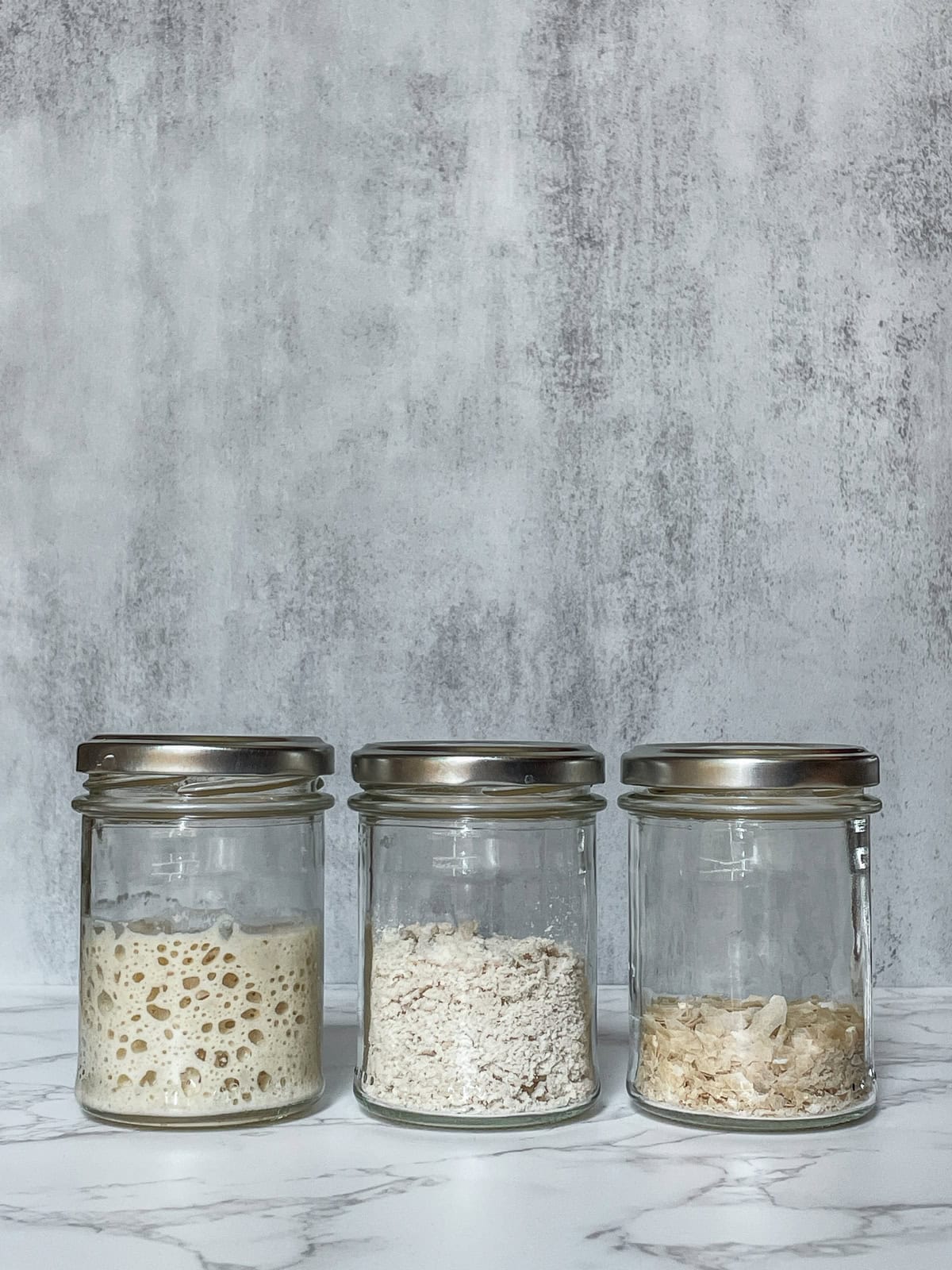
Another long-term storage option is to mix your starter with flour until it forms small, dry pieces.
- Combine one spoonful of the active starter with enough flour to form a crumbly mixture. Use a spatula to mix until slightly combined.
- Use your hands to break the mixture into small pea-sized fragments. This process may take a few minutes, and more flour can be added.
- Allow the mixture to air dry in the bowl for 1-2 hours before sealing it.
- Store the dried crumbles in a jar, away from light and moisture.
This method ensures a long shelf life and is easy to revive when needed.
How to dry sourdough starter
Drying your sourdough starter is an excellent method for long-term storage. Here is how to do it:
- Spread the starter into a thin layer on parchment paper when it is at its peak activity and let it dry completely.
- Once dry, break it into small pieces.
- Fold the parchment and crush the flakes into smaller pieces using a rolling pin.
- Store the dried pieces in an airtight container in a cool, dark place away from direct sunlight. Read more about how to dehydrate the starter effectively.
This method has allowed me to keep my starter dormant for months, with some lasting over two years without issues. It is also the primary method for preparing your starter for sale.
For step-by-step, photographed instructions, refer to my detailed guide on dehydrating sourdough starter.
How to revive your starter
Reving from the fridge
Remove your starter from the fridge and allow it to sit on the counter for 1-3 hours to reach room temperature. Don't wait for a refrigerated starter to "peak" before feeding, as cold fermentation doesn't produce a clear or reliable peak.
Once the starter, which has been stored in the fridge for a week, is warmed up, feed it at a 1:1:1 ratio and let it reach its peak. After that, use it for baking.
After using part of the starter (levain) for baking, feed the remaining starter, let it sit at room temperature for 30-120 minutes, and refrigerate before peak.
When you bake with a young starter (before peak), you can feed the remaining starter without worry. While this might look like "early feeding," it isn't harmful because fermentation has been paused rather than allowed to continue. Acidity issues only develop when early feeding is repeated over and over at room temperature.
The number of feedings after storing your starter in the fridge depends on how long it has been refrigerated. If it has been in the refrigerator for a week, feed it once, let it peak, then use it for baking.
If it was stored in the fridge for 1-2 weeks, feed it at least 2 times, preferably 3, before baking.
If stored for over two weeks but less than six months, the starter must be reactivated through multiple feedings. After six months, the old starter must be revived (see my guide to how to revive an old sourdough starter).
Reviving flour crumbles
To revive your starter from flour crumbles, add 50 g of fresh flour and filtered water to make a pancake-like batter consistency (don't discard anything). Stir it with a jar spatula and leave it in a warm spot for 12-24 hours.
After the initial 12-24 hours, observe the starter. Look for signs of activity such as bubbles forming, a slight rise, and a pleasant sour smell.
Once you see these signs, refeed the starter with the usual flour-to-water ratio. Don't wait for a full sourdough starter peak on the first refeed. Just getting it active again is enough. After one or two more feedings, it will regain full strength and be ready for baking.
Reviving dried flakes
Mix the flakes with warm water and let them soak for 2-3 hours. Then, add flour to create a paste. Let it rest to revive the microbial activity. Once reactivated, begin feeding and adjust the hydration level as needed. Read about how to rehydrate sourdough starter in 5 days.
Observe the starter's activity and continue the usual feeding schedule to restore optimal fermentation levels.
The great debate: room temperature vs. refrigeration
If you have heard that keeping your sourdough starter at room temperature and feeding it once or twice daily makes it stronger, there is plenty of truth to that.
Professional bakeries typically maintain their starters at room temperature without refrigeration, as this is ideal for keeping the starter active and ready to bake.
I feed my starter twice a day and keep it at about 75°F (24°C) using a Brod & Taylor Sourdough Home, spending roughly 5 minutes each feeding. I try to avoid refrigeration except when traveling.
But what about the "hybrid" method, with keeping the starter on the countertop until it peaks in the morning, then refrigerating until the next morning? Does this affect the strength of the starter?
Recent testing by Tom Cucuzza compared two methods: one starter kept at room temperature and fed twice daily, and a "hybrid" starter fed once daily at room temperature, then refrigerated overnight until the next day.
The results showed that intermittent refrigeration at peak didn't reduce yeast activity but did cause a slight increase in acidity over time. However, you can correct any increase in acidity caused by refrigeration with a couple of feedings at room temperature.
So, while twice-daily feedings at room temperature remain the gold standard for peak starter health, refrigeration offers a practical and flexible option.
If you don't bake daily or want to reduce feedings without compromising your starter's strength, the hybrid method will work for you.
FAQ
Can you place the sourdough starter in the fridge once fed?
You can refrigerate the sourdough starter after feeding, but it is recommended to let the fermentation begin before refrigeration. Leave it on the counter for about 1-2 hours before placing it in the fridge.
How much starter should you keep in the fridge?
For most weekly bakes, store a small amount (10-50 grams). It is sufficient.
How long can you leave the starter in the fridge?
For short breaks of up to two or three weeks, your starter will remain fine without feeding. Some bakers have even stored theirs for several months and successfully revived them.
For more questions and answers, check out my Sourdough Starter Questions and Answers blog post.
Let's talk sourdough
What's your go-to method for storing your sourdough starter? Have you noticed a difference in your bread when you store your starter at room temperature versus in the fridge?
Ready to keep learning?
Sometimes storing isn't enough. What if you will be away for weeks? Dehydrating your starter is a great way to pause it safely.