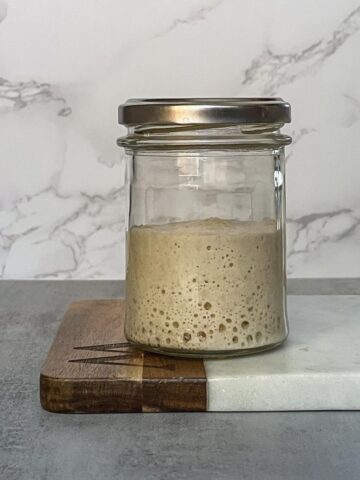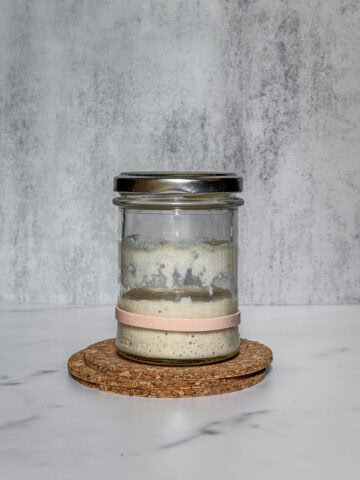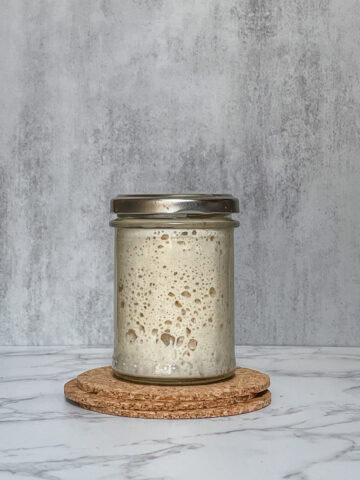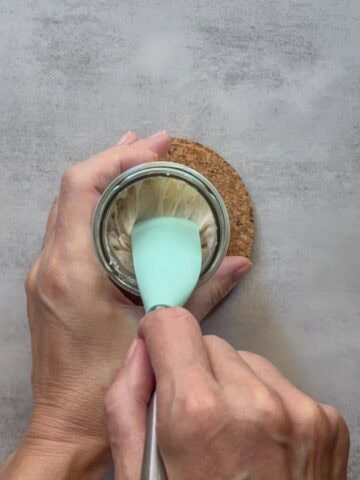

You can revive an old sourdough starter that looks like it has been forgotten and neglected. Maybe it has been sitting in the back of your fridge for months, or it smells bad, and you think it is ruined.
Sourdough starters are surprisingly tough, and in most cases, you can bring your starter back to life, even after being ignored for a long time.
The yeast-bacteria mixture is resilient and forgiving, so as long as you don't notice visible mold, your starter has a good chance of reviving.
However, if you spot fuzzy green or black mold on the surface or the sides of the jar, it is time to throw it out and start over.
When you can't revive sourdough starter
1. Hooch on top
A layer of liquid, called hooch, forms when your starter is hungry. Hooch usually looks gray, brown, or even slightly clear. This is not a sign that your starter is dead.
Stir it back in or pour it off, and feed your starter regularly. A few feedings will usually bring it back to full activity.
2. Weak or overly acidic starter
If your starter smells very sour or vinegar-like and isn't rising properly, it may just need a refresh.
Feed it peak-to-peak for a few days, or try a low-acid refresh by feeding a small portion with a higher flour-to-starter ratio (like 1:5:5 or higher). This helps strengthen the starter without adding too much acidity.
3. Neglected starter
Even after weeks or months in the fridge, you can revive a neglected starter, as long as it hasn't developed mold or harmful bacteria. Start with small, regular feedings (e.g., 1:1:1 ratio) and gradually increase the feeding ratio to 1:3:3 twice a day, or at least 1:5:5 once a day.
4. Kahm yeast
Kahm yeast appears as a thin, white, or cream-brownish colored film on the surface. While it is harmless, it signals a microbial imbalance.
To save your starter, remove the film, discard a portion of the starter, and feed the rest with a large feed first, then continue feeding consistently until it smells fresh and has regular bubbling activity.
5. Accidental heat exposure
If your starter was accidentally microwaved or placed in a hot oven, but the temperature didn't exceed 60°C (140°F), all is not lost.
For reference: yeast and bacteria in a sourdough starter begin to die around 50-60°C (122-140°F). Temperatures above this will kill most of the microbes, and by 70-75°C (158-167°F), the starter is essentially lost.
To try reviving it, scoop out a portion (10 g) from the edges or bottom, and feed it at a 1:3:3 ratio (10 g starter, 30 g flour, 30 g water). Give it some time to reactivate (it may take up to 2 days). If you see signs of life, continue with regular feedings as usual.
6. Broken jar
If your starter jar breaks, you can still save your starter. Even a half-teaspoon of healthy starter is enough to rebuild your culture with regular feedings.
Transfer whatever you can salvage into a new jar and feed as usual. Add water first, mix, and pass the mixture through a fine-mesh sieve to make sure no glass remains. Then, add flour and mix. Continue with regular feedings to restore your starter.
7. Dried starter in the jar
Sometimes, only dried bits of starter remain on the sides of the jar. Scrape off a small piece, dissolve it in water, and feed it as usual. You will see bubbling and activity within a few days.
8. No starter left behind
This happens when you don't make the levain in a separate jar and pour all of your active "mother" starter directly into the dough without saving any for later feedings. But even a tiny smear left in the jar can be revived.
Scrape off whatever remains, then feed it with an equal amount of flour and water (aim for 100% hydration starter). The exact amounts don't have to be precise. Try to eyeball enough to create a thick pancake-batter consistency so the starter can rise.
Let it sit at room temperature until it becomes bubbly and active, then continue with regular feedings.
Attention: Always reserve a portion of your starter for future feedings, or use a separate jar for levain. This guarantees you never accidentally run out of your starter.
9. Strange smells without mold
A weird smell, like cheese, socks, or alcohol, doesn't always mean your starter is gone. Usually, it is a temporary microbial imbalance, often called an acidic sourdough starter. Regular feedings with fresh flour and water will reset the starter's microbial balance.
10. Starter with a dry surface
If your starter has been left uncovered for several hours or a day and has developed a thin dried layer on top, scrape off the top, discard a portion, and feed the remaining starter. It should recover fully.
11. Surface discoloration (no mold)
Oxidation can cause the surface to turn gray or brown. If there's no fuzzy mold or pink/red/orange streaks, the starter is likely safe. A few feedings will restore its normal color and activity.
12. Overly wet or overfed starter
If you accidentally overfed your starter with water, creating a liquid sourdough starter (more water than flour), and it isn't rising well, you can thicken it back to normal consistency.
Feed it with fresh water and flour until it reaches a consistency of thick pancake batter, and let it rise. Then continue your regular feedings.
13. Starters stored too cold
Refrigerated or partially frozen starters may appear inactive or slow down. A few days of room-temperature feedings usually wake them up. Learn more about how to revive a frozen sourdough starter.
14. Runny sourdough starter
If your starter becomes runny, it is a sign that it has over-fermented and collapsed because it has used up all its available food. Discard most of it and feed the remaining portion several times. It usually recovers within a few days.
15. Previously dried starter
If you intentionally dehydrated your starter as a backup, this is one of the safest ways to preserve it. To bring it back to life, rehydrate your starter and feed it regularly until it's active again.
How to revive an old sourdough starter step-by-step
Reviving an old sourdough starter usually refers to bringing back a starter that has been in the refrigerator for a long time. Starters left on the counter for extended periods often develop mold and cannot be saved.
Step 1. Remove most of the old starter
If your starter has hooch, pour it off and mix the starter. If the liquid on top is less than a month old, you can stir it back in.
Remove any dried oxidation layer, and if there is Kahm yeast, scoop off as much as possible.
Next, using a clean spatula or spoon, transfer a small portion (about 10 grams) into a clean jar. A smaller amount is fine as well.
Step 2. Feed the starter
There are two main approaches: you can start with Option A and then move to Option B, or skip Option A and begin directly with Option B.
I usually start with Option A, giving a refrigerated starter a small feed first to check its activity, then gradually adding enough food to get the yeast and lactic acid bacteria working.
Option A: Low feeding ratio to check activity
- Mix 10 grams of starter with 10 grams of unbleached flour and 10 grams of filtered water (1:1:1 ratio).
- Stir well and leave at room temperature for 12 hours.
- After 12 hours, check for signs of life: if you see bubbles forming and the starter rises in the jar, it is alive and fermenting. This means the revival process is working.
Option B: Large feed to jumpstart activity
- Once activity is observed, discard all but 10 grams of starter.
- Feed with a larger ratio, for example, 1:5:5: 10 grams of starter, 50 grams of flour, 50 grams of water.
- Stir thoroughly, then let it rest at room temperature for 24 hours.
Step 3. Observe and repeat
If the starter shows bubbles and rises, continue regular feedings until it doubles in size within 6-8 hours.
Usually, one to two large feedings are enough to revive even the most neglected sourdough starter.
Step 4. If no activity appears
Continue feeding at a low ratio (1:1:1, or 1:2:2 at maximum) twice a day, or at a higher ratio (1:5:5) once a day.
Keep feeding until you see consistent bubbling, rising, and a pleasant sour aroma. Some starters require several feedings before showing activity, so be patient.
What to do with the discarded starter
You might feel that throwing out part of your starter is wasteful. However, during the first few days of revival, don't save the discard, as it might not be in good condition.
Once your starter is strong and active again, you can use the discard to make delicious recipes like pancakes, waffles, or quick bread. This way, nothing goes to waste.
When a starter cannot be safely revived
Sometimes, a sourdough starter reaches a point where it is no longer safe to attempt to revive. This happens when it shows clear signs of contamination or damage that cannot be fixed.
Common warning signs of bad sourdough starters include:
- Visible mold: fuzzy, black, green, or pink/red patches.
- Putrid or rotten smell: beyond normal sourness.
- Contamination with harmful bacteria, such as Serratia marcescens (reddish to pink streaks).
- Severe heat, freezing, or drying
In these cases, discard the starter and begin fresh.
What is a dead sourdough starter?
A dead sourdough starter is one that cannot be revived. The yeast and bacteria that make it active and bubbly have died. Unlike a weak or neglected starter, a dead starter shows no signs of life, no matter how many times you feed it.
Signs your starter is dead include:
- It never bubbles or rises, even after several feedings.
- It smells rotten, putrid, or extremely sour, rather than fresh and tangy.
- It has visible mold (fuzzy, black, green, or pink/red patches) or harmful bacterial growth.
- It has been accidentally cooked, frozen, or dried beyond recovery.
A dead starter must be discarded, as there is no safe way to revive it.
Let's talk sourdough
Have you ever dealt with a neglected starter? Did you try to revive the sourdough starter from the fridge? If so, share your experience in the comments.
Ready to keep learning?
Once your starter is back to life, it is time to keep it healthy in the long term. Learn how to maintain a sourdough starter without discarding it, a budget-friendly method.