


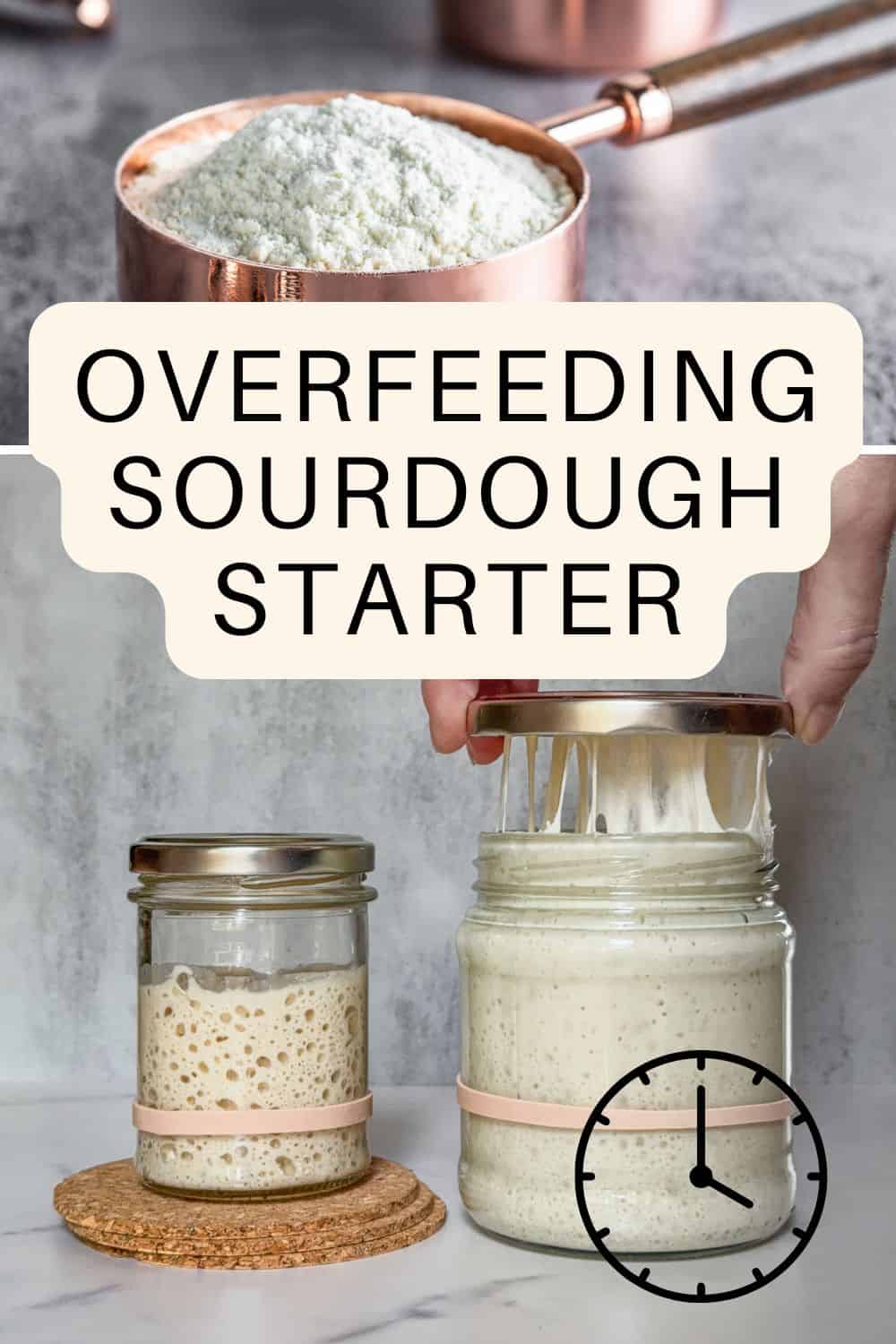
Many bakers worry about overfeeding a sourdough starter. Can you really overfeed a sourdough starter? This question often appears when a starter becomes inconsistent, loses strength, or no longer behaves as predictably as before.
In most cases, the issue is not the amount of food but the timing of feeding in relation to the starter's natural fermentation cycle.
A sourdough starter is a living system that constantly moves through rise, peak, and collapse. Once you understand this rhythm, "overfeeding" becomes much easier to understand.
Can you overfeed a sourdough starter?
Yes, but not in the way many people assume.
Overfeeding does not simply mean feeding your starter at a high ratio, such as 1:10:10. A larger feeding ratio by itself does not harm the starter.
In reality, overfeeding usually happens when the starter is fed too early, before it has reached peak activity (aka sourdough starter peak).
When this happens repeatedly, the starter is constantly reset before fermentation fully develops. Over time, this makes the starter appear weak, slow, or inconsistent.
However, the microbes themselves are not damaged. The problem is not the destruction of the culture, but the repeated interruption of its natural rise, peak, and collapse cycle.
Sourdough starter peak vs collapse
A sourdough starter should be used for baking at peak activity, when the yeast is at its strongest.
For maintenance, timing is just as important, but the goal shifts slightly. You should ideally feed the starter when it is just about to collapse, or just after it has begun to collapse.
Feeding too early interrupts that cycle. Feeding too late allows the starter to remain in its collapsed, acidic state for too long. Over time, both patterns create instability.
Learning your starter's collapse point
There is no universal timing rule for collapse. You have to get to know your starter and how it behaves.
Each starter is unique and responds differently due to temperature, flour type, hydration, environment, and even the natural microbes present in your kitchen.
Over time, you begin to recognize its rhythm, how it rises, when it peaks, and what it looks like just before it falls. This observation is more reliable than any fixed schedule.
Overfeeding vs underfeeding
Overfeeding and underfeeding are often seen as opposite problems, but in reality, they come from the same misunderstanding of timing.
Overfeeding occurs when a sourdough starter is refreshed too early, before it has completed its full rise-and-collapse cycle. The starter is repeatedly reset in its early stages, which makes it slow, mild, and less active over time.
Underfeeding is the opposite. It happens when the starter is left too long after collapse without being refreshed. In this state, acidity continues to build, fermentation gradually weakens, and the structure of the culture becomes stressed over time.
Both issues affect microbial balance rather than "damage." The starter is still alive in both cases, but its rhythm becomes less stable.
In practice, the goal is not to avoid one extreme perfectly, but to understand when your starter is approaching collapse and feed it at the right moment.
How to decide when to feed
Every feeding decision should be based on observation rather than habit. It is not simply about feeding your starter at a fixed 1:3:3 ratio twice a day and expecting consistent results. It is more complex than that.
A sourdough starter is a living fermentation system, and its behavior changes constantly depending on temperature, flour type, hydration, and the surrounding environment. Even the same starter can move through its cycle faster one day and slower the next.
This is why rigid routines often fail over time. A fixed schedule assumes the starter behaves the same way every day, but in reality, it does not.
The exception is when conditions are kept extremely consistent. If you use the same flour, same water, same feeding ratio, and maintain a stable temperature and environment, the starter becomes far more predictable.
This is why tools like the Brod & Taylor Sourdough Home make such a big difference. Creating a stable environment allows the starter to follow a much more repeatable fermentation cycle.
Without that consistency, some days the starter will peak early and collapse quickly, especially in warm conditions. On other days, it will take much longer to rise, particularly in cooler environments or when using different flours.
When feeding becomes habit-based instead of observation-based, the starter is often reset at the wrong time. This can interrupt its natural rhythm and make it harder to read over time.
A more reliable approach is to watch what the starter is actually doing in the moment. Instead of relying on the clock, you are looking for the signs of its current state.
Reading the starter's signs
Is it still rising strongly, full of energy and expansion, or has it already reached its highest point and started to slow down?
The goal is not to follow strict rules, but to understand your starter well enough to recognize when it is about to collapse and respond at the right moment.
When a starter begins to collapse, the surface slowly flattens, the dome relaxes, and you can see it sink slightly in the center. This is the right time to feed your starter.
These visual and physical changes are the language of the starter. They tell you more accurately than any fixed timing ever could.
As a beginner, instead of asking "how long has it been?", you start asking "what is it doing right now?" Over time, learning to read the starter's signs becomes far more reliable than following any set ratio or schedule.
Feeding should always respond to the starter's current state, not a preset routine. When you adjust based on behavior rather than habit, the starter develops a more stable rhythm and becomes easier to maintain and understand over time.
Maintenance feeding guidelines
For general maintenance, feed your sourdough starter once a day using a 1:5:5 ratio. Alternatively, you can feed twice a day, using a lighter feeding ratio between 1:2:2 and 1:4:4 (see my guide on sourdough starter feeding ratios).
These ratios are not strict rules, but flexible reference points. They help guide maintenance, but should always be adjusted based on temperature, flour type, and how quickly the starter moves through its rise-and-collapse cycle.
In warmer conditions, fermentation happens faster, so the starter reaches its peak and begins to collapse sooner. As a result, you may need to increase the feeding ratio.
In cooler conditions, the process slows, and the cycle lengthens, so you may need to decrease the feeding ratio.
Flour choice is also important, as wholegrain flour tends to increase fermentation activity, while more refined flour slows it down and creates a more gradual rise.
Because of these natural variations, feeding should never be based solely on fixed habits. It should always respond to the starter's current behavior rather than a preset routine.
To learn more about feeding sourdough starter, check out these two guides:
Let's talk sourdough
What is your go-to feeding ratio, and how did you arrive at it? Through observation, a feeding ratio chart, or something else?