How to Bake Sourdough in a Loaf Pan
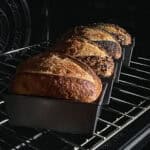
Here is how you can make sourdough bread in a loaf pan, whether it is baked in a single loaf tin or using a double loaf pan method. Perfect for sandwiches and baking sourdough bread in bulk.
- Prep Time: 17 hours
- Cook Time: 40 minutes
- Total Time: 17 hours, 40 minutes
- Yield: 1 loaf 1x
- Method: Baking
- Cuisine: American
Ingredients
Scale
For the levain (an active starter):
- 35 g sourdough starter
- 35 g bread flour
- 35 g water
For the bread dough:
- 500 g bread flour (I use King Arthur organic bread flour)
- 350 g water
- 100 g levain (active starter at peak)
- 10 g sea salt (I use Redmond ancient fine sea salt)
10 g white rice flour (for dusting)
Instructions
- Make a levain (an active starter): Feed your starter in the morning at a 1:1:1 ratio (35g starter, 35g flour, and 35g water), and wait 4-6 hours for it to peak.
- Autolyse: Mix water and flour with your hand or a dough whisk into a large mixing bowl until you have a shaggy dough. Cover the bowl with a plastic film or a damp tea towel and let it sit for 30 minutes.
- Mix the dough: Add the levain (your active starter) and mix it in. Then, sprinkle in the sea salt. Use your hand to mix thoroughly for 3 to 10 minutes, adjusting the time based on your schedule and the desired level of gluten development. A longer mix builds a stronger gluten network. Cover the bowl with plastic wrap or a damp kitchen towel and let it rest for 30 minutes. Once the levain is added, bulk fermentation begins.
- Fold the dough: Start with two sets of stretch and folds, spaced 30 minutes apart. Then perform two sets of coil folds, also 30 minutes apart. For each set, stretch the dough in all four directions. Between folds, cover the bowl with plastic wrap or a damp kitchen towel and let the dough rest for 30 minutes.
- Continue bulk fermentation: Allow the dough to keep fermenting. Bulk fermentation is finished once you see visible bubbles across the surface and along the sides, if you are using a glass bowl. The edges of the dough will appear slightly domed, and if you gently shake the bowl, the dough should have a soft, wobbly jiggle.
- Preshape the dough into a round and let it rest uncovered for 15–20 minutes.
- Shape the dough: Lightly dust your work surface with white rice flour. Gently flip the dough out of the bowl. Shape it into a batard. Place the dough seam side down in a lightly greased tin. Alternatively, place the shaped dough inside the banneton with the seam side up.
- Cold proof: Cover the loaf tin with a towel or place it in a plastic bag. Refrigerate the dough for at least 12 hours, or up to 48 hours. The longer it chills, the tangier the flavor.
- Score: Preheat the oven to 500°F (260°C) and let it heat for 30 minutes. Remove the dough from the fridge. If it was proofed in a banneton, gently flip it into a greased or parchment-lined loaf pan, seam side down. Score the top of the dough with a single slash using a bread lame or sharp knife.
- Bake the bread: Place a second, identical loaf pan over the first to cover it, creating a mini oven. Use oven mitts for safety when placing it in the oven. Immediately lower the oven temperature to 450°F (230°C) and bake for 17-20 minutes. Carefully remove the top pan using oven mitts. Continue baking for 15–20 minutes, or until the crust turns golden brown. Let your bread cool for at least 2 hours before slicing. This helps set the crumb and gives you the best texture.
Notes
- To bake in a single loaf pan, place an empty steam pan (such as a roasting pan or cast-iron skillet) on the lower rack and preheat your oven to 500°F (260°C). Once preheated, bring water to a boil. Bring the loaf pan with the dough to the middle rack of the oven. Carefully pour about 350-400g (or 1½ to 2 cups) of boiling water into the steam pan, then quickly close the oven door. Lower the temperature to 430°F (220°C) and bake for 20 minutes. After that, remove the steam pan and bake for an additional 17–20 minutes, until the crust is nicely browned.
- Multiple batches: If baking several loaves, allow the oven to return to 500°F (260°C) before loading the next batch. Adjust the baking temperature and time as needed by testing.
- Safety Tip: Always use oven mitts or silicone gloves when handling hot pans. When pouring boiling water into the steam pan, wear safety goggles.
- Check for doneness: Your bread is fully baked when the internal temperature reaches 205–210°F (96–99°C). Use a digital thermometer to check.
- Storage and freezing: Keep your sourdough bread at room temperature for 3 to 5 days. For longer storage, freeze individual slices for up to 1–2 weeks, or freeze a whole loaf for 1–2 months.
- Want to create a custom formula for your loaf? Try my sourdough calculator.
- Need help getting started? Check out my beginner's sourdough bread guide to learn sourdough basics first.
- Note: Nutritional information does not include the white rice flour used for dusting.
Nutrition
- Calories: 2002
- Sugar: 1.5g
- Sodium: 3923mg
- Fat: 5.4g
- Saturated Fat: 0.9g
- Carbohydrates: 419.7g
- Fiber: 14.9g
- Protein: 56.8g
- Cholesterol: 0mg
Find it online: https://sourdoughtalk.com/how-to-bake-sourdough-in-a-loaf-pan/