Parbaked Sourdough Bread
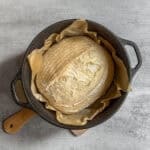
Parbaked sourdough bread lets you bake your loaf partway, store it, and finish it later for fresh, crusty bread. Perfect for busy schedules, meal prep, or sharing with friends.
- Prep Time: 20 hours, 40 minutes
- Cook Time: 40 minutes
- Total Time: 21 hours, 20 minutes
- Method: Baking
- Cuisine: American
Ingredients
Scale
For the levain (an active starter):
- 30 g sourdough starter
- 30 g bread flour
- 30 g water
For the bread dough:
- 400 g bread flour (I use King Arthur organic bread flour)
- 300 g water (75% hydration)
- 80 g levain (active starter at peak)
- 8 g fine sea salt (I use Redmond ancient fine sea salt)
10 g white rice flour (for dusting)
Instructions
- Make levain: Feed the sourdough starter at a 1:1:1 ratio and let it rise in a warm place until it peaks.
- Autolyse: Pour the water into a mixing bowl. Add the flour to the water, mix until combined, and let the dough rest for 30 minutes.
- Incorporate levain and salt: Add levain (active starter at peak) and mix. Sprinkle in the salt and mix using one of the bread dough mixing techniques. Cover the dough and let it rest for 30 minutes.
- Bulk fermentation: Perform two sets of stretch and folds and two sets of coil folds, with a 30-minute rest between sets. After the final set of coil folds, let the dough continue bulk fermentation and monitor its rise closely. Bulk fermentation is done when the dough shows bubbles on the surface and along the sides, the edges appear slightly domed, and the dough gently wobbles when you shake the bowl.
- Preshape and shape: Lightly flour your work surface, pre-shape the dough into a round, and let it rest for 10-15 minutes. Perform the final shaping into a battard, then place it in a prepared 10-inch oval banneton.
- Proof: Cover the banneton with a clean towel, disposable plastic cap, or place it inside a reusable plastic bag. Refrigerate overnight (8–14 hours).
- Bake: Preheat the oven to 500°F (260°C) with a Dutch oven inside for 30 minutes. Transfer the dough onto parchment paper, score the top, and place it inside the Dutch oven. Decrease the oven temperature to 450°F (232 °C), then bake, covered, for 20 minutes. After 20 minutes, remove the lid, and continue baking for another 5-10 minutes. At this stage, you want the loaf to set, but not start browning. Stop baking when the loaf is pale and matte. If in doubt, underbake slightly because you can always brown it later. Check the internal temperature of bread. It should be around 180-190°F (82-88°C).
- Cool: Carefully lift the loaf out of the Dutch oven and place it on a wire rack to cool. This step is important as it allows steam to escape, preventing the crust from softening as the bread cools and later goes into storage.
Notes
- Adjust to your oven: Tweak baking times and temperatures to get the best baking results.
- Safety tip: Always use oven mitts or silicone gloves when handling hot pans.
- Be gentle when removing the loaf: Handle parbaked bread carefully when removing it from a hot Dutch oven or roaster.
- Cool completely before storing: Let parbaked bread cool fully on a wire rack to prevent trapped steam from softening the crust.
- Freeze: Parbaked loaves freeze very well. Wrap tightly in plastic and foil to preserve flavor, texture, and structure for up to 1–2 months.
- Label your loaves: If storing multiple parbaked loaves, label with the date and type so you can track freshness and bake times.
- Want to create a custom formula for your loaf? Try my sourdough calculator.
- Need help getting started? Check out my beginner's sourdough bread guide to learn sourdough basics first.
- Note: Nutritional information does not include the white rice flour used for dusting.
Nutrition
- Calories: 1602
- Sugar: 1.2g
- Sodium: 3120mg
- Fat: 4.3g
- Saturated Fat: 0.7g
- Carbohydrates: 335.8g
- Fiber: 11.9g
- Protein: 45.5g
- Cholesterol: 0mg
Find it online: https://sourdoughtalk.com/how-to-parbake-sourdough-bread/