Unloaf Sourdough Bread Recipe
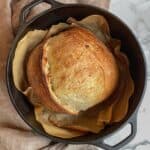
Unloaf sourdough bread recipe is a relaxed, beginner-friendly sourdough made with unfed starter. No stretching, no fancy shaping, and no preheating: mix the dough, place it in a pan, and bake for simple, homemade, unloaf bread.
- Prep Time: 21 hours, 40 minutes
- Cook Time: 50 minutes
- Total Time: 22 hours, 30 minutes
- Yield: 10 slices 1x
- Method: Baking
- Cuisine: American
Ingredients
Scale
For the bread dough:
- 500 g bread flour (I use King Arthur organic bread flour)
- 375 g water (75% hydration)
- 100 g unfed starter (flat and warmed up)
- 10 g fine sea salt (I use Redmond ancient fine sea salt)
10 g white rice flour (for dusting)
Instructions
- Mix ingredients: In a large mixing bowl, mix unfed sourdough starter and water. Add bread flour and salt, and mix by hand for 3–5 minutes. Cover the bowl with a damp kitchen towel or a plastic cap and let it ferment.
- Bulk fermentation: To track bulk fermentation, transfer the dough to a straight-sided container or a 2-L measuring cup. Alternatively, use the aliquot jar method. The target dough rise depends on the dough temperature, which is influenced by your room temperature. Look for visual signs when bulk fermentation is done, such as bubbles on the surface, and a light, airy feel. The dough edges should look slightly domed, and the dough should gently wobble when you shake the bowl from side to side.
- Preshape (optional) and shape: Lightly flour your work surface with white rice flour, preshape the dough into a round, and let it rest for 10–15 minutes. This step is optional: you can skip it when making a single loaf. Shape the dough into a batard (or a boule), then place it seam-side up in a prepared 12-inch oval banneton.
- Proof: Cover the banneton with a clean towel, disposable plastic cap, or place it inside a reusable plastic bag. Transfer the dough to the refrigerator and let it proof overnight.
- Score: Take the chilled dough from the fridge and place it on a piece of parchment paper. Using a bread lame, make a single slash for a batard or score a square pattern for a boule.
- Bake the bread in a cold conventional oven. Place the dough in a cold Dutch oven or Granite Ware roasting pan, cover with the lid, and place the pot in the cold oven. Set the oven to 450°F (230°C) and bake for about 45-50 minutes with the lid on. Check the doneness, using a probe thermometer. The bread internal temperature should reach 205–210°F (96–99°C).
- Cool bread: Carefully remove the bread from the Dutch oven and let it cool on a wire rack for at least 2 hours before slicing.
Notes
- Unfed starter: While you can use unfed sourdough starter straight from the fridge, I recommend using a starter that was fed within the past week and allowed to peak before being refrigerated. I am all about better-quality bread than just mediocre.
- Warm up your starter: If time allows, let your unfed sourdough starter warm up at room temperature before mixing the dough. Using a cold starter lowers the final dough temperature (FDT), slowing fermentation and extending bulk fermentation.
- Baking vessel: You can bake sourdough in a cold oven using a Dutch oven, but a roasting pan is preferable because it heats up faster.
- Storage and freezing: Store sourdough bread for 3-5 days. Freeze individual slices for up to 1-2 weeks, a whole loaf for 1-2 months.
- Safety tip: Always use oven mitts or silicone gloves when handling hot pans.
- Check for doneness: Your bread is fully baked when the internal temperature reaches 205–210°F (96–99°C). I usually aim for 207°F (97°C) or higher. Use a digital probe thermometer to check.
- Want to create a custom formula for your loaf? Try my sourdough calculator.
- Need help getting started? Check out my beginner's sourdough bread guide to learn sourdough basics first.
- Note: Nutritional information does not include the white rice flour used for dusting.
Nutrition
- Serving Size: 1 slice
- Calories: 167
- Sugar: 0.1g
- Sodium: 324mg
- Fat: 0.5g
- Saturated Fat: 0.1g
- Carbohydrates: 35g
- Fiber: 1.2g
- Protein: 4.7g
- Cholesterol: 0mg