No-Knead Sourdough Bread
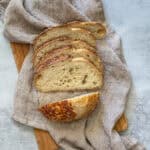
No-knead sourdough bread is an easy, almost hands-off method that relies on long fermentation instead of traditional kneading. Mix the ingredients, let time do the work, and enjoy a rustic loaf with a crisp crust, open crumb, and deep sourdough flavor.
- Prep Time: 20 hours, 30 minutes
- Cook Time: 40 minutes
- Total Time: 21 hours, 10 minutes
- Yield: 1 loaf 1x
- Method: Baking
- Cuisine: American
Ingredients
Scale
For the levain (an active starter):
- 35 g sourdough starter
- 35 g bread flour
- 35 g water
For the bread dough:
- 500 g bread flour (I use King Arthur organic bread flour)
- 375 g water (75% hydration)
- 100 g levain (active starter at peak)
- 10 g fine sea salt (I use Redmond ancient fine sea salt)
10 g white rice flour (for dusting)
Instructions
- Make a levain (an active starter): Feed your starter in the morning at a 1:1:1 ratio (35 g starter, 35 g flour, and 35 g water), and wait 4-6 hours for it to peak.
- Mix the dough: Combine water with levain (active starter at peak), then add flour and salt. Mix just combine. Cover the bowl with a damp kitchen towel or plastic wrap and let the dough rest for 30 minutes. Once you add levain (active sourdough starter), bulk fermentation starts.
- Bulk fermentation: With wet hands, perform two sets of stretch and folds and two sets of coil folds with 30-minute intervals between sets. Cover the bowl with the dough during resting periods. After the last set of coil folds, allow the dough to continue bulk fermentation until the dough reaches a slightly domed top, has large bubbles on the surface and smaller bubbles on the sides of the container, pulls easily from the sides, and jiggles when shaken.
- Preshape and shape: Lightly flour your work surface, preshape the dough into a round, and let it rest for 15 minutes. You can omit preshaping when making a single loaf. Perform the final shaping into a battard (or a boule), then place it in a prepared 12-inch oval banneton, seam-side up.
- Proof: Cover the dough with a towel or plastic bag and refrigerate at 39°F (4°C) overnight, or for at least 8-10 hours.
- Score: Remove the dough from the fridge. Flip it out of the banneton onto a piece of parchment paper. Using a sharp bread lame, score the dough.
- Bake: Preheat the oven to 500°F (260°C) with the Dutch oven inside for 25–30 minutes. Carefully transfer the dough onto parchment paper, score it, and place it into the hot Dutch oven. Reduce the oven temperature to 450°F (232°C) and bake, covered, for 20 minutes. Remove the lid and continue baking for another 17–20 minutes, until the crust is golden and crisp.
- Cool the bread: Using the oven mitts, remove the baking vessel from the oven. Carefully remove the bread and let it cool on a wire rack for at least 2 hours before slicing.
Notes
- Use the double loaf pan method, as it is the most forgiving sourdough baking method if your bulk fermentation isn’t perfect.
- Safety tip: Always use oven mitts or silicone gloves when handling a hot pan.
- Check for doneness: Use a digital probe thermometer to check the internal temperature of the bread. It should reach 205–210°F (96–99°C). I usually aim for 207°F (97°C) or higher.
- Storage and freezing: Store sourdough bread at room temperature for 3-5 days. Freeze for up to 3 months. Thaw at room temperature. Freeze individual slices for up to 1-2 weeks, a whole loaf for 1-2 months.
- Want to create a custom formula for your loaf? Try my sourdough calculator.
- Need help getting started? Check out my beginner's sourdough bread guide to learn sourdough basics first.
- Note: Nutritional information doesn't include the white rice flour used for dusting.
Nutrition
- Calories: 2002
- Sugar: 1.5g
- Sodium: 3900mg
- Fat: 5.4g
- Saturated Fat: 0.9g
- Carbohydrates: 419.7g
- Fiber: 14.9g
- Protein: 56.8g
- Cholesterol: 0mg
Find it online: https://sourdoughtalk.com/no-knead-sourdough-bread/