Guinness Sourdough Bread
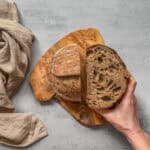
This Guinness sourdough bread is rich and malty, made with stout beer, rye flour, molasses, and a hint of cocoa powder. The loaf has a soft crumb and a dark crust, and pairs perfectly with hearty dishes or Irish butter. Perfect for St. Patrick’s Day baking.
- Yield: 1 loaf 1x
- Category: Sourdough Recipes
- Method: Baking
- Cuisine: American
Ingredients
Scale
For the levain (an active starter):
- 22 g sourdough starter
- 22 g bread flour
- 22 g water
For the bread dough:
- 270 g bread flour (I use King Arthur organic bread flour)
- 30 g rye flour
- 240 g Guinness stout (room temperature, degassed)
- 70 g levain (active sourdough starter at peak)
- 7 g fine sea salt (I use Redmond ancient fine sea salt)
- 4 g molasses
- 9 g olive oil
- 4 g unsweetened cocoa powder
10 g white rice flour (for dusting)
Instructions
- Degass the Guinness: Pour it into a bowl and stir for 20-30 seconds to release the carbonation. Excess carbonation can interfere with gluten formation.
- Autolyse: Mix in a bowl, mix bread and rye flour with cocoa powder. Then, pour degassed Guinness stout, and mix until no dry flour remains. Cover and rest 30 minutes.
- Add remaining ingredients: After autolyse, add levain (active sourdough starter at peak activity), salt, molasses, and olive oil to the dough. Mix gently but thoroughly until everything is fully incorporated (use one of the bread dough mixing techniques). Cover the dough and let it rest for 30 minutes. Once you add levain (active sourdough starter), bulk fermentation starts.
- Bulk fermentation: With wet hands, perform two sets of stretch and folds followed by two sets of coil folds, allowing a 30-minute rest between each set. The exact number of coil folds varies depending on the dough’s strength and extensibility. After the final set of coil folds, let the dough continue bulk fermentation and monitor its rise closely. Bulk fermentation is complete when small bubbles appear on the surface and along the sides of the dough, the edges look slightly domed, and the dough gently wobbles when you shake the bowl.
- Preshape and shape: Lightly flour your work surface, preshape the dough into a round, and let it rest for 10-15 minutes. If you are making just one loaf, you can skip the preshaping step. Then shape the dough into a batard and place it seam side up in a prepared 8-inch oval banneton.
- Proof: Cover the banneton with a clean towel or a disposable plastic cap, or place it in a reusable plastic bag. Refrigerate overnight (8–14 hours) for a slow, even fermentation.
- Bake the loaf: Preheat the oven to 500°F (260°C) with a Dutch oven inside for 30 minutes. Turn the dough out onto parchment paper, score the top, and carefully transfer it into the hot Dutch oven. Reduce the oven temperature to 450°F (232°C) and bake covered for 20 minutes. Remove the lid and continue baking for 15-17 minutes, until the crust is deeply browned. Once baked, remove the bread from the Dutch oven and let it cool on a wire rack for at least 2 hours before slicing.
Notes
- Degass the Guinness before mixing: Fresh stout contains dissolved CO₂, which can interfere with gluten development. Make sure to degass the Guinness before adding it to the dough.
- Use gentle handling during shaping: Guinness dough feels slightly softer due to sugars and proteins in the stout. Handle the dough gently during shaping to preserve the gas produced during fermentation.
- Watch the crust color during baking: Sugars from Guinness and molasses promote faster browning. If the crust darkens too quickly, lower the oven temperature slightly during the final stage of baking.
- Handle hot equipment safely: Always use oven mitts or silicone gloves when handling hot pans or Dutch ovens.
- Check the bread's internal temperature: It should reach 205–210°F (96–99°C). I usually aim for 207°F (97°C) or higher.
- Store the bread properly: Store sourdough bread at room temperature for 3-5 days. Freeze for up to 3 months. Thaw at room temperature. Freeze individual slices for up to 1-2 weeks, a whole loaf for 1-2 months.
- Want to create a custom formula for your loaf? Try my sourdough calculator.
- Need help getting started? Check out my beginner's sourdough bread guide to learn sourdough basics first.
- Note: Nutritional information does not include the white rice flour used for dusting.
Nutrition
- Calories: 1494
- Sugar: 3.4g
- Sodium: 2723mg
- Fat: 12.8g
- Saturated Fat: 2.1g
- Carbohydrates: 264.8g
- Fiber: 16.4g
- Protein: 37.3g
- Cholesterol: 0mg
Find it online: https://sourdoughtalk.com/guinness-sourdough-bread/