
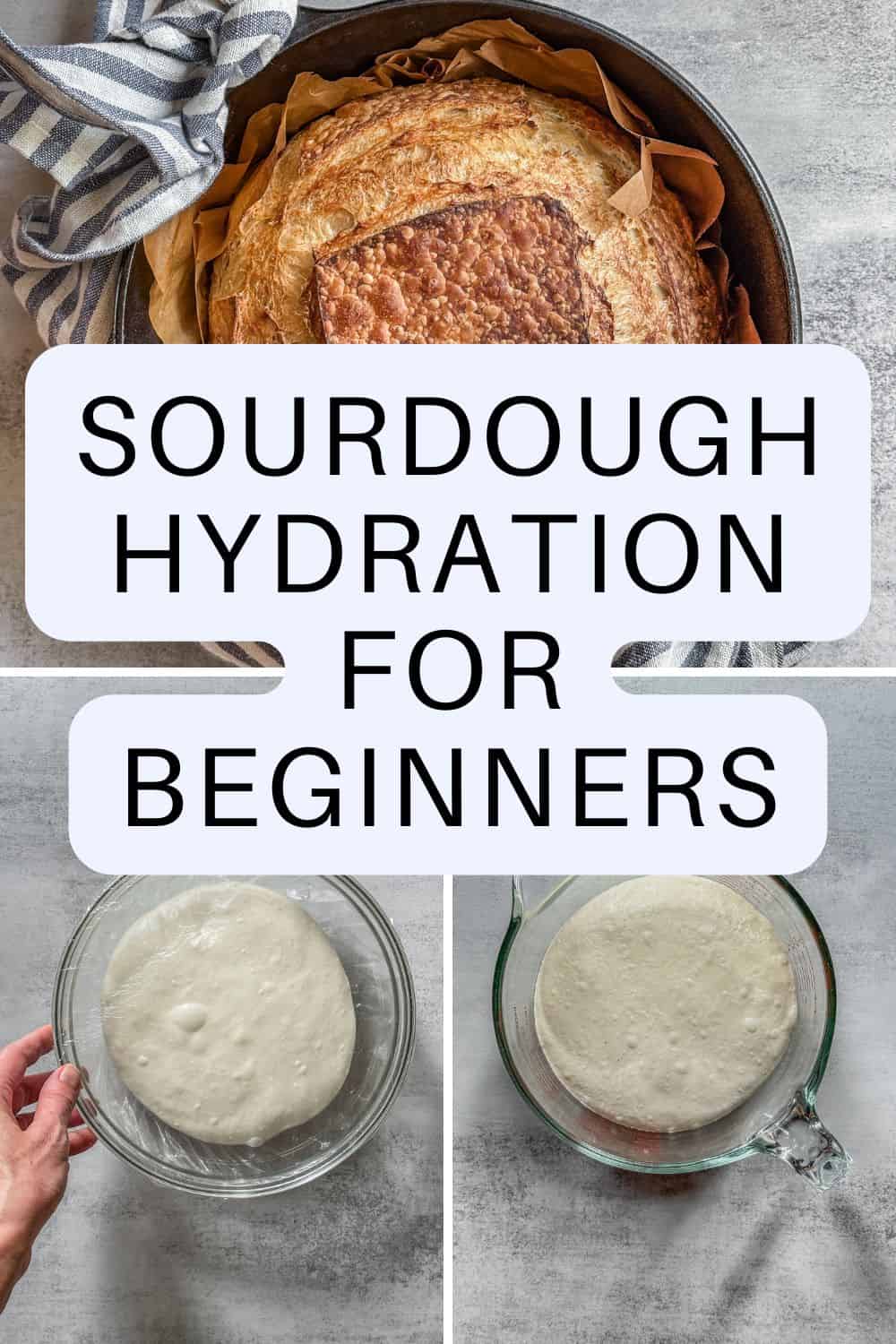

Sourdough hydration is the percentage of water relative to flour in your dough. This is a fundamental point because it affects how sticky or firm the dough feels, the crumb texture, the crust, and the overall flavor and taste of your bread.
I will show you how to calculate dough hydration, but you do not have to do the math yourself. Try using my sourdough calculator, which accounts for the starter for you.
What is sourdough hydration?
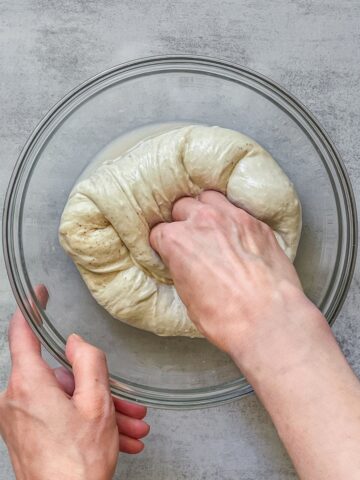
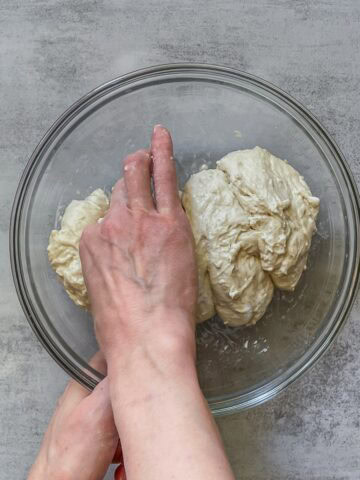
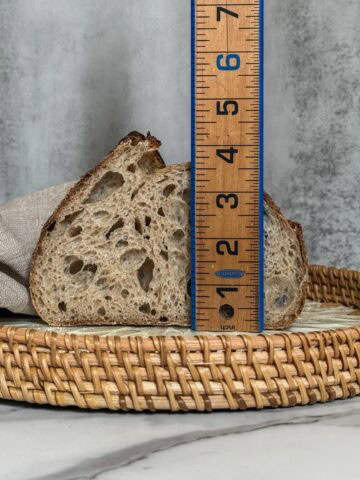
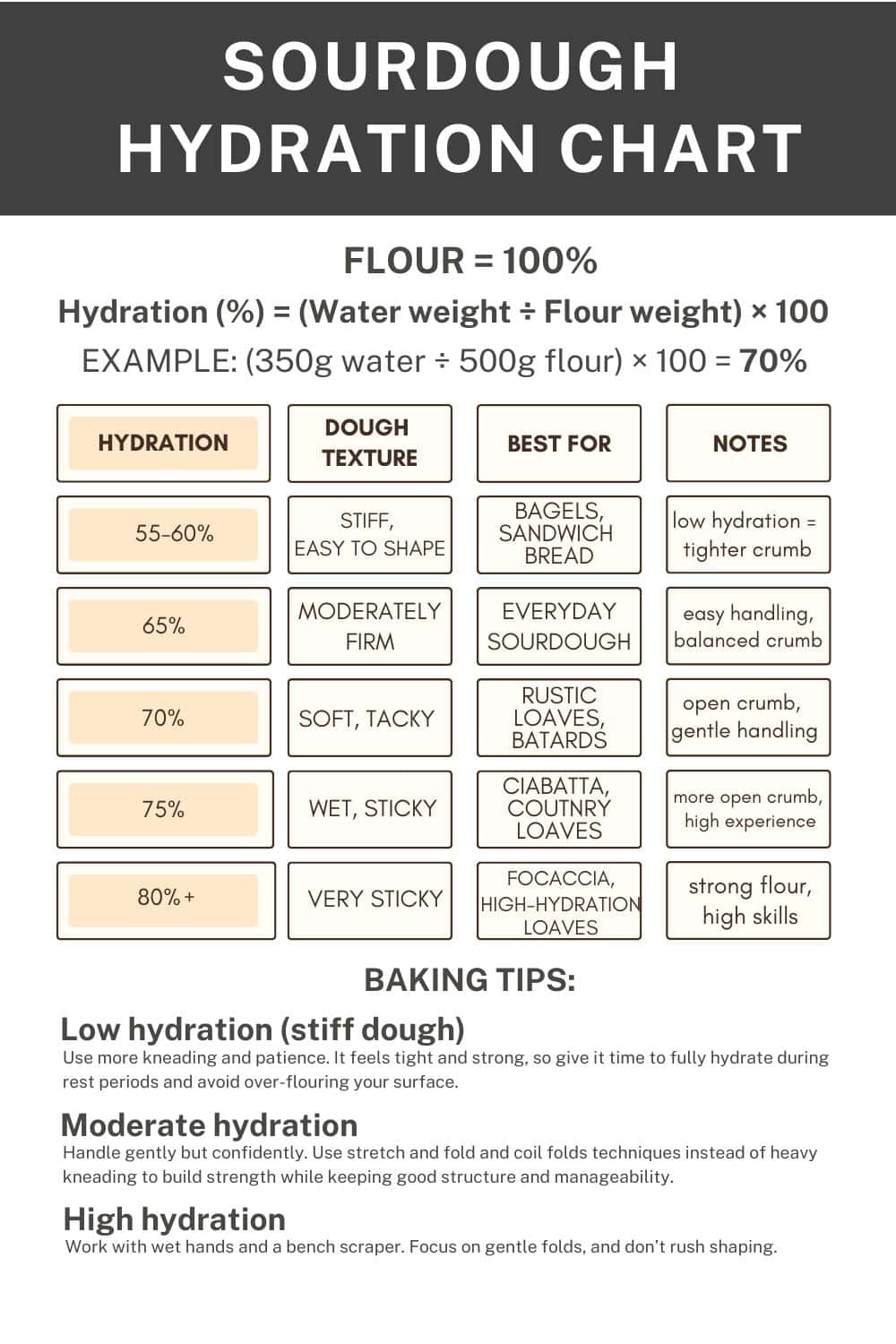
Sourdough hydration is the ratio of water to flour in your dough, usually expressed as a percentage. Higher hydration makes a wetter, stickier dough with bigger holes in the crumb, while lower hydration gives a firmer dough with a tighter crumb.
How to calculate sourdough hydration
The formula for sourdough hydration is simple: divide the water weight by the flour weight, then multiply by 100.
Sourdough Hydration = (Water Weight ÷ Flour Weight) x 100
For example, if your recipe uses 500 grams of flour and 375 grams of water, you calculate the hydration like this:
(375 ÷ 500 ) x 100 = 75. This means your dough has 75% hydration.
What if you know the hydration percentage and need to figure out the water amount? Just flip the formula around:
Water Weight = (Flour Weight x Sourdough Hydration) ÷ 100
Let's say you have 500 grams of flour and want an 80% hydration dough. Here is the calculation:
(500 x 80) ÷ 100 = 400, meaning 80% hydration requires 400g of water for a 500g flour bread recipe.
Learning this formula is like learning the ABCs of sourdough. It helps you follow recipes accurately and adjust them to your liking.
Should you include the starter in the sourdough hydration?
There are two ways to calculate sourdough hydration:
- Simpler method: The levain or active starter is listed as the percentage of total flour weight.
- More precise method: The levain/active starter is listed as a percentage of pre-fermented flour (PPF).
How does listing the preferment as the percentage of total flour weight affect the actual hydration percentage?
Here is an example. Imagine you are using this recipe:
- 500g Bread flour
- 70% Water
- 20% Levain
- 2% Salt
Using the simpler method, 70% hydration means 350g of water. The 20% levain adds 100g. A 100% hydration levain is made with 50g of flour and 50g of water.
Adding everything together:
- Total water = 350g (recipe) + 50g (levain) = 400g.
- Total flour = 500g (recipe) + 50g (levain) = 550g.
The actual hydration is (400 ÷ 550) x 100 = 72.7%, which is slightly higher than the recipe's stated 70%.
How does listing the preferment as the percentage of pre-fermented flour (PPF) affect the actual hydration percentage?
Here is an example recipe:
- 500g Bread flour
- 70% Water
- 10% PPF
- 2% Salt
To figure out the PPF, multiply the total flour by 10% (0.10):
500 x 0.10 = 50g PPF.
A 100% hydration levain is made with equal parts flour and water. So, these 50g of PPF are made up of:
- 50g flour
- 50g water
Now, let's calculate the final dough mix:
- Flour: 500g total flour - 50g from the levain = 450g.
- Water: 350g total water - 50g from the levain = 300g.
- Levain: 100g (50g flour + 50g water).
- Salt: 10g (2% of 500g flour).
The total flour is still 500g (450g from the recipe + 50g from the levain), and the total water is 350g (300g from the recipe + 50g from the levain).
When we calculate hydration:
(350 ÷ 500) x 100 = 70%.
This shows that the hydration percentage remains unchanged when using the PPF method. Both methods (the simpler one and the PPF method) can help you calculate hydration, so it is up to you which one to use.
Why and how to adjust hydration levels
Sometimes, you might need to tweak the hydration in your dough. Here are some reasons why:
- Flour type: Whole grain flours, such as whole wheat or rye, contain more bran and germ than refined flours, so you need to increase the hydration for these flours. On the other hand, all-purpose flour absorbs less water than bread flour, so you might need to lower the hydration.
- Humidity: On humid days, flour can absorb water from the air, making the dough stickier. You must adjust the hydration level by reducing the amount of water in your recipe to make the dough easier to handle.
- Skill level: Beginners often find it easier to work with dough with 68-70% hydration. As you gain experience, you can try higher hydration levels.
Finding the right hydration level for your dough is like finding your rhythm in sourdough baking. If a lower hydration works well for you, there is no need to change it.
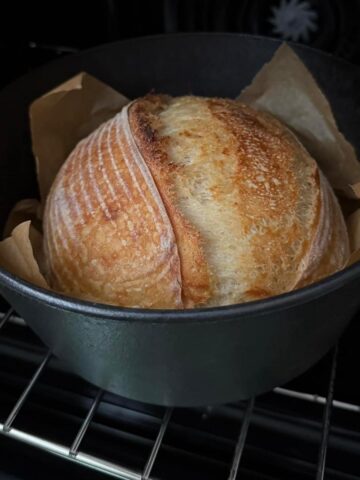
But if you want to explore the benefits of higher hydration, like big air pockets in the crumb and a golden, crackly crust, give it a try. Increase your dough hydration by just 1-2% at a time, and observe the changes. Take it slow, and don't rush.
If you are a beginner, start with a lower hydration level first. Get comfortable with my Beginner's Sourdough Bread recipe, then gradually experiment with higher hydration.
Let's talk sourdough
What is your current go-to sourdough hydration? And when you first started baking, what hydration did you begin with? Share your experience in the comments.
Ready to keep learning?
Once you understand hydration, explore high- vs. low-hydration dough. This will help you adjust your recipes for texture, crumb, and ease of handling.