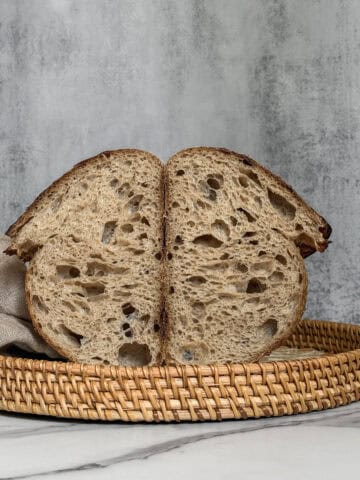

Quick Summary: Cold oven sourdough means placing your dough in an unheated oven, then turning it on, so the bread heats up gradually with the oven. It works, but results depend heavily on your bakeware: a graniteware roaster gives excellent oven spring, while a cold Dutch oven produces less spring because its thick walls heat slowly.
Energy savings are minimal (around 6 cents per bake), so cold baking is more about convenience and safety than saving money. For the strongest oven spring, a preheated vessel still wins, but for an easy, hands-off bake, cold starting works well.
I first discovered cold oven baking through Elaine Boddy, author of The Sourdough Whisperer. According to Elaine, the method saves energy and produces excellent oven spring.
But is it really worth it? Rather than take the claims at face value, I looked into them, calculating the actual energy savings and comparing oven spring across different bakeware.
And if you decide to give it a try, print my Sourdough Baking Log to track each bake and compare your results.
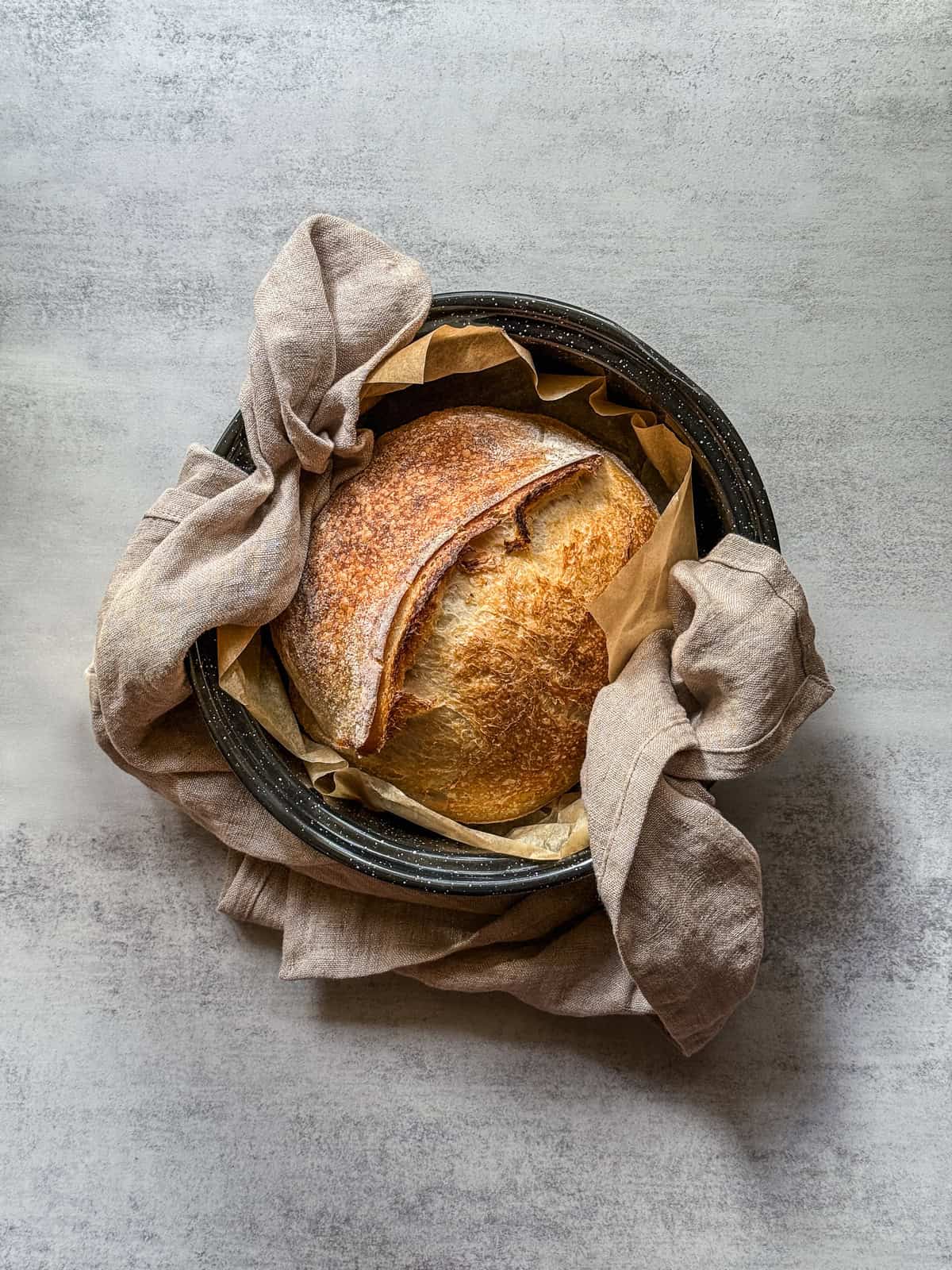
What is cold oven sourdough?
Cold oven sourdough, also called the cold bake or cold oven start method, means placing your dough into an unheated oven and then turning it on, rather than preheating first. The bread heats up gradually as the oven comes to temperature, instead of hitting a blast of heat right away.
This is different from the traditional method, where you preheat your oven (and often your Dutch oven) to a high temperature before the dough goes in. With the cold oven method, there is no preheating. You load the cold dough into the cold oven, set the temperature, and let it heat together.
The promise: Energy savings and oven spring
The main selling points of cold oven sourdough are energy efficiency and the potential for a strong oven spring.
The logic goes like this: preheating your oven to 500°F (260°C) takes extra time and electricity (or gas). By skipping that step, you save energy and reduce your carbon footprint.
It sounds great, but let's see what really happens when you bake sourdough in a cold oven.
Regular bake vs. cold bake: What's the difference?
In a regular sourdough bake, you preheat your oven to 500°F (260°C) for 30 minutes, then bake the bread at 450°F (230°C) for about 40 minutes. With preheating time included, your oven is running for roughly 70 minutes in total.
This method gives your loaf a beautiful golden crust and strong oven spring (the kind that makes your bread rise tall and proud!).
Cold baking works differently. Instead of preheating, you place your dough in a cold oven, set it to 450°F (230°C), and let the oven heat up while the bread bakes.
Because the oven warms gradually, the loaf bakes more slowly, usually taking about 45 to 50 minutes. If you want a darker crust, you might need to add another 10 minutes of baking time.
What's the result? The loaf might turn out a bit paler (but you can always bake it a few extra minutes) and may have slightly less oven spring, and that is completely normal.
Still, for some bakers, the trade-off is worth it. There is no preheat wait, less fuss, and potentially a small energy savings. But as you will see, the time and energy differences aren't as big as they first appear.
The pros of cold oven baking
- No waiting for preheat: You save time and simplify your baking routine. Just pop your dough in, turn on the oven, and go do your laundry or other chores.
- Less energy used up front: By skipping the preheat stage, you save a little electricity or gas.
- Great for small ovens: If your oven heats up quickly, cold baking is surprisingly efficient.
- Gentler on your bakeware: Cold starts help extend the life of enamel-coated pans that aren't meant to be preheated empty.
- Hands-off simplicity: You don't need to lower your dough into a hot Dutch oven, keep an eye on the timer to adjust the temperature, or remove the lid halfway through baking. Just set it, walk away, and come back to a perfectly baked loaf.
The cons of cold bake sourdough
- Less oven spring: Without that initial blast of heat, the dough doesn't expand as quickly, resulting in a less oven spring.
- Paler crust: The bread may not brown as deeply unless you extend the bake time with the lid off.
- Longer baking time: You may end up baking for 10 minutes more, offsetting any energy saved.
- Inconsistent results: Depending on your oven type, heat-up speed, and pan material, results vary widely.
Does it actually save energy?
A regular bake takes 30 minutes of preheating at 500°F (260°C) and 40 minutes of baking at 450°F (230°C), for a total of 70 minutes in the oven.
Cold oven start method takes 45-50 minutes without preheating, so it is about the same total time.
So, while you skip the preheating step, the oven stays on for nearly as long, but in a different way. The energy savings are minimal, maybe about 10 minutes.
If we put that into dollars, a typical electric oven uses around 2 kW. Saving 10 minutes of oven time equals roughly 0.33 kWh, which at an average U.S. electricity rate of $0.188/kWh (as of 2026, though rates vary by state) comes out to about 6 cents per bake.
Which bakeware works best for cold oven baking?
This is the most important factor in cold-bake results, and where my testing showed the biggest difference. Not all bakeware behaves the same when it starts cold.
- Graniteware roasters: excellent. A graniteware roaster gave me oven spring just as good as baking in a preheated Dutch oven. Its thin walls heat quickly, so the dough still gets a strong burst of heat as the oven warms.
- Clay pots: excellent. Clay pots are actually meant to start cold (preheating can crack them), so they are a natural fit for cold baking.
- Dutch ovens: reduced spring. A cast-iron Dutch oven has thick, heavy walls that heat slowly. Starting cold, the dough doesn't get the rapid initial blast of heat that traps gases and drives oven spring, so you will likely see a shorter rise.
So, if you are using a graniteware roaster or clay pot, cold baking works beautifully, no need to preheat. If you are using a Dutch oven and want maximum oven spring, preheating still gives better results.
How to bake sourdough in a cold oven
One of the nicest things about the cold oven method is that it is simpler and safer than working with a screaming-hot Dutch oven, but the vessel still gets very hot by the end, so you will want oven mitts on hand. Here is how to do it, step by step.
- Prepare and score your dough: Take your proofed, chilled dough from the fridge, place it on a piece of parchment paper, and score it. Chilled dough is firmer and easier to score, and it holds its shape better as the oven warms.
- Place the dough in your baking vessel: Lower the parchment and dough into a baking vessel of your choice (a graniteware roaster, clay pot, or Dutch oven).
- Cover and place it in the cold oven: Put the lid on and set the covered pot into the cold, unheated oven. There is no preheating, the pot goes in cold, with the dough.
- Turn on the oven and bake. Set the oven to 450°F (230°C) and bake for about 45-50 minutes with the lid on. The dough and vessel heat up together as the oven comes to temperature.
- Uncover for a deeper crust (optional). Using oven mitts, carefully remove the hot lid (it will be extremely hot by now) and bake for another 5-10 minutes to deepen the crust color.
- Remove and cool. When baking is done, use oven mitts to take the hot vessel out of the oven, then lift the loaf out (using the parchment or a sling) and place it on a cooling rack. Let it cool completely before slicing.
Is cold oven sourdough worth it? My honest takeaway
Cold oven sourdough is a smart idea, and yes, it does work. However, in most home kitchens, the energy savings are minimal, and the results will vary from loaf to loaf.
If you enjoy experimenting, it is absolutely worth trying. Cold-start baking can simplify your process and give a slightly gentler rise and a softer crust, which some bakers actually prefer.
If you bake often and already know your oven well, it is worth doing a side-by-side test: bake one loaf from a cold oven and another from a preheated oven. The comparison will tell you far more than any chart.
Overall, the cold oven method is more about convenience and workflow than significant energy savings, though every bit still helps.
It can also be a practical option for busy home bakers, especially when handling a very hot Dutch oven around small children may feel challenging or unsafe.
So, if your main goal is maximum oven spring and an open crumb, a traditional preheated oven still tends to give the strongest results.
FAQ
Does cold oven baking reduce oven spring? It depends on your bakeware. In a fast-heating vessel like a graniteware roaster or clay pot, oven spring stays strong. In a heavy Dutch oven that heats slowly from cold, you will usually get less oven spring than with preheating.
Does cold oven sourdough actually save energy? Only a little. Because the oven runs longer to bake (about 45-50 minutes versus 40 minutes plus preheating), the total energy use is similar, with savings of roughly 6 cents per bake. The bigger benefits are convenience and safety, not cost.
Will my dough spread in a cold oven before it sets? It can spread slightly as the oven warms, but a well-proofed, cold dough (proofed in the fridge) holds its shape and then rises as it bakes. Proofing in the fridge firms up the dough and reduces spreading.
Can you bake sourdough in a cold Dutch oven? Yes, but expect less oven spring than preheating gives, because the thick walls heat slowly. If you use a Dutch oven, cold baking works, it just won't rise as tall.
What temperature do you use for cold oven sourdough? Set the oven to 450°F (230°C) and bake for about 45-50 minutes with the lid on, adding 5-10 minutes uncovered for a deeper crust. There is no separate preheat.
PrintRecipe
Cold Bake Sourdough Bread

Cold bake sourdough bread is baked in a cold oven for a thicker crust, beautiful oven spring, and a more relaxed baking routine. Perfect for home bakers who want to bake artisan bread with less stress and more flexibility.
- Prep Time: 20 hours, 40 minutes
- Cook Time: 50 minutes
- Total Time: 21 hours, 20 minutes
- Yield: 12 slices 1x
- Method: Baking
- Cuisine: American
Ingredients
For the levain (an active starter):
- 35 g sourdough starter
- 35 g bread flour
- 35 g water
For the bread dough:
- 500 g bread flour (I use King Arthur organic bread flour)
- 375 g water (75% hydration)
- 100 g levain (active starter at peak)
- 10 g fine sea salt (I use Redmond ancient fine sea salt)
10 g white rice flour (for dusting)
Instructions
- Make a levain (an active starter): Feed your starter in the morning at a 1:1:1 ratio (35 g starter, 35 g flour, and 35 g water), and wait 4-6 hours for it to peak.
- Fermentolyse: In a mixing bowl, combine 355 g of water (set the remaining 20 g aside for the next step) with 100 g of levain (active starter), and mix. Add 500 g of bread flour by hand and mix for 2-3 minutes until a shaggy mass forms. Cover the bowl with a clean kitchen towel and let it rest at room temperature for 30 minutes. Bulk fermentation starts when the starter is added.
- Add salt: Sprinkle salt over the dough, then pour in 20 g of water (this water you saved from the fermentolyse step). Mix the dough for 5-10 minutes.
- Bulk fermentation: Perform two sets of stretch and folds and two sets of coil folds with 30-minute intervals. Cover the dough during these resting periods. Continue bulk fermentation until the dough reaches a slightly domed top, has large bubbles on the surface and smaller bubbles on the sides of the container, pulls easily from the sides, and jiggles when shaken.
- Preshape and shape: Preshape the dough into a round. Cover it with a clean tea towel or leave it uncovered for 15 minutes. Shape the dough as a boule or batard. Place the shaped dough into the prepared banneton, seam side up.
- Proof: Cover the dough with a towel or plastic bag and refrigerate at 39°F (4°C) overnight, or for at least 8-10 hours.
- Score: Remove the dough from the fridge. Flip it out of the banneton onto a piece of parchment paper. Using a sharp bread lame, score the dough.
- Bake the bread: Transfer the dough to a baking vessel (Granite Ware roaster or a Dutch oven), cover with the lid, and place it on the middle rack of a cold oven. Set the oven to 450°F (230°C) and bake for about 45-50 minutes with the lid on. Remove the lid and bake for an additional 5-10 minutes for a deeper crust color (optional). Using the oven mitts, remove the baking vessel from the oven. Carefully remove the bread and let it cool on a wire rack for at least 2 hours before slicing.
Notes
- Refer to my Beginner's Sourdough Bread recipe for step-by-step instructions and photos.
- Safety tip: Always use oven mitts or silicone gloves when handling a hot pan.
- Check for doneness: Use a digital probe thermometer to check the internal temperature of bread. It should reach 205-210°F (96-99°C). I usually aim for 207°F (97°C) or higher.
- Storage and freezing: Store sourdough bread at room temperature for 3-5 days. Freeze for up to 3 months. Thaw at room temperature. Freeze individual slices for up to 1-2 weeks, a whole loaf for 1-2 months.
- Want to create a custom formula for your loaf? Try my sourdough calculator.
- Need help getting started? Check out my beginner's sourdough bread guide to learn sourdough basics first.
- Note: Nutritional information doesn't include the white rice flour used for dusting.
Nutrition
- Serving Size: 1 slice
- Calories: 167
- Sugar: 0.1g
- Sodium: 325mg
- Fat: 0.5g
- Saturated Fat: 0.1g
- Carbohydrates: 35g
- Fiber: 1.2g
- Protein: 4.7g
- Cholesterol: 0mg