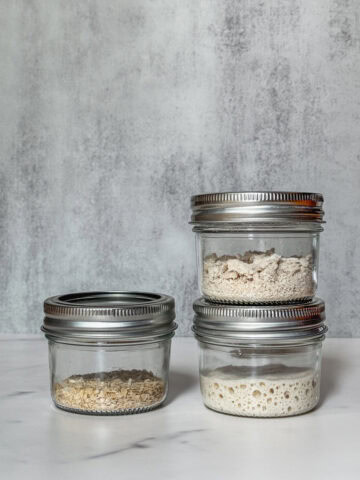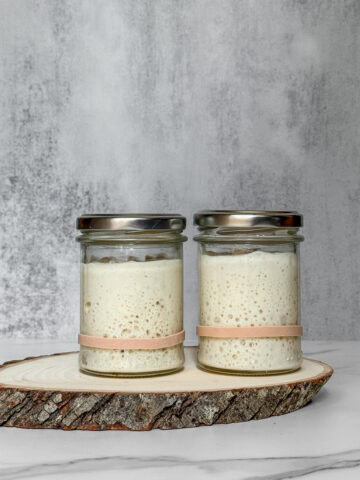


Quick Summary: A sourdough starter is the living culture you maintain long-term, feeding it regularly to keep it alive. A levain is a portion of that starter, freshly fed and built specifically for one bake, then used up entirely in the dough. In short, the starter is ongoing, and the levain is made fresh for a single loaf. In most recipes, you can use a ripe, active starter and a levain interchangeably in the same amount.
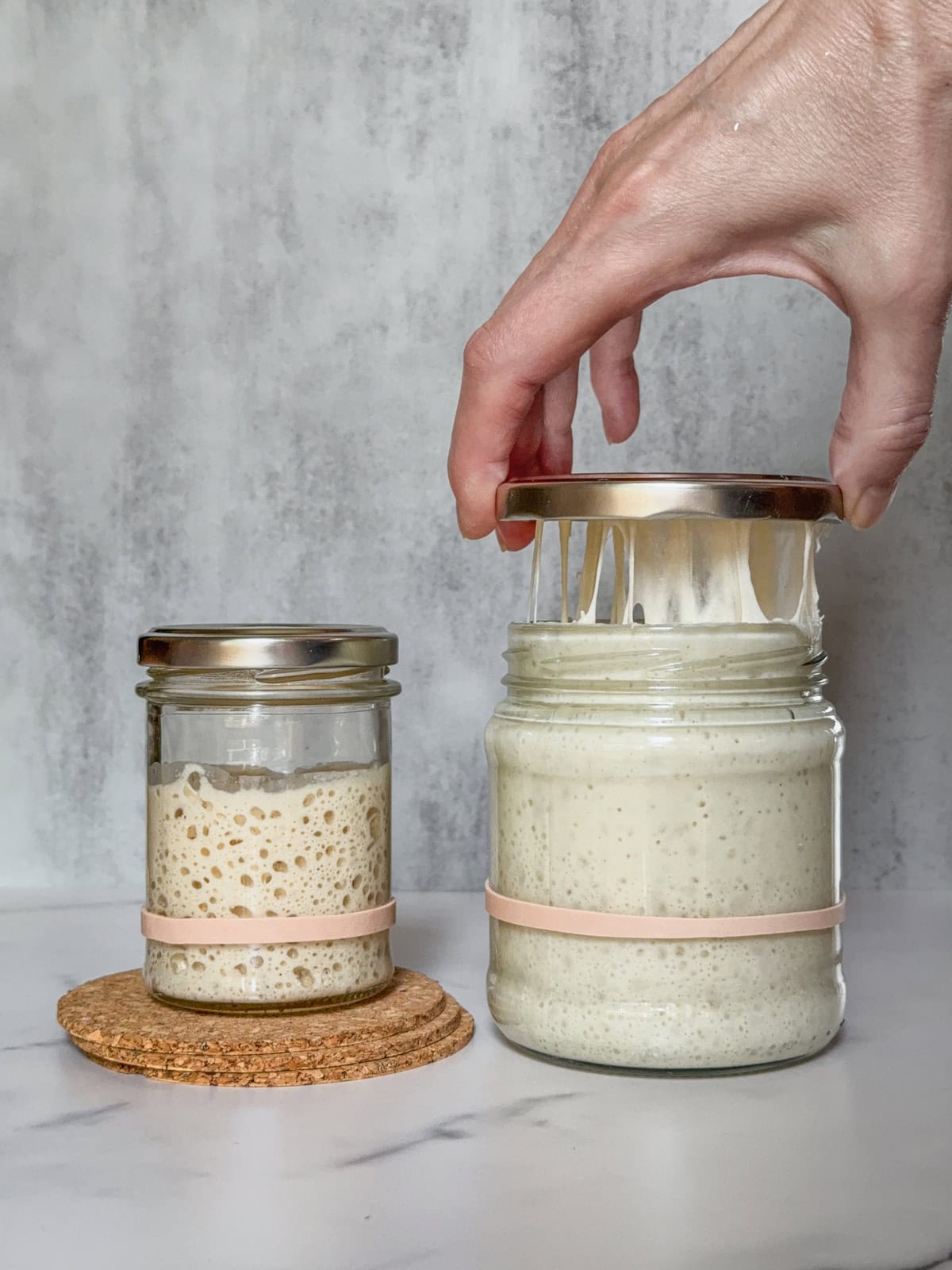
What is a sourdough starter?
A sourdough starter is a live culture of wild yeast and friendly bacteria made by mixing flour and water.
To keep it healthy, you need to feed it regularly, which means discarding some of the starter and adding fresh flour and water. A well-maintained starter can stay alive for years, even decades.
This culture is what gives sourdough bread its ability to rise and its unique tangy flavor and chewy texture.
What is a levain?
A levain (sometimes spelled leaven) is a mixture of flour, water, and a portion of the ripe starter that is taken and fed before being used in a bread recipe. The word "levain" comes from the French verb se lever, meaning "to rise."
When it is time to bake, make levain by mixing a specific amount of starter with new flour and water. It ferments at room temperature until it becomes bubbly and active.
How are they different?
Both sourdough starter and levain are types of "preferment." They are prepared in advance, left to ferment, and used to make bread dough. Despite their similarities, they serve different purposes:
- Timing: The starter is a long-term culture that you keep alive on your counter or in the fridge. Levain is a one-time mixture you prepare just for a specific bake.
- Size: A starter is kept small to minimize waste, while levain is made in larger quantities to meet a recipe's needs.
- Maintenance: The starter needs regular feedings, while levain is made fresh every time you bake, so no long-term care is involved.
- Flavor: The starter typically uses the same type of flour, creating a consistent flavor. Levain can be made with different flours, such as whole wheat or rye, allowing you to experiment with new flavors and textures.
Here is a table summarizing the differences between starter and levain:
| Sourdough Starter | Levain | |
| Purpose | Long-term culture you maintain | Built fresh for a specific bake |
| Lifespan | Continuous (years/decades) | One-time use |
| Discard | Has discard when fed | No discard |
| Flour | Usually the same flour | Can use different flours |
| Used up? | Never fully used | Used up entirely in one bake |
| Maintenance | Regular feeding needed | No ongoing care |
Note: You build the necessary amount of levain for a recipe, potentially resulting in a small excess of levain (a few grams).
Examples of using a levain
Suppose you keep a small starter of just 5 grams, feeding it daily with 20 grams each of flour and water to create 45 grams of ripe starter. This is not enough for a recipe requiring 100 grams of starter.
To make more, you can build a levain. For example:
- Mix 10 grams of starter with 55 grams each of flour and water to create 120 grams of levain, perfect for one loaf of bread.
- If you need enough for two loaves, mix 18 grams of starter with 108 grams each of flour and water to make 234 grams of levain.
- Are you baking for a crowd? Combine 60 grams of starter with 600 grams each of flour and water to make 1,260 grams of levain, enough for about 12 loaves.
To simplify calculations, use my sourdough calculator and learn how to scale up sourdough starter.
To make a single loaf, you can speed up the process by feeding 35 grams of starter with equal parts flour and water (35 grams each) and fermenting it in a warm spot for 4-6 hours. This quick method creates enough levain for my Beginner's Sourdough Bread recipe.
FAQ
Is levain the same as sourdough starter? Not exactly. A levain is a fresh, active build made from your sourdough starter for a specific bake. The starter is the long-term culture you maintain. They are closely related, and many bakers use the terms interchangeably, but technically, they serve different purposes.
Can I use starter and levain interchangeably? In most recipes, yes, a ripe, active starter can replace levain in the same amount, and vice versa. Just remember to keep some starter back to maintain your culture.
Why do recipes call for levain instead of just using the starter? Building a levain lets you make the exact amount you need for a bake without using up your whole starter, and lets you tailor the flour and flavor to that specific loaf.
How much levain should you use in sourdough bread? Most recipes suggest about 20% levain, but the range can vary from 10% to 30% depending on the recipe (see my guide on how much sourdough starter to use).
Can you change a levain recipe? Yes, you can adjust the levain recipe to suit your preferences or experiment with different flours and flavors.
Let's talk sourdough
Did you know the difference between a starter and levain before reading this article? For many, it is quite the eye-opener.
Ready to keep learning?
With the basics in hand, it is time to learn the language of sourdough. Check out the sourdough glossary to learn the most common terms and abbreviations.