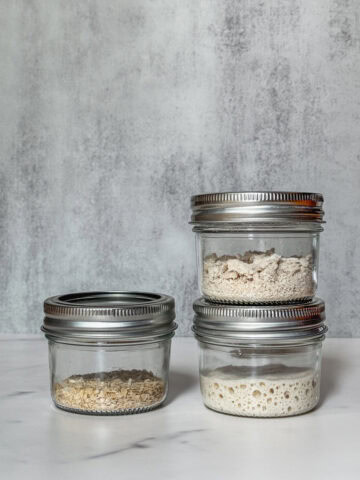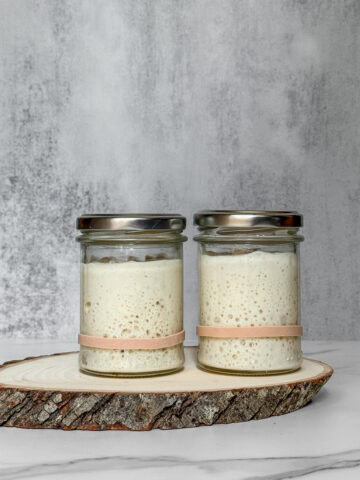

Let's talk about how to scale up a sourdough starter or levain to bake multiple loaves of bread. With the right method, you can apply similar techniques to make enough for 100 loaves, though the process for larger batches needs other adjustments.
Check out the no-discard starter maintenance method if you want to bake two to four loaves. It is a great way to increase your starter without wasting any of it.
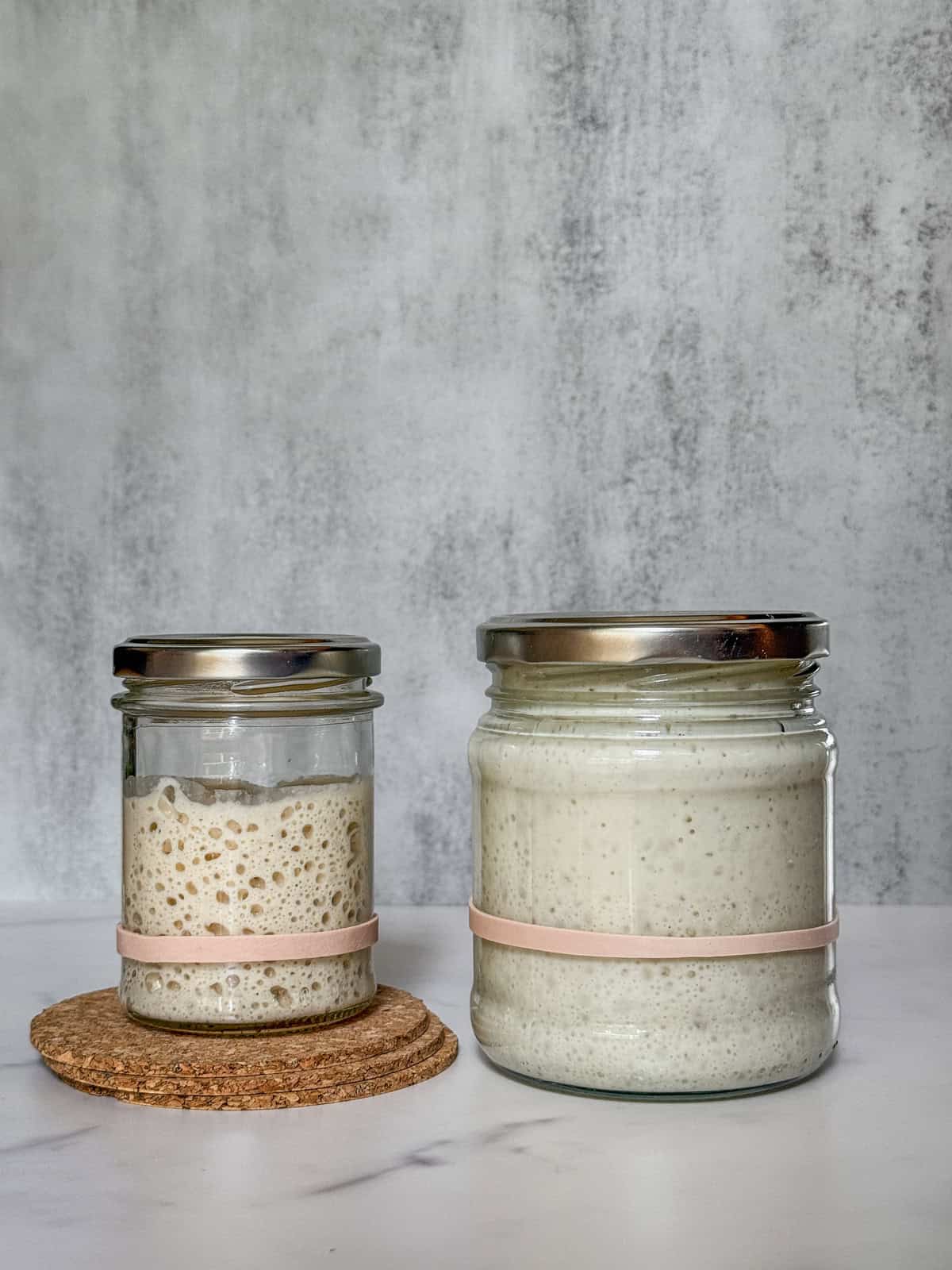
Ways to increase your sourdough starter
You can scale up your sourdough starter in two simple ways:
- Build a levain in a separate jar (best for larger builds). This is the safest approach because you won't risk using up your entire mother starter. It also makes it easier to control the timing and activity.
- Scale up directly in your main starter jar. This method keeps cleanup minimal. Just be sure to always leave 10-20 g of your mother starter in the jar so you never lose your original culture.
Basic terms to know
- Mother starter/seed: The starter you maintain.
- Levain: The portion you build for a specific bake. Here is how to make levain.
- Hydration (%): water ÷ flour × 100. All the examples here use a 100% hydration starter (equal water and flour).
- Feeding ratio: The proportion of starter, flour, and water used when you feed your culture. For example, a 1:1:1 feeding ratio means 1 part starter, 1 part flour, 1 part water. Read more about sourdough starter feeding ratios.
- Time to peak: The amount of time it takes for your starter or levain to rise to its highest point, called the sourdough starter peak.
To learn more terms and abbreviations, take a look at the blog post all about the sourdough glossary.
How long does it take for your starter to peak?
When you feed your sourdough starter, it grows until it peaks and becomes most active.
To plan your sourdough baking schedule, you need to know how long this takes at different feeding ratios. In other words, you need to learn your starter's times to peak.
I recommend using a sourdough starter feeding log to track each feeding and the time it peaks. The time between feeding and peak is your starter's 'time to peak' for that specific feeding ratio and room temperature.
According to Hendrik from The Bread Code, the average estimated time for the starter to peak at 77°F (25°C) depends on the feeding ratio:
| Ratio | Estimated Time to Peak |
| 1:1:1 | 5-6 hours |
| 1:2:2 | 7 hours |
| 1:3:3 | 8-9 hours |
| 1:4:4 | 10 hours |
| 1:5:5 | 11-12 hours |
As you experiment with feeding ratios, use the same type of flour and water, and maintain consistent ambient conditions. A ratio that peaks overnight is especially helpful, as it lets you sleep a full night and wake up to a perfectly peaked starter.
Consider investing in a Goldie starter warmer or a Brod & Taylor Sourdough Home for even better control. These devices can keep your starter at an ideal temperature range of 75-78°F (24-25°C), making it easy to create the table above.
With Goldie and Sourdough Home, you can rely on a consistent feed-to-peak time every time you bake.
How to scale up sourdough starter
Scaling up sourdough starter or levain comes down to one easy formula. If your feeding ratio is
Starter : Water : Flour = 1 : x : y, then the total number of parts is 1 + x + y.
To build levain (a final amount of active starter for baking), let's call it D:
- Levain = D ÷ (1 + x + y)
- Water = x × Starter
- Flour = y × Starter
Here is a quick example using a 1:1:1 ratio:
- Total parts: 1+1+1 = 3
- Starter = D ÷ 3
- Water = D ÷ 3
- Flour = D ÷ 3
That is it. Once you understand this simple breakdown, you can scale your starter to any size you need.
Examples: How to build a specific amount of starter
Let's look at a few real-life examples to see how the math works in practice. Make sure you are making levain separately and keep the mother starter untouched.
Example #1: Building levain (the same day)
- Decide how much levain you need to build. For example, if I want to make 2 loaves at once with a single recipe that requires 100g of starter at 100% hydration, I will need 2 x 100 = 200g of levain (active starter).
- Determine the feeding ratio. To mix bread dough and ferment it the same day, use a low ratio (1:1:1 to 1:2:2) for speed levain building. For instance, I am using a 1:1:1 ratio.
- Use the scaling formula (see above): In my example, for a 1:1:1 feeding ratio, there are 3 total parts: 1 + 1 + 1 = 3.
- Calculate the amount of ingredients needed: In my example, to make 200 g of levain using a 1:1:1 feeding ratio, first add up the total parts: 1 (starter) + 1 (flour) + 1 (water) = 3 parts. Divide your target weight, 200 g, by 3 to find the weight of one part: 66.6 g. I will need 67 g of starter, 67 g of water, and 67 g of flour.
This calculation works if you already have 67 g of starter (separate from your mother starter) and want to build your levain the same day using a 1:1:1 feeding ratio.
If you don't have that exact amount, you will need to build the levain overnight to reach your target.
Example #2: Building levain (overnight)
- Decide how much levain you need to build. For example, if I want to make 2 loaves at once with a single recipe that requires 100g of starter at 100% hydration, I will need 2 x 100 = 200g of levain (active starter).
- Choose the time you want to start mixing the dough. For example, I want to start at 7 AM tomorrow.
- Determine the feeding ratio based on your starter's time to peak. For example, if my starter reaches its peak in about 10 hours using a 1:6:6 feeding ratio,I will want to feed it around 10 PM to have it perfectly ready by 7 AM the next morning.
- Use the scaling formula (see above): In my example, for a 1:6:6 feeding ratio, there are 3 total parts: 1 + 6 + 6 = 13.
- Calculate the amount of ingredients needed: In my example, to make 200 g of levain using a 1:6:6 feeding ratio, first add up the total parts: 1 (starter) + 6 (flour) + 6 (water) = 13 parts. Divide your target weight, 200 g, by 13 to find the weight of one part: 15.4 g. Then multiply each component by its ratio: 1 part starter = 16 g, 6 parts flour = 96 g, and 6 parts water = 96 g.
As a result, mixing 16 g of starter with 96 g of flour and 96 g of water yields 208 g of levain, enough for baking two loaves of bread.
Example #3: Building a large amount of levain (bakery-style)
Even just 10-20 g of starter is enough to gradually build a big batch of levain when you stage the feedings. This method is my personal favorite. It allows you to increase the starter slowly over a day or two, reducing stress on both the starter and the baker compared with one massive feeding.
- Decide how much levain you need to build. For example, I want to make 12 loaves at once with a single recipe that requires 100g of starter at 100% hydration, so that I will need 20 x 100 = 1200g of starter.
- Check how much starter you have in a jar (separately from the mother starter; remember to feed your mother starter on its own). For example, I have 15g of starter to build levain.
- Choose the time you want to start mixing the dough. For example, I want to start at 7 AM tomorrow.
- Plan ahead: To build a large levain (e.g., 1,200 g), you will need two feedings. Start with a smaller feed in the morning to grow the starter, then follow with a larger feed in the evening. This second build will be ready to mix into your bread dough the next morning.
- Calculate the SECOND feeding ratio: Let's say my starter peaks in about 10 hours when fed at a 1:6:6 ratio. Using the scaling formula, first calculate the total number of "parts" for the ingredients: 1 + 6 + 6 = 13. Next, divide the levain amount by the total number of parts: 1200 ÷ 13 = 92.3 g. This means that if I feed 93 g of starter at a 1:6:6 ratio, I will end up with roughly 1209 g of levain, ready by 7 AM. To hit this timing, I would feed it at 10 pm.
But I only have 10 g of starter, not 92 g. So I need to build up to 92 g in the morning so it will be ready for the 10 PM feeding.
- Calculate the FIRST feeding ratio: To build the 92 g starter, I will use my regular 1:4:4 feeding ratio, which peaks in about 8 hours. Again, calculate the total parts: 1 + 4 + 4 = 9. Then divide the target amount of starter by the total parts: 92 ÷ 9 = 10.2 g. This means that if I feed 11 g of starter at a 1:4:4 ratio, I'll get roughly 99 g of active starter. To have it ready for the second feeding at 10 PM, I would feed it at 2 PM.
- Determine a suitable timeline for your baking: In this example, I want to build 1200 g of levain from just 11 g of starter (I have 15 g on hand) through two feedings, so it is ready by 7 AM the next day. I will feed the starter in two stages. First feeding (afternoon, around 2 PM): 11g of starter, 44 g flour, 44 g water (1:4:4 ratio). Second feeding (evening, around 10 PM): 92 g of starter, 552 g flour, 552 g water (1:6:6 ratio). Following this schedule, the levain will peak in the early morning, ready to be mixed into your dough by 7 AM.
Ready-to-use templates
To make the calculation process simpler, here are templates you can apply to any quantity:
Simple 1:1:1 build:
Divide the final amount by 3.
The result is the amount of your starter, flour, and water (equal parts).
Two-stage build (when you don't have much starter):
Start with a 1:3:3 or 1:4:4 feeding in the morning/afternoon.
Then take what you need and finish with a larger feeding (e.g., 1:6:6 or higher) to reach the final weight overnight.
"Grow then Top-Off" Method:
First grow: Start by building your starter to a larger quantity (200-1,000 g) using a generous feed.
Top-Off: Do a final 1:1:1 feeding to reach the exact amount needed for your recipe.
Expert tips:
- Plan to scale up your starter ahead of time to have time to build in gradually.
- Build 10% more levain than required to account for the loss during transfer of the jar.
- Round the numbers to whole values.
- Build the levain separately from the mother starter.
- Choose a sourdough starter jar that is 3 times the volume of the levain required.
- Mark the starting level with a rubber band so you can track the rise.
- Mix thoroughly so that the flour hydrates well.
- Use a digital kitchen scale for accuracy.
- Keep the starter in a warm environment if you need it to peak faster.
How to use the excess starter
Once you have scaled up, you might end up with more starter than you need. Here are some ideas for using the extra:
- Bake an extra loaf or two.
- Use the excess in discard recipes, such as pancakes or crackers.
- Save it for next week's baking (if you don't mind using the starter from the fridge to make the Unloaf sourdough bread).
Let's talk sourdough
Have you tried making more than one loaf of bread? If so, how hard was the calculation for the starter amount? Please share your experience in the comments.
Ready to keep learning?
Now that your recipe scaling is set, decide on your mixing method. Discover the difference between hand-mixed sourdough and mixer-mixed dough for optimal gluten development.