
Quick Summary: Yes, in most cases, you should cover the dough while it proofs to prevent it from drying out and forming a skin. For a short room-temperature rise, use a clean tea towel.
For a long, cold proof in the fridge, cover it loosely (a towel, a reusable cover, or a container) to keep it from drying. So, leaving it uncovered won't ruin your bread. The dry skin just becomes the base of the loaf. Proofing in the oven (off, light on) follows the same rule: cover it to prevent drying.
Whether to cover the dough during proofing comes down to preventing it from drying out. Covering the dough helps in almost every situation, whether it is proofing at room temperature, in the refrigerator, or in a turned-off oven. Even if the dough is left uncovered, it can still bake into a good loaf.
Below, I will cover each situation, including the cold retard method I use most.
Should you cover the dough in the fridge?
Covering sourdough during final proofing in the fridge helps prevent it from drying out or forming a crusty skin. It retains moisture, so the dough stays soft and hydrated as it ferments slowly.
But what if you decide not to cover the dough during cold proofing? Leaving it uncovered can cause a thin, dry layer to form on the surface, but it won't ruin your bread.
When you turn the dough out of the basket to bake, the dry layer becomes the base of the loaf, which will still bake into a delicious loaf.
Many bakers, including me, have tried leaving the dough uncovered during cold proofing and still got great results with perfect crusts and soft crumbs, even when baking over 100 loaves at once, like in Cottage Food businesses.
Ways to cover dough during final proofing
There are several ways to cover the dough during cold proofing, but the material you use matters.
- Plastic bags or shower caps are popular options, but they sometimes cause problems. Condensation builds up inside the plastic, making the dough stick to it. The warmth trapped inside the plastic also leads to overproofing. In addition, plastic is not the best option for being eco-friendly.
- Clean tea towels or banneton liners are a better option. These materials keep the dough's surface moist and support balanced fermentation. As a beginner, you can use flour sack towels. There is no need to invest in specialized sourdough baking equipment yet. If you are proofing in a basket, here is how to use a banneton properly.
- Another interesting option is disposable non-woven liners resembling hairnets. You can use the edges of the liner to cover the dough, allowing the surface to dry just a little. This won't affect the quality of baked bread, but make sure that the liner is food-safe.
As you can see, there is no one-size-fits-all answer to whether to cover or not cover sourdough. Each fridge has its own unique microclimate, which can impact the dough in various ways.
In the end, it is your choice. Both methods work well, so try them out and see which one you like.
Should you cover dough proofing in the oven?
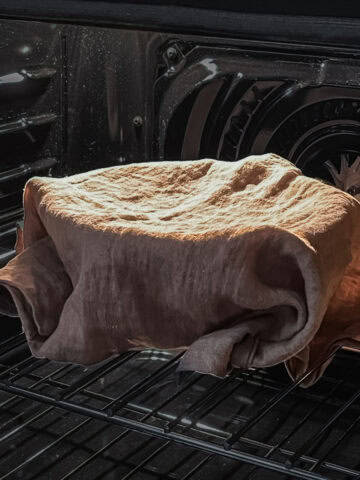
If you proof in a turned-off oven (with just the light on for warmth), cover the dough with a tea towel so the dry oven air doesn't form a skin.
Don't use plastic near any heat source. If you are using the oven simply as a draft-free place to proof, keep the dough covered to prevent it from drying out.
If your kitchen runs cold, see how to proof dough in a cold kitchen for more warm spots that work.
FAQ
Should you cover bread dough while it rises? Yes, covering keeps the surface from drying into a skin. A clean, damp-proof tea towel is the simplest cover for a room-temperature rise.
Do you cover the dough when proofing in the oven? Yes. Even with the oven off, the air can still dry the surface, so cover the dough with a tea towel. Never use plastic wrap near heat.
What happens if you don't cover the dough when proofing? A thin, dry skin forms on top. It won't ruin the loaf. When you turn the dough out to bake, that skin becomes the base. Many bakers proof uncovered with great results.
What does proofing mean in sourdough? Proofing is the final rise after shaping, when the shaped dough ferments and expands before baking. It can happen at room temperature or in the fridge (a cold-proof).
Let's talk sourdough
Do you cover your dough while proofing, or let it rest uncovered? How has it affected your loaves? Share your experience in the comments.
Ready to keep learning?
The next step is knowing when proofing is complete. Learn how to tell if the dough is proofed by noticing its volume, texture, and how it responds to the poke test.