
Quick Summary: To tell if your dough is proofed, use the poke test: lightly flour a finger and press about ½ inch into the dough. If the dent springs back slowly and only partially, it is perfectly proofed and ready to bake. If it springs back fast, it needs more time (underproofed). If the dent stays and doesn't spring back, it is overproofed, so bake it right away.
The poke test works for room-temperature proofing. For cold-proofed dough from the fridge, the test isn't reliable. There, dough rise during bulk fermentation is your guide.
Below, I will walk through the signs for each method, how to read dough proofed on the counter, and how cold-proofed dough behaves differently.
What happens during proofing?
When you proof sourdough, the dough essentially rests while the yeast and lactic acid bacteria (LAB) continue working.
During final proofing on the countertop, the yeast continues to produce carbon dioxide, causing the dough to rise. During cold proofing in the fridge, the yeast slows its activity, while lactic acid bacteria continue acid production.
Whether warm or cold, final proofing is the last stage of dough fermentation before scoring and baking. During this time, the dough develops its final structure and flavor. Proper proofing is key to baking a delicious loaf with a perfect crumb and crust.
Signs of well-proofed dough on the counter
When proofing dough at room temperature, a warm environment helps the dough rise more quickly. Here are the key signs that your dough is proofed:
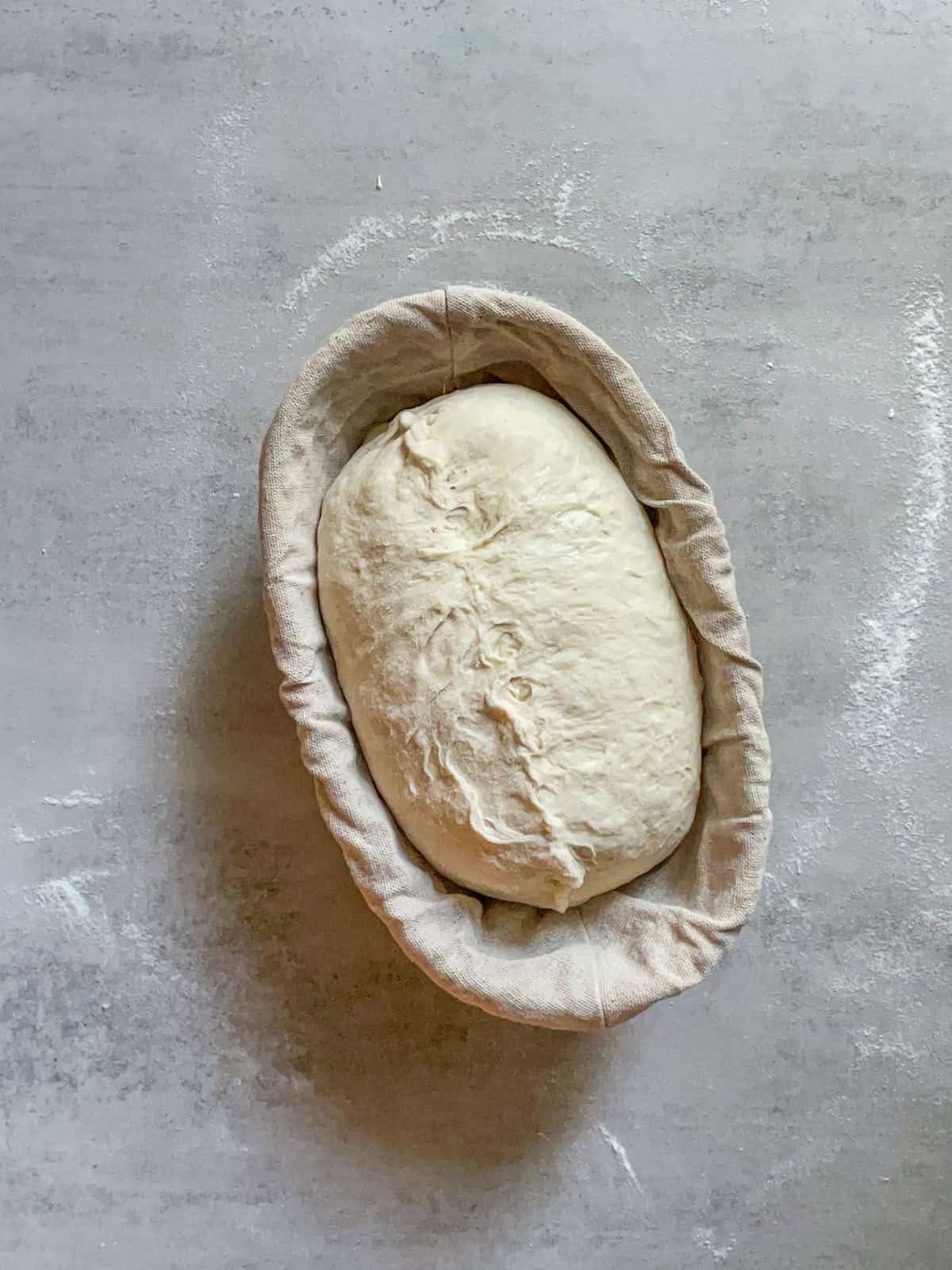
- The dough has risen in size: A well-proofed dough will have doubled in size by the end of proofing. If you shape your dough after a 30% rise during bulk fermentation, the remaining 70% will rise in the banneton. If you shape it at 50%, it will raise the remaining 50%, and so on. The total rise will always add up to 100%.
In the end, it takes practice and intuition to recognize how much the dough has risen in the banneton. Use this sign in combination with the "poke test."
- The dough looks relaxed: As it rises, it will appear soft and relaxed, gently filling the banneton's shape.
- The dough passes the poke test: Gently press the floured finger into the dough. If it springs back slowly and leaves a small dent, your dough is ready for baking.
What is the poke test?
The poke test is an easy way to check whether your dough is ready to bake during countertop proofing. You lightly flour a finger, gently press it into the dough, and watch how it springs back.
| Proof level | Poke test result | What you will see |
| Underproofed | Springs back quickly | Tight, dense, very elastic |
| Properly proofed | Springs back slowly and only partway | Relaxed, soft, airy, but cohesive |
| Overproofed | Dent stays, doesn't spring back | Slack, over-relaxed, spreads out |
- If the dough springs back slowly and only partially, your dough is perfectly proofed and ready to bake. The gluten has relaxed, and the dough is holding just the right amount of gas.
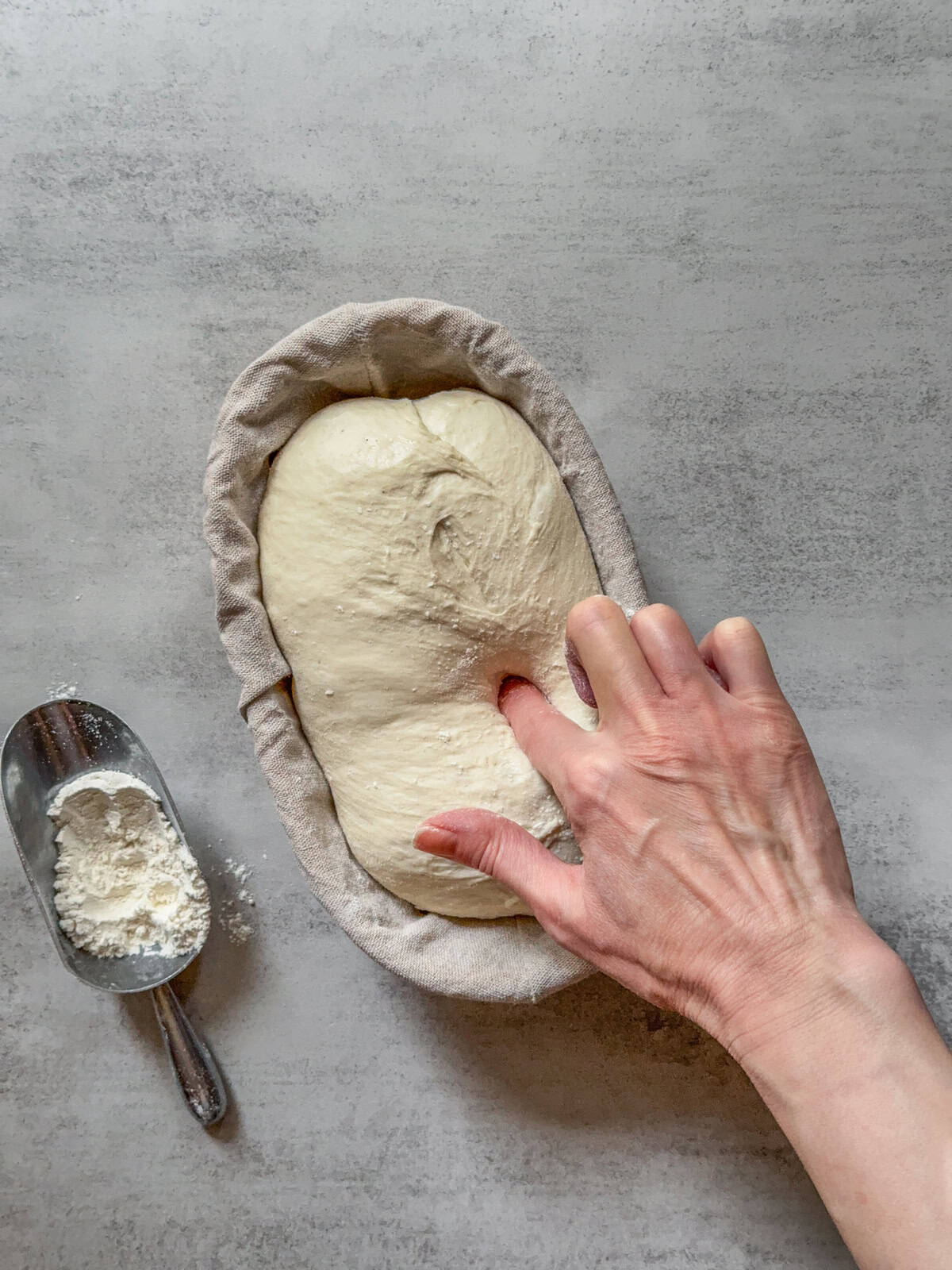
Checking the dough using the poke test with a finger.
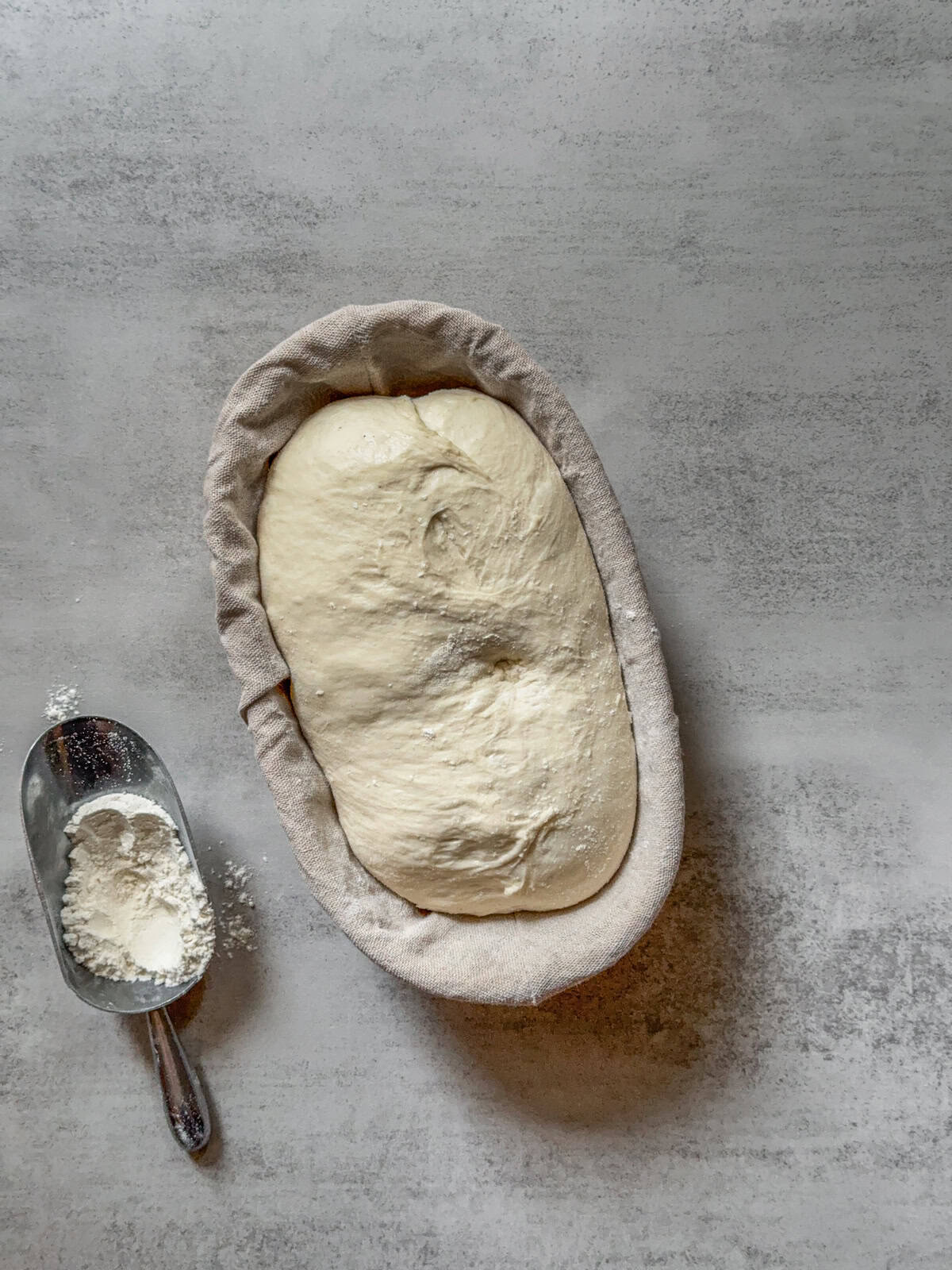
The dough springs back slowly and only partially, indicating it is perfectly proofed.
- If the dough bounces back quickly, the dough is underproofed and needs more time to rise. It is still tight and elastic, meaning the gluten hasn't relaxed enough yet.
- If the dough stays and doesn't spring back, it is overproofed and should be baked right away. This happens because the dough has lost its strength, and the gas that once kept it airy has escaped.
If you prefer proofing on the counter, keep practicing the poke test. The more you poke your dough, the better you will learn to recognize that perfect readiness.
When the poke test doesn't work
The poke test is helpful, but it isn't foolproof. A few doughs give misleading results:
- Cold dough from the fridge: Cold dough is firm and springs back quickly, which can look underproofed even when it is ready. Don't rely on the poke test straight from the fridge.
- High-hydration dough: Very wet dough is more extensible and less elastic, so it may spring back slowly even when it isn't fully proofed. The dent can look "done" early.
- Whole-grain or low-gluten dough: Doughs with lots of whole wheat, rye, or einkorn have weaker gluten, so they spring back sluggishly and can read as more proofed than they actually are.
Signs the dough is proofed after refrigeration
When you proof sourdough in the fridge, the low temperature slows fermentation (for the full method, see my guide to cold proofing sourdough).
According to Tom Cucuzza, depending on the dough temperature at the end of bulk fermentation, it takes about 10 hours for the dough to cool to 39°F (4°C) in the fridge.
Telling if your dough is fully proofed after cold proofing relies more on knowledge and experience. If you have mastered bulk fermentation and understand when it is finished based on dough temperature and percentage rise, you will know when to move the dough to the fridge.
The key to knowing when the dough is fully proofed is to finish bulk fermentation in time and move it to the fridge. With the refrigerator set to 39°F (4°C), the dough will usually be fully proofed in 8-10 hours.
Unlike proofing at room temperature, there are no clear visual or textural changes to guide you. Let me explain:
- The dough doesn't rise much: It continues to ferment in the fridge, but the cold temperature causes it to contract slightly. It may increase in size slightly or stay the same.
- The dough feels firm yet soft: When you press it, it will feel firm from the cold but still soft and relaxed. However, this isn't a reliable indicator.
- Bubbles may or may not be visible: You might notice bubbles on the surface, but this depends on whether the banneton was covered during proofing. If the dough was uncovered, the top may have a light skin.
- The poke test doesn't work. Cold dough springs back quickly, misleading you to believe it is underproofed. The test is unreliable when the dough is chilled.
What happens if you get the final proofing wrong?
If you mess up the final proofing, you will end up with under- or overproofed sourdough.
Overproofed sourdough bread appears as a flat, unstructured loaf. Underproofed sourdough means the dough hasn't finished fermentation, resulting in dense bread.
It is important to find the right balance so the bread dough can rise properly and bake into a light, airy loaf.
FAQ
How do you know when sourdough is proofed? The poke test is the easiest way to tell. If the dough slowly springs back and leaves a slight indentation, it is ready to bake. It should also look puffy, relaxed, and noticeably risen. For cold-proofed dough from the fridge, the poke test isn't reliable. Instead, getting bulk fermentation right, judged by the dough's rise and temperature, is what tells you it will proof correctly in the fridge.
How can you tell if dough is overproofed? Gently press the dough with your finger. If the indentation stays and doesn't spring back, it is likely overproofed. The dough may also look slack and spread out instead of holding its shape. If this happens, bake it as soon as possible rather than letting it proof any longer.
How can you tell if dough is underproofed? If the dent springs back quickly and completely, the dough is underproofed and needs more time. It still feels tight and elastic because the gluten hasn't relaxed yet.
Does the poke test work for cold-proofed dough? No. Cold dough tends to spring back quickly, regardless of how well it is proofed, making the poke test unreliable. For cold proofing, it is better to rely on proper bulk fermentation and dough expansion instead of the poke test.
Does the poke test work during bulk fermentation? No, the poke test is for the final proof, after shaping, just before baking. During bulk fermentation, the dough is stickier and weaker, so a poke won't give the same spring-back. It is still worth feeling and watching your dough throughout bulk, but save the poke test for final proofing.
Let's talk sourdough
Do you prefer countertop or cold proofing, and why? Share your experience in the comments below.
Ready to keep learning?
Once you know how to tell if the dough is proofed, it is natural to have more questions. Check out the most common sourdough proofing FAQs to clarify common concerns bakers face.