
After reading this, you will feel excited to try different baking temperatures and times for sourdough bread. You will discover how oven heat affects oven spring and how small changes make a big difference in baking results.
I have gathered baking temperature and time variations from experienced bakers and sourdough enthusiasts to try.
Start with an oven thermometer
First, use a dial-style oven thermometer to check if the heat is the same on different oven racks. Then, use an infrared thermometer to measure the temperature of the oven walls. This is important because some ovens heat unevenly.
How often I hear that the bottom of a sourdough loaf burns, and the cause is often surprisingly simple: the oven temperature doesn't actually match what the display shows.
How baking temperature affects sourdough bread
Baking temperature affects how your sourdough bread rises and how the final crumb and crust turn out. Higher temperatures, especially around 500°F (260°C), encourage strong oven spring, but they also set the crust too quickly.
When the crust hardens before the crumb finishes expanding, the bread loses some height and develops issues like crust separation. And while crust separation can happen from excessive heat, it is also a common sign of overproofed sourdough.
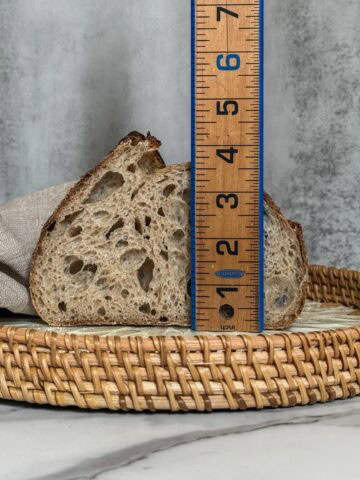
Lower temperatures give the dough more time to expand gently. This often produces a more even crumb, fewer large trapped bubbles, and a thinner, more tender crust. However, baking at too low a temperature reduces oven spring and leads to a paler loaf.
The right heat balance allows the crust to stay flexible long enough for the loaf to rise fully, while still developing good color and texture.
Small temperature changes, even 10-20 degrees, can noticeably affect the oven spring, crumb structure, and crispness of your loaf. This temperature control brings you much closer to baking perfect sourdough bread.
How long should you preheat your oven for sourdough?
Most sourdough bread recipes suggest preheating the oven to 500°F (260°C), with preheating times ranging from 20 to 60 minutes. During this time, the Dutch oven inside usually heats to a lower temperature than the oven itself.
Interestingly, some bakers have found that preheating for a shorter time, such as 25 minutes, yields the same results as preheating for an hour. Both of my staple recipes, the Beginner's Sourdough Bread and the Master Sourdough Bread, use a simple 30-minute preheat.
There is also the cold-bake sourdough method, where the dough goes straight into a cold oven with no preheating. It is definitely worth experimenting to see if you like the results. I do.
Should you preheat the Dutch oven with the lid on or separately?
Since the Dutch oven heats more slowly than the oven, you should preheat both the pot and the lid.
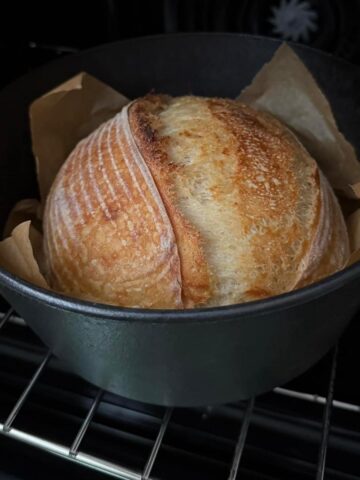
Preheating the Dutch oven with the lid on is slightly better because it provides the entire enclosed space, including the lid, with the same high temperature. This gives your dough maximum heat and steam immediately, helping with oven spring, crust formation, and even baking.
If the lid is preheated separately on the same oven rack and fully hot when placed on the pot, the difference is minimal. Both methods still produce excellent bread, but preheating the lid on the pot is the most reliable way to create a perfectly heated, humid baking environment.
How vessel material affects your bread
Your choice of baking vessel affects how your sourdough bakes. Cast iron heats aggressively and retains heat, which makes it favorable for a strong oven spring.
But if your dough is even slightly underproofed, this intense heat traps large gas bubbles under the crust, often called "fool's crumb."
Ceramic vessels like Emile Henry heat more gently and a bit more slowly, which helps prevent those oversized bubbles and encourages a smoother, more controlled oven spring.
Thin-walled enameled roasters heat more gradually. This allows the dough to continue proofing slightly after entering the oven. This leads to a more even crumb and reduces the risk of underproofing in the baked loaf.
Rack placement and lid seal are important as well. A tight-fitting lid traps steam for a better rise, while placing the vessel on the bottom rack promotes faster browning. You can play with these factors based on how your dough is proofed and the crust you want to achieve.
Sourdough baking temperatures and time variations
Heat your Dutch oven to 500°F (260°C) for 25 to 60 minutes before baking (I usually preheat for 30 minutes), then select a baking temperature and time from these expert recommendations.
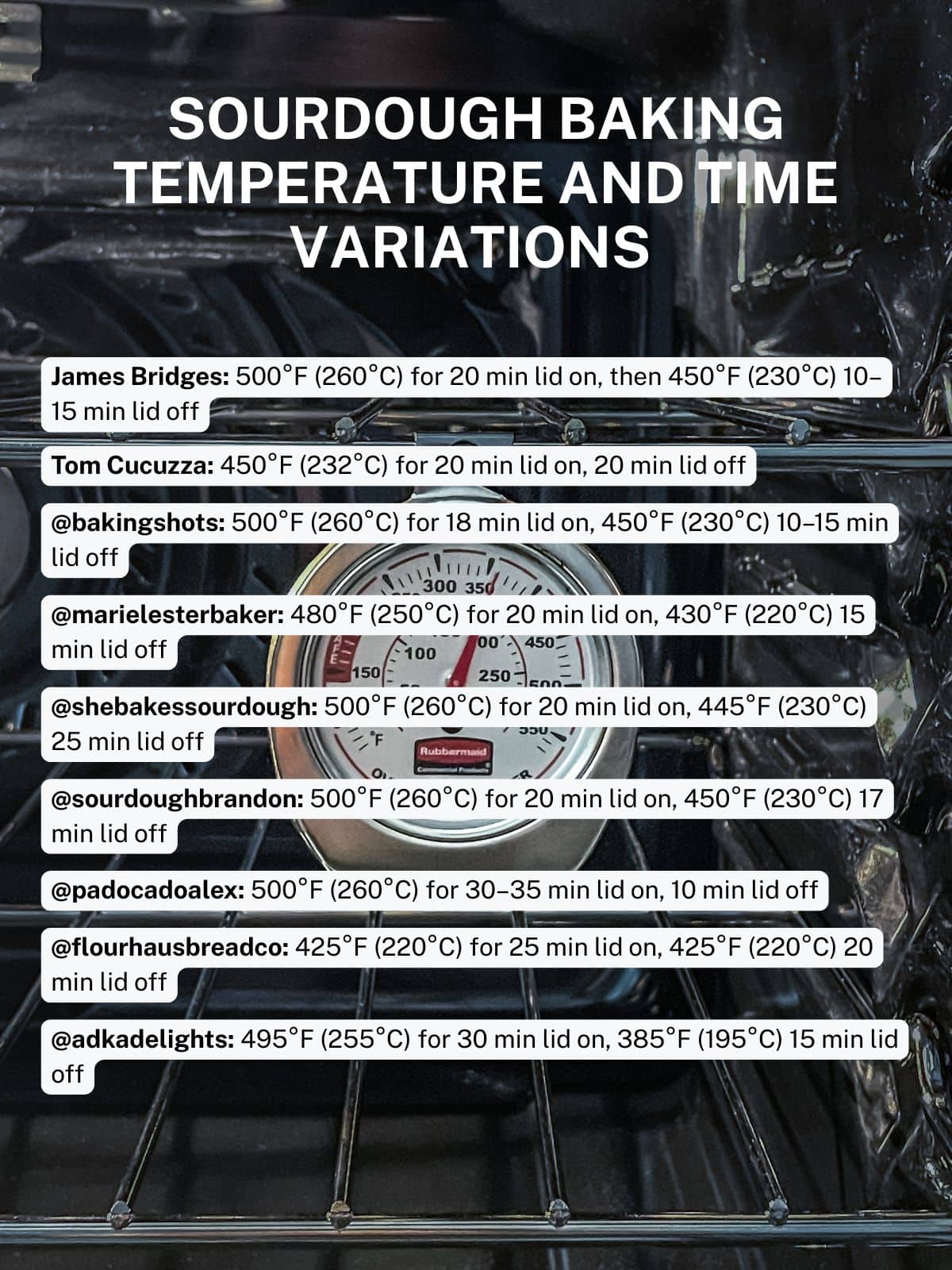
- James Bridges: Bake at 500°F (260°C) for 20 minutes with the lid on, then reduce to 450°F (230°C) for another 10-15 minutes without the lid.
- Tom Cucuzza: Bake at 450°F (232°C) for 20 minutes with the lid on and 20 minutes without the lid.
- @bakingshots: Bake at 500°F (260°C) for 18 minutes with the lid on, then at 450°F (230°C) for 10-15 minutes without the lid.
- @marielesterbaker: Bake at 480°F (250°C) for 20 minutes with the lid on, then at 430°F (220°C) for 15 minutes.
- @shebakessourdough: Bake at 500°F (260°C) for 20 minutes with the lid on, then at 445°F (230°C) for 25 minutes with the lid off.
- @sourdoughbrandon: Bake at 500°F (260°C) for 20 minutes with the lid on, then at 450°F (230°C) for 17 minutes without the lid.
- @padocadoalex: Bake at 500°F (260°C) for 30-35 minutes with the lid on and 10 minutes without the lid.
- @flourhausbreadco: Bake at 425°F (220°C) for 25 minutes with the lid on, then at 425°F (220°C) for 20 minutes without the lid.
- @adkadelights: Bake at 495°F (255°C) for 30 minutes with the lid on, then at 385°F (195°C) for 15 minutes without the lid.
How to choose the right oven temperature and baking time
You may be wondering what the best temperature and time are for baking sourdough bread.
The truth is, it depends on your oven, Dutch oven, and baking method. Even with the same recipe, the results will be different in your kitchen compared to someone else's.
Keep a baking journal to record every minor adjustment you make. This will help you improve with each loaf and learn to create bread that looks and tastes amazing.
Let's talk sourdough
Now it's your turn. What oven temperature and baking time have you tried, and were you happy with the results? Share your experiences. I'd love to hear how your sourdough experiments turned out.
Ready to keep learning?
While mastering baking temperature, you might notice the bottom of your loaves browning too quickly. Discover simple techniques to prevent the bottom of bread from burning.