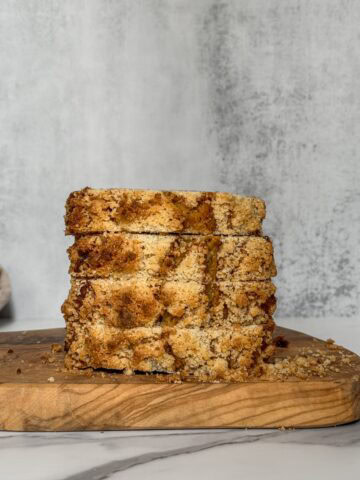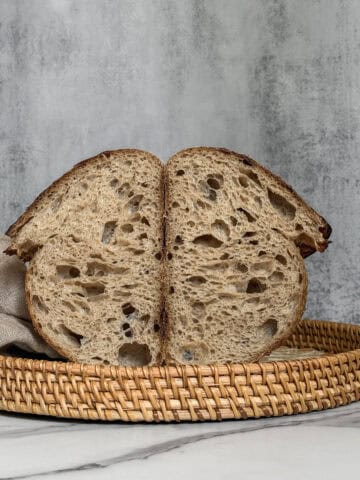

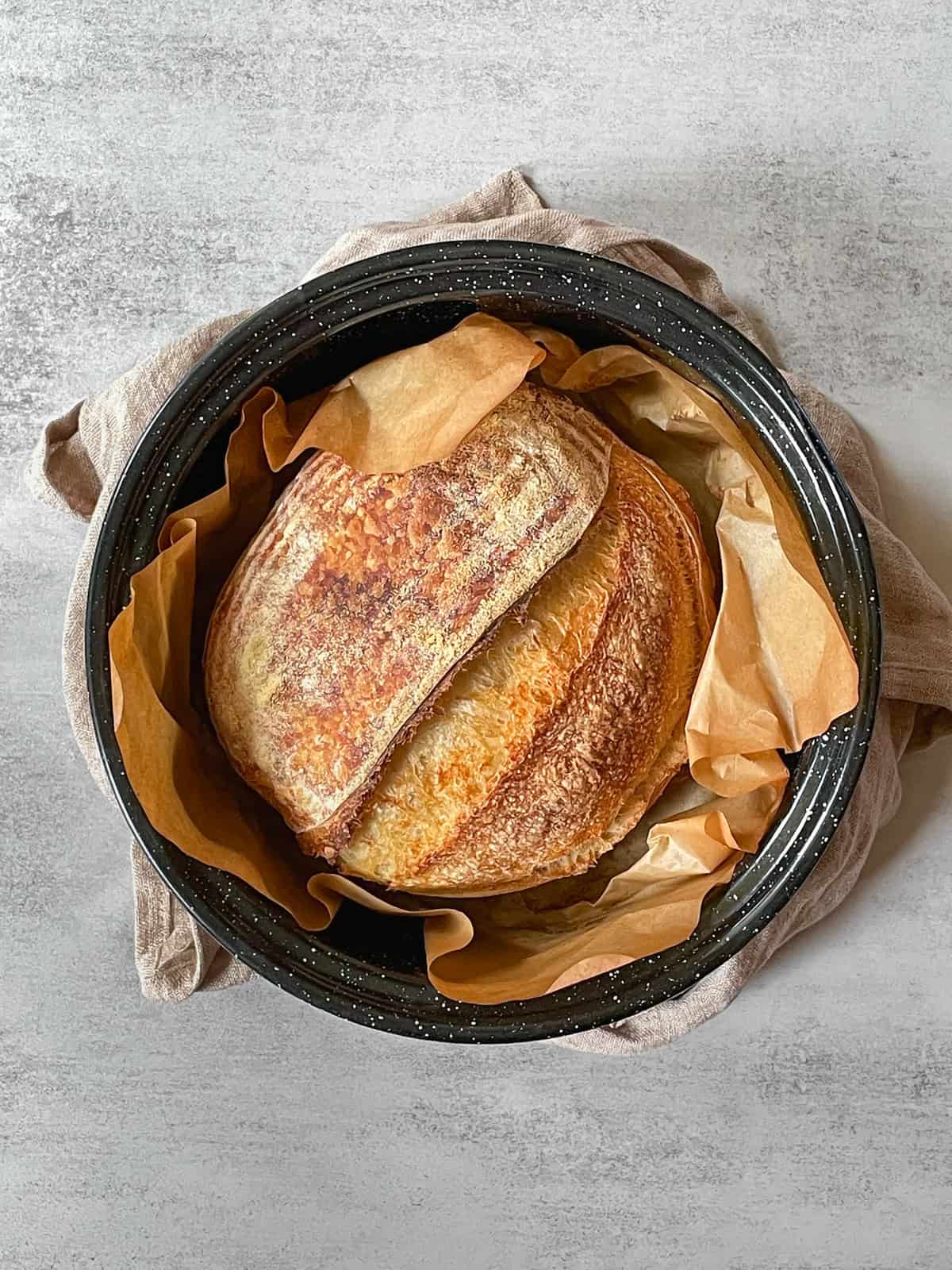
With this cheap bread recipe, you can make sourdough bread on a budget for as little as $1.20 a loaf. You do not need a fancy banneton, bread lame, or Dutch oven to make great bread.
Think about how your grandma used to bake. She didn't need fancy equipment; just her hands and some basic ingredients were all she needed.
In the end, baking sourdough doesn't have to be expensive. Find my cheap bread recipe at the end of the post.
Is it cheaper to make your own bread?
Yes! Making your own bread is cheaper than buying it at the store. A store-bought loaf of "sourdough" bread costs between $6 and $9, and true sourdough from a farmer's market can go for $15 or even more.
Believe it or not, you can bake a homemade sourdough loaf for as little as $1.20! The total cost depends on the ingredients you use, the tools you have, and your electricity rate.
While you can't control electricity prices, you can save by making two loaves at once or by baking in a cold oven using a cold bake sourdough bread method.
You can also cut costs by buying flour in bulk and picking up baking tools secondhand. Check out Facebook Marketplace or your local thrift store for a Dutch oven at a great price.
How much does homemade bread cost
Let's break down the cost of making your own bread. As for bread ingredients, such as flour, water, and salt, the price of flour can vary, so let's use an average cost.
For a recipe using 500 grams of flour, the cost of flour ranges from $0.44 to $0.53 (Power High Gluten Grain Craft Flour) or $1.50 to $1.80 (King Arthur Bread Flour).
Salt and water add only a small amount, and rice flour for dusting is inexpensive. In total, the ingredients for a homemade loaf cost about $0.60 to $1.50.
Some people worry about the cost of feeding their sourdough starter every day, but it is actually quite inexpensive.
Feeding it twice a day with organic flour costs approximately $1.20 per week or $4.80 per month. Keeping your starter in the fridge and feeding it once a week costs about $0.20 per feeding.
Electricity is another cost. Baking sourdough bread in an electric oven (25-30 minutes of preheating and 40 minutes of baking) costs about $0.48.
This estimate uses the average electricity rate in the United States, $0.16 per kilowatt-hour (kWh). You can adjust this cost using an electric oven energy calculator.
When you add up the cost of ingredients and electricity, a homemade sourdough loaf costs between $1.20 and $2.50, which is significantly cheaper than store-bought bread.
Make your own sourdough starter to save
Starting with sourdough, all you need is flour, water, salt, and a bit of curiosity. Create a sourdough starter, borrow one from a friend, ask at a local sourdough bakery, or purchase a starter online for an affordable price.
Keep the sourdough tools simple: a wooden spoon and a repurposed old jar to create and maintain your starter (this is what I do).
Buy bread ingredients on a budget
Flour, water, and salt play a big role in both the cost and quality of your sourdough bread.
It is important to use the correct type of flour. If you are new to sourdough baking, I strongly recommend starting with strong bread flour, such as King Arthur (12.7% protein) or Bob's Red Mill, which has a protein content between 12.5% and 13.5%. These flours are designed to give your bread the right texture and rise.
If bread flour is too expensive, all-purpose flour with a lower protein can be a cheaper option. If you use all-purpose flour instead of the bread flour listed in the recipe, reduce the hydration (water content) by 5%.
Buying flour in bulk, such as 10-25 lb bags, can save you money. A loaf can cost just $0.44 to $0.50, often cheaper than buying smaller 1-5 lb bags.
Unchlorinated tap or filtered water is usually fine, so there is no need to buy bottled water. You do not need anything fancy; even basic, non-iodized salt works perfectly.
Bake smarter: Use what you already have
You don't need to spend a lot on baking tools and sourdough equipment. Most of what you need, such as a mixing bowl, a wooden spoon, and an oven, is already in your kitchen.
Instead of buying a banneton, use an 8-inch mixing bowl and a clean tea towel or other proofing basket alternatives. To score the dough, use a sharp paring knife or scissors; no bread lame is needed.
To make great bread, I highly recommend two essential tools: a digital kitchen scale and a probe thermometer. These two cost about $10 each and will help you get the best results.
Other tools, like a dough whisk or a spiral mixer, make things easier, but they are not necessary. Even if you want to bake a large batch, you can mix up to 100 loaves without a fancy mixer (I know a few bakers who do this).
Before buying any new tools, consider whether you really need them. There is no rush to get everything at once. You can always upgrade your sourdough equipment later.
More ways to cut sourdough costs
You will be surprised by how much you can save with a few simple adjustments:
- Keep your starter in the fridge: If you don't bake every day, avoid feeding it daily. Store your starter in the fridge and feed it just once a week. This simple change still reduces flour waste and saves you money over time (see my guide to storing sourdough starter).
- Bake in batches: Instead of baking one loaf at a time, bake two or three, or even multiple loaves. This helps cut down on electricity costs. You can freeze the extra loaves and refresh them later to enjoy fresh-tasting bread whenever you like.
- Make smaller loaves: Bake only the amount of bread you need at a time. Small-batch sourdough is ideal for solo bakers or small households.
- Use alternative baking methods: A Dutch oven is great, but it takes a long time to preheat. Try a roasting pan or a double loaf pan method. They heat up much faster without needing to preheat in the oven. Or try a cookie sheet with an upside-down stainless steel pot to trap steam.
- Try a cold oven method: Popularized by Elaine Boddy, cold-bake sourdough skips preheating altogether. Simply place your dough in a cold oven, then turn it on. It saves time and power while still delivering great results.
- Experiment with a slow cooker: It can also be used to bake sourdough. It is a fun and energy-efficient method to try.
Ready to keep learning?
While baking your bread, you certainly wish it could stay fresh longer. Learn how to store sourdough bread with simple tips and tricks.
PrintRecipe
Cheap Sourdough Bread Recipe
With this cheap bread recipe, you can make sourdough bread on a budget, much cheaper than store-bought. No banneton or bread lame needed.
- Prep Time: 17 hours
- Cook Time: 40 minutes
- Total Time: 17 hours, 40 minutes
- Yield: 1 loaf 1x
- Method: Baking
- Cuisine: American
Ingredients
For the levain (an active starter):
- 35 g sourdough starter
- 35 g bread flour
- 35 g water
For the bread dough:
- 500 g bread flour (I use King Arthur organic bread flour)
- 350 g water (70% hydration)
- 100 g levain (active starter at peak)
- 10 g fine sea salt (I use Redmond ancient fine sea salt)
10 g white rice flour (for dusting)
Instructions
- Make a levain (an active starter): Feed the "mother" starter in the morning at a 1:1:1 ratio (35 g starter, 35 g flour, and 35 g water), and wait 4-6 hours for it to peak.
- Autolyse: Mix water and flour with your hands in a large bowl until the mixture resembles a shaggy, rough dough. Cover the bowl with plastic wrap or a damp tea towel and let it rest for 30 minutes.
- Mix the dough: Add your levain (active starter) and sea salt to the dough. Mix everything well with your hand for about 3 to 10 minutes-longer mixing builds stronger gluten. Cover again and let the dough rest for 30 minutes. Bulk fermentation starts as soon as you add the starter.
- Fold the dough: Do two sets of stretch and folds, 30 minutes apart. Then do two sets of coil folds, also 30 minutes apart. For each set, stretch the dough gently in all four directions. After each fold, check the dough temperature and write it down in your baking log. Between folds, keep the bowl covered and let the dough rest.
- Continue bulk fermentation: Allow the dough to continue fermenting. Check the dough temperature every 30 minutes. Bulk fermentation is done once the dough has reached the target percentage rise, which depends on the dough temperature. The dough should have bubbles on the surface and sides, a slightly domed edge, and a gentle jiggle when you move the bowl.
- Preshape the dough into a round and let it rest uncovered for 15-20 minutes.
- Shape the dough: Lightly dust your work surface with rice flour. Gently flip the dough out of the bowl. Shape it into a round boule. Dust an 8-inch bowl lined with a tea towel generously with rice flour. Place the shaped dough inside, seam side up. If using a loaf pan, place the dough seam side down in a lightly greased pan.
- Cold proof: Cover the bowl or tin with a towel or place it in a plastic bag. Refrigerate the dough for at least 12 hours, or up to 48 hours. The longer it chills, the tangier the flavor.
- Preheat the oven: Place your Dutch oven in the oven and preheat to 500°F (260°C) for 30 minutes. If using a roasting pan instead, simply preheat the oven-there is no need to preheat the pan.
- Score the dough: Remove the dough from the fridge and gently flip it onto parchment paper. Brush off any extra flour. Score the top of a boule with a sharp knife-a cross or a square pattern. You can use kitchen scissors to make quick snips along the top, creating mini "V" cuts.
- Bake the bread: Wearing oven mitts, place the dough into the hot Dutch oven (or a cold roasting pan if using). Cover with the lid and put it in the oven. Lower the heat to 450°F (232°C) and bake for 20 minutes. Then, remove the lid and bake for an additional 15-20 minutes until the crust is golden. To add more steam, lightly mist the dough or the Dutch oven's lid before baking.
- Cool the bread: Let your bread cool for at least 2 hours before slicing. This helps set the crumb and gives you the best texture.
Notes
- Storage and freezing: Keep your sourdough bread at room temperature for 3 to 5 days. For longer storage, freeze individual slices for up to 1-2 weeks, or freeze a whole loaf for 1-2 months.
- To bake on a baking stone: Place an empty steam pan (like a roasting pan or cast-iron skillet) on the lower rack. Preheat your oven to 500°F (260°C) with a baking stone, baking steel, or a baking sheet on the middle rack. Once preheated, bring water to a boil. Use a pizza peel to slide the dough onto the hot surface. Carefully pour about 350 ml (or 1½ to 2 cups) of boiling water into the steam pan, then quickly close the oven door. Lower the temperature to 430°F (220°C) and bake for 20 minutes. After that, remove the steam pan and bake for an additional 17-20 minutes, until the crust is nicely browned.
- Safety tip: Always use oven mitts or silicone gloves when handling hot pans. When pouring boiling water into the steam pan, wear safety goggles.
- Check for doneness: Your bread is fully baked when the internal temperature reaches 205-210°F (96-99°C). Use a digital thermometer to check.
- Need help getting started? Check out my beginner's sourdough bread guide to learn sourdough basics first.
- Note: Nutritional information does not include the white rice flour used for dusting.
Nutrition
- Calories: 2002
- Sugar: 1.5g
- Sodium: 3923mg
- Fat: 5.4g
- Saturated Fat: 0.9g
- Carbohydrates: 419.7g
- Fiber: 14.9g
- Protein: 56.8g
- Cholesterol: 0mg