

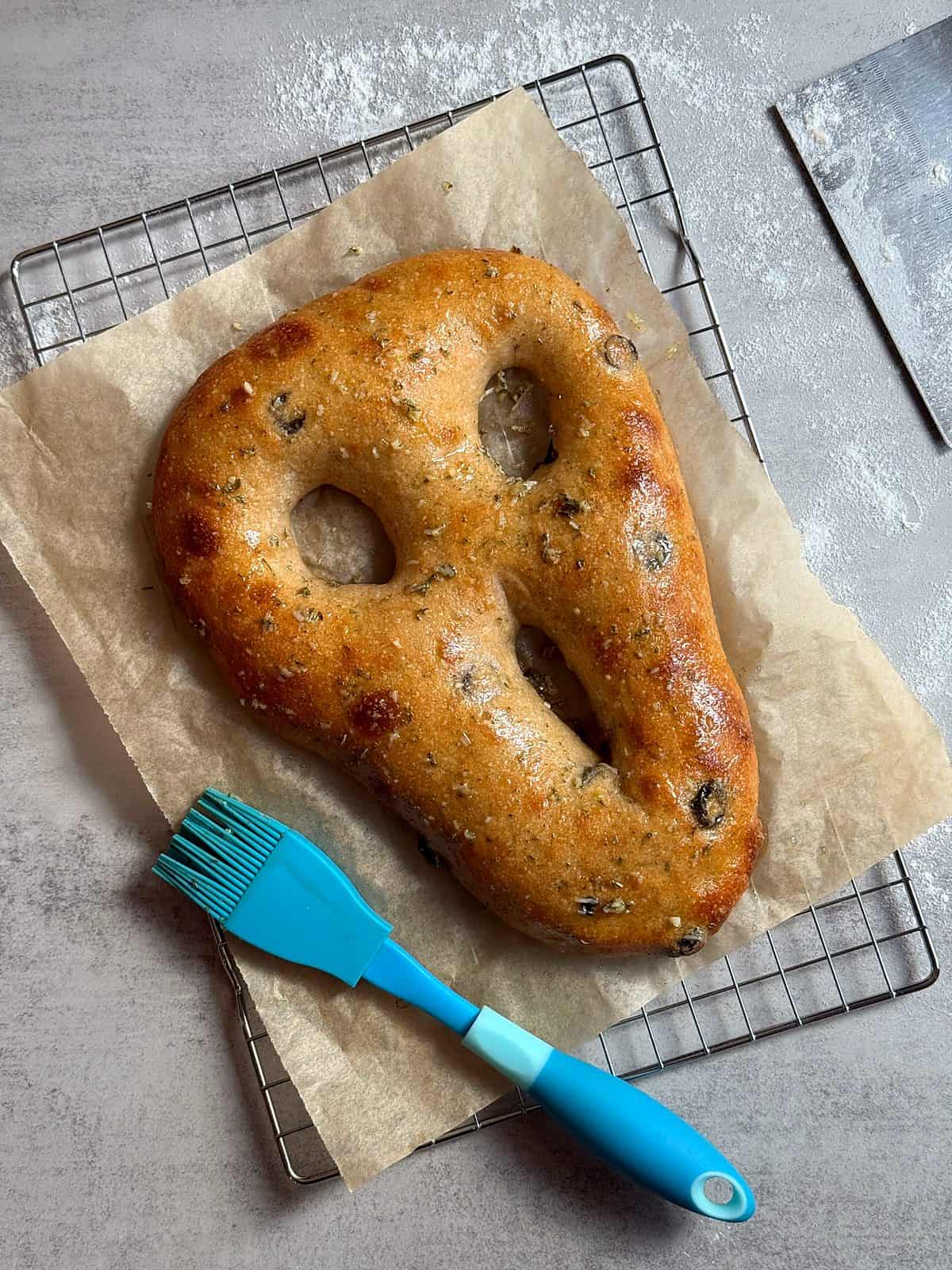
Sourdough ghost fougasse is a French leaf-shaped bread with a little Halloween twist. It has a thin, crisp crust, and the olives add a nice salty bite. Once it comes out of the oven, I brush it with olive oil, garlic, parsley, and Parmesan.
It looks a little fancy, but it's actually easy to make. Just flatten the dough, cut out two eyes and a mouth, and gently stretch the openings. That's it. It's one of my favorite breads to bring to a Halloween party!
Quick Summary
- What it is: a naturally leavened fougasse shaped like a ghost
- Flour: King Arthur bread flour with 10% Bob's Red Mill whole wheat
- Hydration: 75%
- Add-ins: Herbes de Provence and sliced black olives, folded in during lamination
- Bake: 430°F (221°C) for 20 to 25 minutes on a baking sheet
- Finish: brush with olive oil mixed with garlic, parsley, and Parmesan right out of the oven
- Yield: 2 ghost fougasses
Note: This dough is 75% hydration, so it is soft but manageable. If you are new to sourdough, start with my Beginner's Sourdough Guide and my Beginner's Sourdough Bread recipe. You will also need an active starter. My Beginner Sourdough Starter recipe shows you how to make one.
What Is Sourdough Ghost Fougasse?
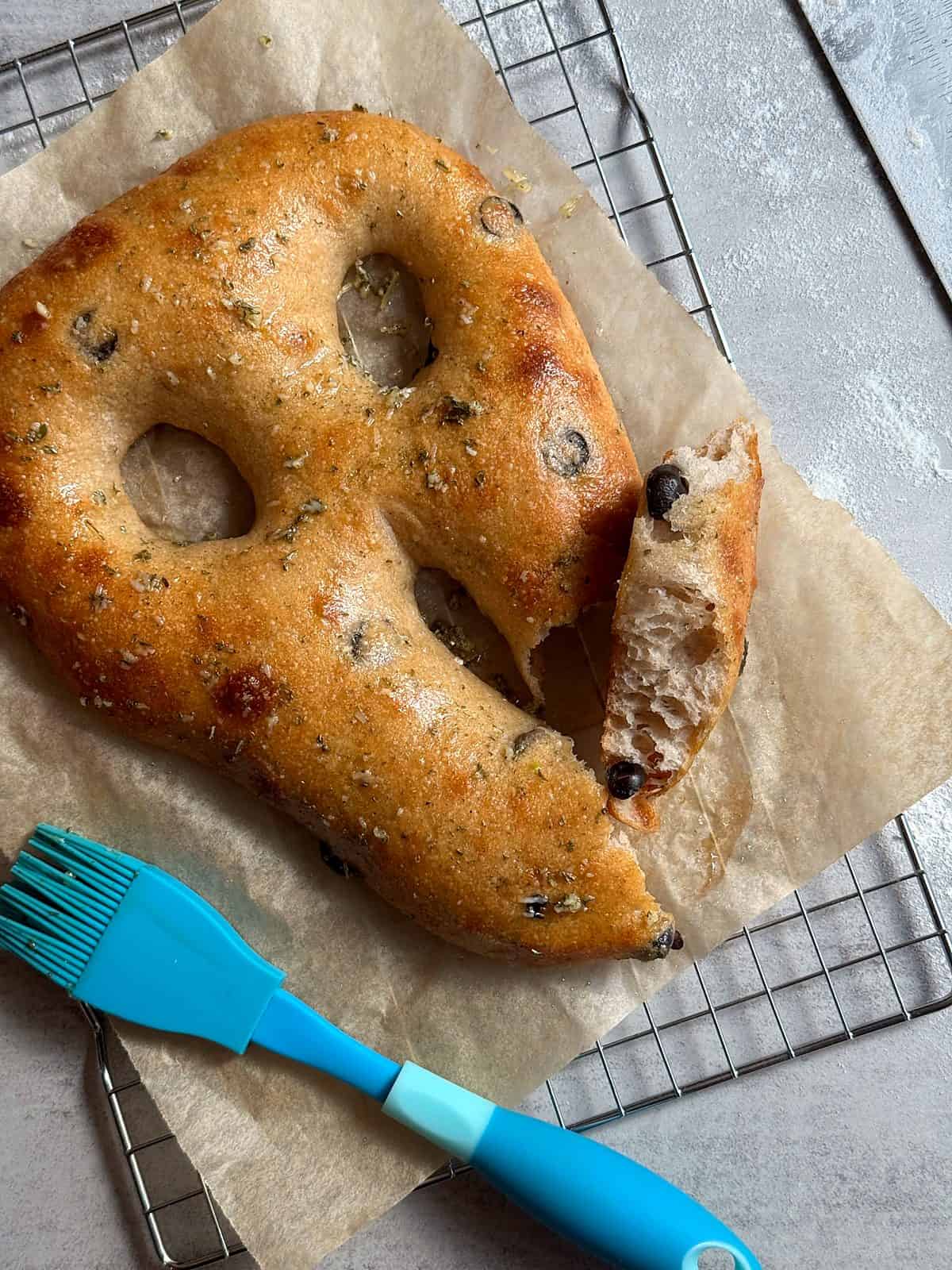
Fougasse is a flatbread from Provence, a region of southeastern France. Bakers cut slits in the dough and stretch them open, so it often looks like a leaf or a wheat stalk. The holes give the bread more crust and less crumb.
A sourdough ghost fougasse uses the same idea. Instead of leaf veins, you cut two eyes and a mouth. The bread rises with a natural sourdough starter instead of commercial yeast, so it has more flavor and a light tang. Think of it as ghost bread made the French way.
Some bakers call this Halloween fougasse a "boogasse." I think the name is too good not to use.
Fougasse vs. Focaccia
Fougasse and focaccia are cousins, but they are not the same bread. Focaccia is Italian. It bakes in an oiled pan, comes out thick and soft, and has dimples on top.
Fougasse is French. It bakes free-form on a sheet. It is thinner, with cuts that open into holes. That means more crust in every bite. It is also why fougasse works so well for a ghost face.
Ingredients
- Bread flour: I use King Arthur bread flour. Its high protein makes a strong dough that holds the holes open during baking.
- Whole wheat flour: I use Bob's Red Mill whole wheat flour. A small amount adds flavor and color.
- Water: Use filtered or dechlorinated water.
- Levain (sourdough starter at peak): Use a 100% hydration starter that is active and bubbly. See my guide on sourdough starter peak.
- Herbes de Provence: I use this Herbes de Provence blend. The dried herbs add a savory flavor that goes well with the olives.
- Salt: Use fine sea salt. Avoid iodized table salt.
- Olives: Use ready-sliced black olives, or chop whole pitted olives yourself. I use canned sliced olives. Drain them well and pat them dry.
- Garlic parsley Parmesan oil: Olive oil, garlic, parsley, and finely grated Parmesan. Fresh or dried parsley both work.
Final Bread Formula
| Ingredient | Baker's Percentage | Weight |
|---|---|---|
| Bread flour | 90% | 450 g |
| Whole wheat flour | 10% | 50 g |
| Water | 75% | 375 g |
| Levain (active starter, 100% hydration) | 20% | 100 g |
| Salt | 2% | 10 g |
| Black olives, sliced or chopped | 13% | 65 g |
| Herbes de Provence | 0.7% | 3.5 g |
- Total dough weight is about 1,054 g, enough for two ghosts of about 527 g each. To adjust the formula, use baker's percentages or my sourdough calculator.
- For the brushing oil, mix 3 tablespoons olive oil, 1 small minced garlic clove, 1 tablespoon chopped fresh parsley (or 1 teaspoon dried), and 1 tablespoon finely grated Parmesan.
- My kitchen temperature is 73°F (23°C) and the humidity is 40%.
- Bulk fermentation: about 6 hours with a 40-45% increase in dough size.
- Proofing time: 1 to 2 hours on the counter
- Bake in a conventional oven at 430°F (221°C) for 20 to 25 minutes, until deep golden brown.
Tools & Equipment
You need a bench scraper, parchment paper, and a large baking sheet. For everything else I use, see my Essential Sourdough Tools & Equipment guide.
How to Make Sourdough Ghost Fougasse
1. Autolyse
In a large bowl, mix the bread flour, whole wheat flour, and water until no dry flour remains. Cover the bowl. Let it rest until the dough looks smoother and stretches a little when you pull it. See my post on sourdough autolyse.
2. Add Levain and Salt
Add the levain and squeeze it into the dough with wet hands. Fold the dough over itself until the starter is fully mixed in. Bulk fermentation starts.
Sprinkle the salt over the dough and mix it in with one of my bread dough mixing techniques. Cover and let the dough relax for 30 minutes before the first fold.
3. Fold the dough
Wet your hands and perform two sets of stretch and folds followed by one set of coil folds, with a 30-minute rest between each set.
4. Laminate and Add the Herbs and Olives
Wet your counter lightly. Stretch the dough into a thin rectangle, as thin as you can without tearing. Scatter the olives evenly over the surface and sprinkle the herbes de Provence over them. Fold the dough into thirds from the long side, then into thirds again from the short side. Put it back in the bowl and cover it. See my guide on sourdough lamination.
Lamination spreads the olives and herbs evenly without tearing the gluten. If you don't want to laminate, add them during the first set of stretch and folds instead.
5. Continue Bulk Fermentation
Bulk fermentation is done when the dough has a domed top and shows bubbles on the surface and sides. It should feel airy and jiggle when you shake the bowl.
Note: I allowed the dough to rise about 40-45% at 73°F (23°C). Your target rise will vary depending on your kitchen temperature. Warmer kitchens speed up bulk fermentation, and cooler ones slow it down.
6. Divide and Preshape
Tip the dough onto a lightly floured counter (I use white rice flour) and divide it into two equal pieces. Gently shape each piece into a loose oval. Place each oval on its own sheet of parchment.
Cover and let each oval rest until it relaxes and spreads slightly. Relaxed dough is much easier to stretch into a ghost.
7. Shape the Ghosts
With oiled fingers, press each oval into a flat ghost shape, about ⅝ inch (about 1.5 cm) thick. Keep the top rounded. Make the bottom a little narrower.
Cut two eyes near the top. I use the wide end of a piping tip dipped in water. Cut all the way through to the parchment. With a bench scraper, cut a short slit below the eyes to make the mouth.
Gently pull each cut open with your oiled fingers. Make the holes bigger than you want them. They shrink as the dough rises.
8. Final Proof
Cover the ghosts loosely (I use upside-down baking sheets). Let them proof for 1 to 2 hours until they look puffy and spring back slowly when you press them with a finger.
9. Bake
Preheat the oven to 430°F (221°C) with a baking sheet inside.
Check the holes and use oiled fingers to stretch open any that closed up. Brush the dough with olive oil. Slide the parchment with the ghosts onto the hot baking sheet. Bake for 20 to 25 minutes, until the fougasse is deep golden brown.
10. Brush with Garlic Parsley Parmesan Oil
Mix the olive oil, garlic, parsley, and Parmesan while the bread bakes. Brush the oil over the hot fougasse as soon as it comes out of the oven. The heat releases the garlic smell, the Parmesan melts in, and the bread soaks up the oil.
Let the ghosts cool on a wire rack for a few minutes. Fougasse is best served warm, the same day, torn by hand.
Sample Baking Schedule
Here is the same-day schedule I used. My kitchen was 73°F (23°C). In a warmer kitchen, bulk fermentation will finish sooner, so watch the dough more than the clock.
- Before you start: Build the levain so it peaks when you are ready to mix
- 8:00 am: Autolyse: mix the flours and water, cover, and rest
- 8:30 am: Add levain and salt (bulk fermentation starts), rest 30 minutes
- 9:00 am: First set of stretch and folds
- 9:30 am: Second set of stretch and folds
- 10:00 am: Set of coil folds
- 10:30 am: Laminate and add the herbs and olives
- 10:30 am to 2:30 pm: Bulk fermentation continues until the dough rises about 40 to 45%
- 2:30 pm: Divide, preshape into ovals on parchment, and rest
- 3:00 pm: Shape the ghosts and cut the eyes and mouth
- 3:00 to 5:00 pm: Final proof for 1 to 2 hours; preheat the oven to 430°F (221°C) toward the end
- About 4:30 pm: Bake for 20 to 25 minutes
- About 5:00 pm: Brush with garlic parsley Parmesan oil and serve warm
Want fresh fougasse for dinner on a busy day? Shape the ghosts, refrigerate them overnight, and bake the next day. See the FAQ below.
Bulk Fermentation Expectations
This dough is 90% bread flour and 10% whole wheat. The small amount of whole wheat speeds up fermentation a little, because bran and germ feed the yeast and bacteria. It won't change much at 10%, but the dough may finish bulk a bit sooner than an all-white dough.
The olives don't feed fermentation. Drain them well and pat them dry. Extra brine adds salt and water to the dough and can make it sticky.
For fougasse, I end bulk at a moderate rise. An overfermented dough is slack and won't hold the holes open.
How to Make a Skull Fougasse
Want something spookier? Use the same dough and turn one ghost into a skull.
- Shape the dough into a wide round top with a narrower jaw at the bottom.
- Cut two large round eye sockets.
- Cut a small upside-down triangle for the nose.
- Cut a row of short vertical slits across the jaw for teeth.
- Pull the eyes and nose open wide. Leave the teeth slits narrow.
You can bake one ghost and one skull from the same batch. They look great together on a Halloween board.
How to Make Mini Ghost Fougasse
Small ghosts are perfect for dipping in soup. Use the same dough and make a whole little haunted tray.
- After bulk fermentation, divide the dough into six or eight equal pieces, about 130 to 175 g each.
- Preshape each piece into a small oval and let it relax on parchment.
- Press each oval into a small ghost about ⅝ inch (about 1.5 cm) thick.
- Cut two small eyes with a small piping tip and a short slit for the mouth. Pull the holes open.
- Proof until puffy, as with the large ghosts.
- Brush with olive oil and bake at 430°F (221°C). Small ghosts bake faster, so start checking after about 12 minutes. They are done when golden brown.
- Brush with the garlic parsley Parmesan oil right out of the oven.
How to Serve Sourdough Ghost Fougasse
Serve it warm and let everyone tear off a piece. Fougasse is a bread you share, not slice.
I like it next to a bowl of soup or chili, especially the mini ghosts for dipping. It also fits nicely on a Halloween charcuterie board with cheese, cured meats, and grapes. For a party, set a large ghost in the middle of the table as a snack. It will not last long.
Expert Tips for the Best Halloween Fougasse
- Make the holes bigger than you think: The dough rises in the oven and closes small cuts. Stretch them wide right before baking.
- Dry the olives well: Wet olives make the dough sticky and can leave gummy spots.
- Use parchment: Shape the ghosts right on the parchment. Moving a cut fougasse is how ghosts lose their faces.
- Brush the oil while hot: Hot bread soaks up the garlic Parmesan oil. Cold bread lets it sit on top.
- Check for doneness: The fougasse is done when it is deep golden brown. The internal temperature should reach about 205°F (96°C) or higher.
- Swap the add-ins: Try chopped rosemary or sun-dried tomatoes instead of olives.
A ghost fougasse looks different from a loaf, but it follows the same sourdough steps: an active starter, a well-read bulk, and gentle shaping. If you want those steps in order, from feeding your starter to baking, grab my free Sourdough Baking Roadmap.
Sourdough Ghost Fougasse FAQ
Can I make this Halloween fougasse ahead of time?
Yes. End bulk fermentation a little earlier. Shape the ghosts, cover them well, and refrigerate them overnight. Let them warm up and look puffy before baking. Fougasse tastes best the day it is baked.
Can I add the olives during stretch and folds instead of lamination?
Yes. Add them during the first set of stretch and folds. Lamination spreads them more evenly, but both methods work.
Why did the holes in my ghost fougasse close up?
The cuts were too small, or the dough proofed too long after shaping. Pull the holes wide open and stretch them again right before baking.
Should I bake fougasse with steam or without?
I bake mine without steam. Fougasse is thin and bakes fast, so it doesn't need steam to rise. The olive oil I brush on before baking keeps the surface from drying out and gives it a golden, crisp crust. Some bakers add steam for a shinier crust. Both ways work, so pick the crust you like.
Can I use fresh or dried parsley?
Both work. Use about 1 tablespoon chopped fresh parsley or 1 teaspoon dried.
How do I store leftover fougasse?
Keep it in a paper bag at room temperature for a day. Reheat it in a hot oven for a few minutes to bring back the crisp crust.
More Sourdough Recipes to Try
PrintRecipe
Sourdough Ghost Fougasse (Easy Halloween Bread)
This sourdough ghost fougasse is a crisp Halloween bread with black olives and herbes de Provence, shaped like a ghost. It rises with a natural starter and finishes with a brush of olive oil mixed with garlic, parsley, and Parmesan.
- Prep Time: 8 hours 40 minutes
- Cook Time: 25 minutes
- Total Time: 9 hours
- Yield: 2 fougasses 1x
- Category: Sourdough Recipes
- Method: Baking
- Cuisine: French
Ingredients
For the levain (an active starter):
- 35 g sourdough starter
- 35 g bread flour
- 35 g water
For the dough:
- 450 g bread flour (I use King Arthur bread flour)
- 50 g whole wheat flour (I use Bob's Red Mill whole wheat flour)
- 375 g water (75% hydration)
- 100 g levain (active starter at peak)
- 10 g fine sea salt (I use Redmond fine sea salt)
- 3.5 g dried Herbes de Provence (0.7%, about 1 tablespoon)
- 65 g sliced black olives (or whole pitted olives, chopped), drained and patted dry
- Olive oil, for brushing before baking
- White rice flour, for dusting
For the garlic parsley Parmesan oil:
- 3 tablespoons olive oil
- 1 small garlic clove, minced
- 1 tablespoon chopped fresh parsley (or 1 teaspoon dried)
- 1 tablespoon finely grated Parmesan
Instructions
- Autolyse: In a large bowl, mix the bread flour, whole wheat flour, and water until no dry flour remains. Cover and let rest until the dough looks smoother and stretches a little.
- Add levain and salt: Add the levain and squeeze it in with wet hands until fully mixed. Bulk fermentation starts. Sprinkle in the salt and mix it in. Cover and let the dough relax for 30 minutes.
- Fold the dough: With wet hands, do two sets of stretch and folds followed by one set of coil folds, with a 30-minute rest between each set.
- Laminate and add the herbs and olives: Stretch the dough into a thin rectangle on a lightly wet counter. Scatter the olives over it and sprinkle with the herbes de Provence. Fold into thirds from the long side, then into thirds from the short side. Return it to the bowl and cover.
- Continue bulk fermentation: Let the dough rise until it has grown about 40-45% at 73°F (23°C), has a domed top, and shows bubbles on the surface and sides.
- Divide and preshape: Tip the dough onto a counter lightly dusted with rice flour and divide it into two equal pieces. Shape each into a loose oval and place it on its own sheet of parchment. Cover and let each oval rest until relaxed.
- Shape the ghosts: With oiled fingers, press each oval into a ghost shape about ⅝ inch (1.5 cm) thick, with a rounded top and a narrower bottom. Cut two eyes with the wide end of a piping tip dipped in water. With a bench scraper, cut a short slit below the eyes for the mouth. Cut all the way through to the parchment. Pull the holes wide open with oiled fingers.
- Final proof: Cover loosely (I use an upside-down baking sheet). Proof on the counter until puffy and the dough springs back slowly when pressed, 1 to 2 hours at 73°F (23°C).
- Bake: Preheat the oven to 430°F (221°C) with a baking sheet inside. Reopen any holes that closed with oiled fingers. Brush the dough with olive oil. Slide the parchment onto the hot baking sheet and bake without steam for 20 to 25 minutes, until deep golden brown.
- Brush with garlic parsley Parmesan oil: Mix the olive oil, garlic, parsley, and Parmesan. Brush it over the hot fougasse right out of the oven. Cool briefly on a wire rack and serve warm.
Notes
- Olives and herbs: Add them during lamination, or during the first set of stretch and folds if you don't laminate.
- Big holes: Stretch the cuts wider than you want. They shrink as the dough rises.
- No steam needed: Fougasse is thin and bakes fast, so I bake it without steam. The olive oil brushed on before baking gives it a golden, crisp crust.
- Mini ghosts: Divide the dough into six or eight pieces and shape small ghosts for dipping in soup. Start checking them after about 12 minutes in the oven.
- Skull version: Shape a round top with a narrow jaw. Cut eye sockets, a triangle nose, and slits for teeth.
- Make ahead: End bulk a little earlier, shape, cover well, and refrigerate overnight. Let the ghosts warm up and look puffy before baking.
- Doneness: Bake until deep golden brown, with an internal temperature of 205°F (96°C) or higher.
- Custom formula: Use my sourdough calculator to scale the recipe.
- Nutrition: Nutrition is per fougasse and includes the levain and the garlic parsley Parmesan oil. It does not include the olive oil brushed on before baking or the rice flour used for dusting.
Nutrition
- Serving Size: 1 fougasse
- Calories: 1222
- Sugar: 0.9g
- Sodium: 2221mg
- Fat: 29.4g
- Saturated Fat: 4.4g
- Unsaturated Fat: 22.5g
- Trans Fat: 0g
- Carbohydrates: 203g
- Fiber: 10.5g
- Protein: 34.8g
- Cholesterol: 2mg

Comments
No Comments