

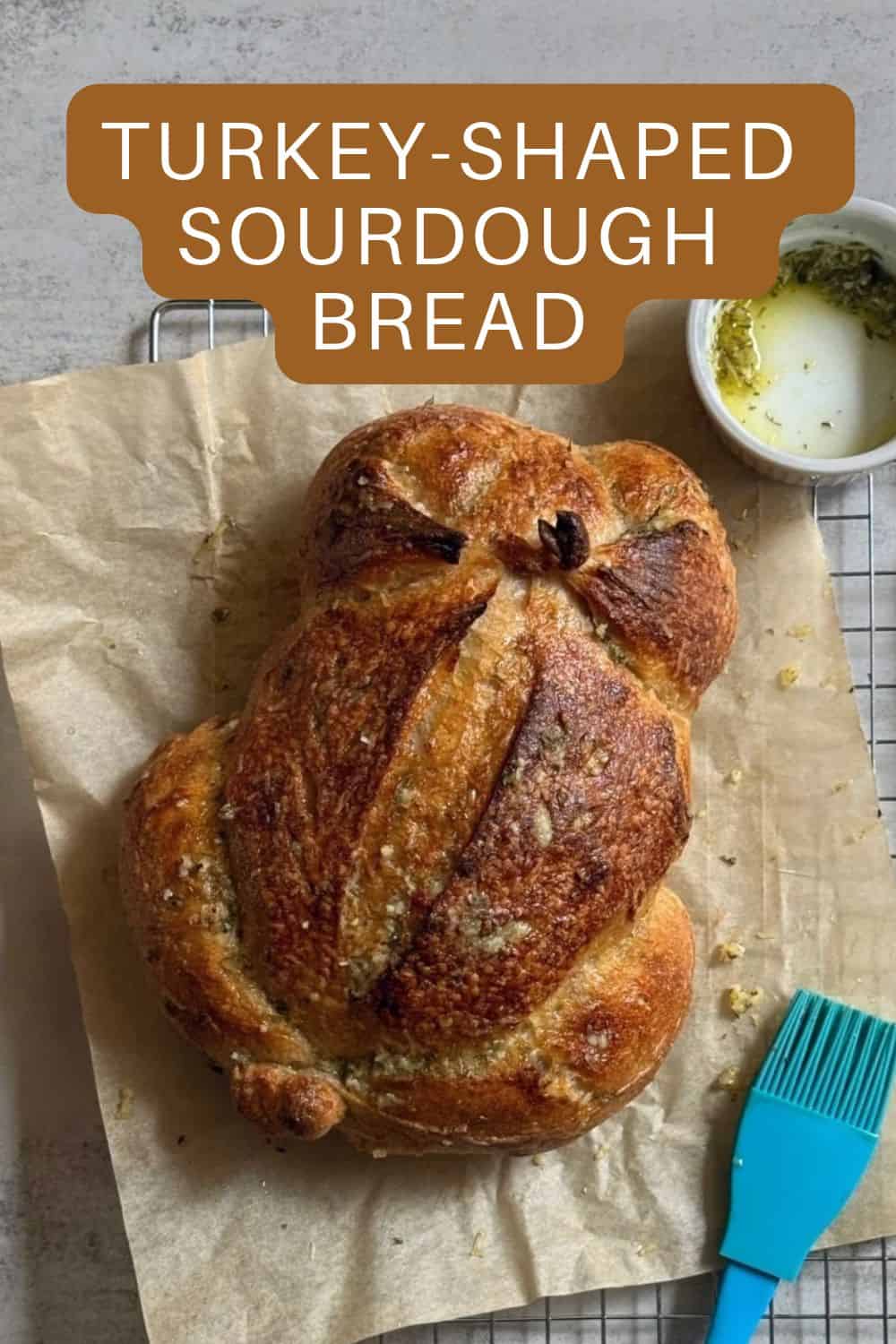
Turkey-shaped sourdough bread is a sourdough loaf that you cut and shape to look like a roast turkey. Cut the cold dough into two wings and two drumsticks, tie them with kitchen twine if you like, and bake the loaf in a Dutch oven. After baking, you brush it with garlic, parsley, and Parmesan oil. It tastes so good!
The first time I saw one, I thought it would be hard to make, but it is much easier than it looks. If you can shape a batard, you can make a turkey. Trust me, it is the most fun bread you can bake for Thanksgiving.
Quick Summary
- What it is: a sourdough batard cut into a turkey shape with wings and drumsticks
- Flour: 450 g King Arthur bread flour
- Hydration: 75%
- Banneton: 12-inch (30 cm) oval, or an 8-inch (20 cm) round if you shape a boule
- Shaping: cut the wings and drumsticks from the cold dough, then tie them with cotton kitchen twine if needed
- Bake: in a large Dutch oven at 450°F (230°C), lid on, then lid off
- Finish: brush with garlic, parsley, and Parmesan olive oil right out of the oven
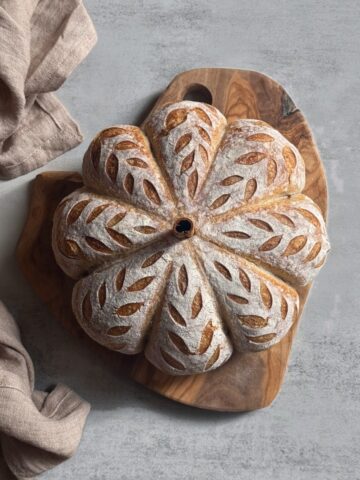
Note: This recipe uses the same method as my pumpkin-shaped sourdough bread, with a slightly lower hydration. If you are new to sourdough, start with my Beginner's Sourdough Guide and my Beginner's Sourdough Bread recipe. You will also need an active starter. My Beginner Sourdough Starter recipe shows you how to make one.
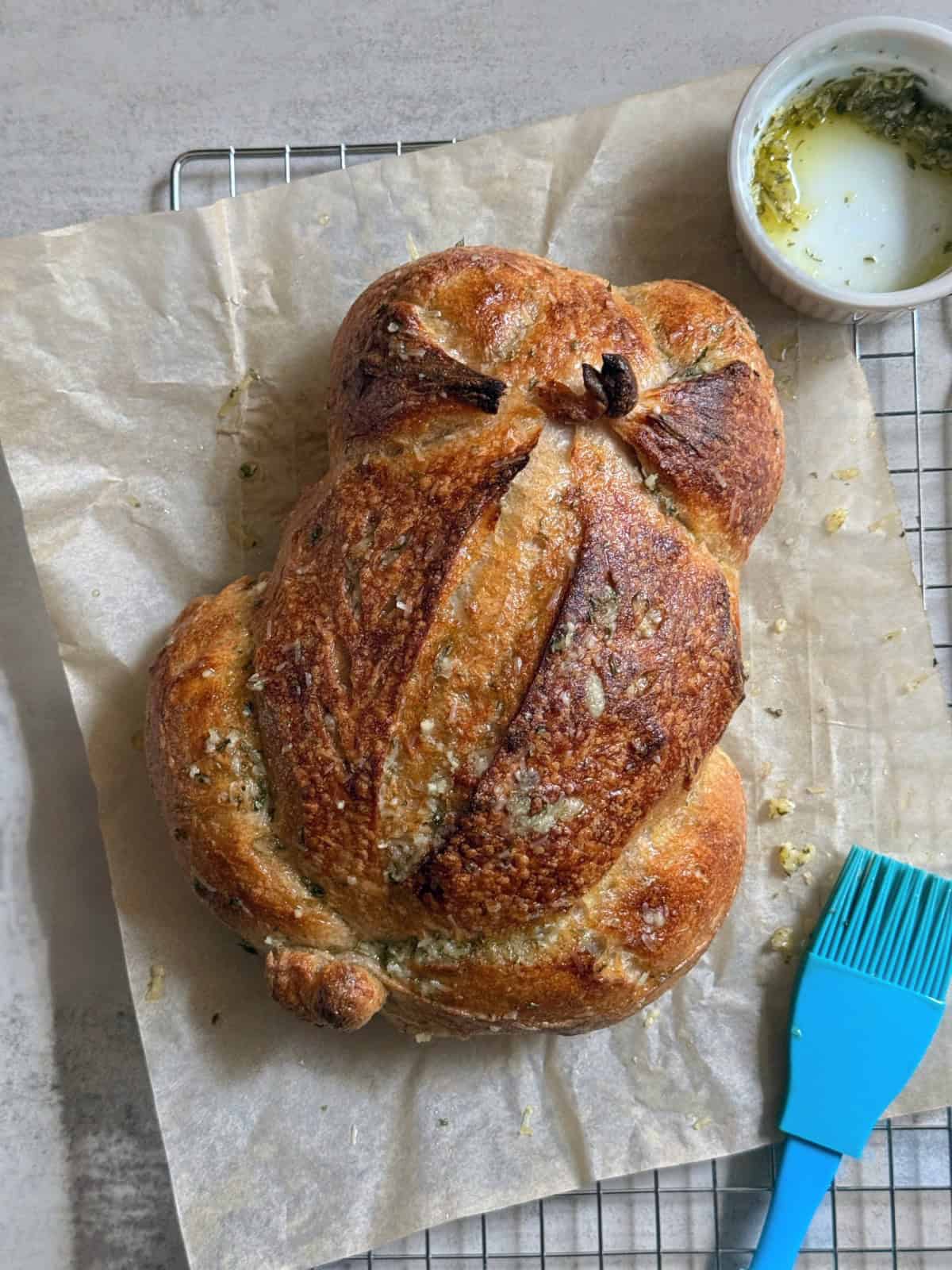
What Is Turkey-Shaped Sourdough Bread?
Turkey-shaped sourdough bread is a regular sourdough loaf shaped like a roast turkey. You do not need a special dough. The shape comes from a few cuts in a cold, proofed batard.
You cut two strips at the top end for the drumsticks and two strips along the sides for the wings. Kitchen twine holds the drumsticks and wings in place, like a trussed turkey. Two small wheat patterns on the breast open up in the oven.
I shape my turkey from a batard, because its oval shape looks more like a real turkey. You can also use a round boule.
What Hydration Should You Use for Turkey-Shaped Bread?
Keep your dough at 70-75% hydration. At this hydration, the dough bakes up with a soft crumb and still holds the wings and drumsticks. Wetter dough might spread in the oven, and your turkey might lose its shape. This recipe uses 75%.
Ingredients
- Bread flour: I use King Arthur bread flour. Its high protein gives the dough the strength to hold its shape.
- Water: Use filtered or dechlorinated water.
- Levain (sourdough starter at peak): Use an active, bubbly starter at 100% hydration. See my guide on sourdough starter peak.
- Salt: Use fine sea salt. Avoid iodized table salt.
- Rice flour: You use it to dust the banneton.
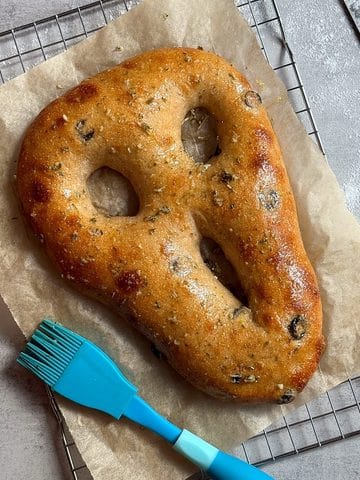
- Garlic parsley Parmesan oil: You mix olive oil, garlic, parsley, and finely grated Parmesan. It is the same oil I use for my sourdough ghost fougasse.
Final Bread Formula
| Ingredient | Baker's Percentage | Weight |
|---|---|---|
| Bread flour | 100% | 450 g |
| Water | 75% | 338 g |
| Levain (active starter, 100% hydration) | 20% | 90 g |
| Salt | 2% | 9 g |
- Total dough weight is 887 g. It fits a 12-inch (30 cm) oval banneton or an 8-inch (20 cm) round banneton. To adjust the formula, use baker's percentages or my sourdough calculator.
- For the oil, mix 3 tablespoons olive oil, 1 small minced garlic clove, 1 tablespoon chopped fresh parsley (or 1 teaspoon dried), and 1 tablespoon finely grated Parmesan.
- My kitchen temperature is 73°F (23°C), and the humidity is 46%.
- Bulk fermentation: 7 hours to 7 hours 30 minutes, with a 75 to 80% increase in dough size.
- Proofing: overnight in the fridge.
- Bake in a Dutch oven at 450°F (230°C) with the lid on for 20 minutes, then with the lid off for 15-20 minutes.
Tools & Equipment
You need a 12-inch (30 cm) oval banneton, 100% cotton kitchen twine, a large Dutch oven, oven mitts, parchment paper, a pastry brush, a bench scraper or sharp knife, a bread lame, and scissors. For everything else I use, see my Essential Sourdough Tools & Equipment guide.
What Twine Should You Use for Turkey Bread?
Use 100% cotton kitchen twine that is unwaxed and undyed. Never use polyester or nylon string, because it can melt in a hot oven.
You can use the twine dry, soaked in water, or soaked in oil. Dry twine is the easiest to tie, but it sticks to the crust. Oiled twine slides out the easiest. You only need short pieces for the drumsticks and wings, so you can choose any of the three. I explain all three in my pumpkin-shaped sourdough post.
How to Make Turkey-Shaped Sourdough Bread
1. Autolyse
Pour the water over the bread flour in a large bowl. Mix until all the flour is wet. Cover the bowl and leave it until the dough looks smoother and stretches a little. Read more about sourdough autolyse.
2. Add Levain and Salt
Put the levain on top of the dough. With wet hands, pinch it in and fold the dough over until you see no streaks of starter. Bulk fermentation begins here.
Add the salt and mix it in with one of my bread dough mixing techniques. Cover the bowl and let the dough relax.
3. Fold the Dough
Give the dough four sets of folds: two sets of stretch and folds first, then two sets of coil folds. Keep your hands wet. Wait about 30 minutes between sets, until the dough relaxes and spreads out again.
4. Finish Bulk Fermentation
Cover the bowl after the last fold and let the dough keep rising. Bulk fermentation is done when the dough is domed, bubbly on top and along the sides, and jiggles when you move the bowl.
Note: My dough rose about 75-80% at 73°F (23°C). In a warmer kitchen, your dough will get there faster. In a cooler kitchen, it will take longer.
5. Preshape and Shape a Batard
Turn the dough out onto a counter lightly dusted with rice flour. Preshape it into a round and let it rest for 15 to 20 minutes. Then shape a tight batard. A tight surface keeps the wings and drumsticks neat. If you prefer, you can shape a boule instead. See my guide to shaping bread dough.
6. Cold Proof Overnight
Dust a 12-inch (30 cm) oval banneton with rice flour. For a boule, use an 8-inch (20 cm) round banneton. Set the dough in it, seam side up. Cover and refrigerate overnight. Cold dough is firm, so you can cut and shape it much more easily.
7. Prepare the Dough for Shaping
Preheat the oven to 500°F (260°C) with a large Dutch oven inside. From here on, always use oven mitts when you touch the hot pot or lid.
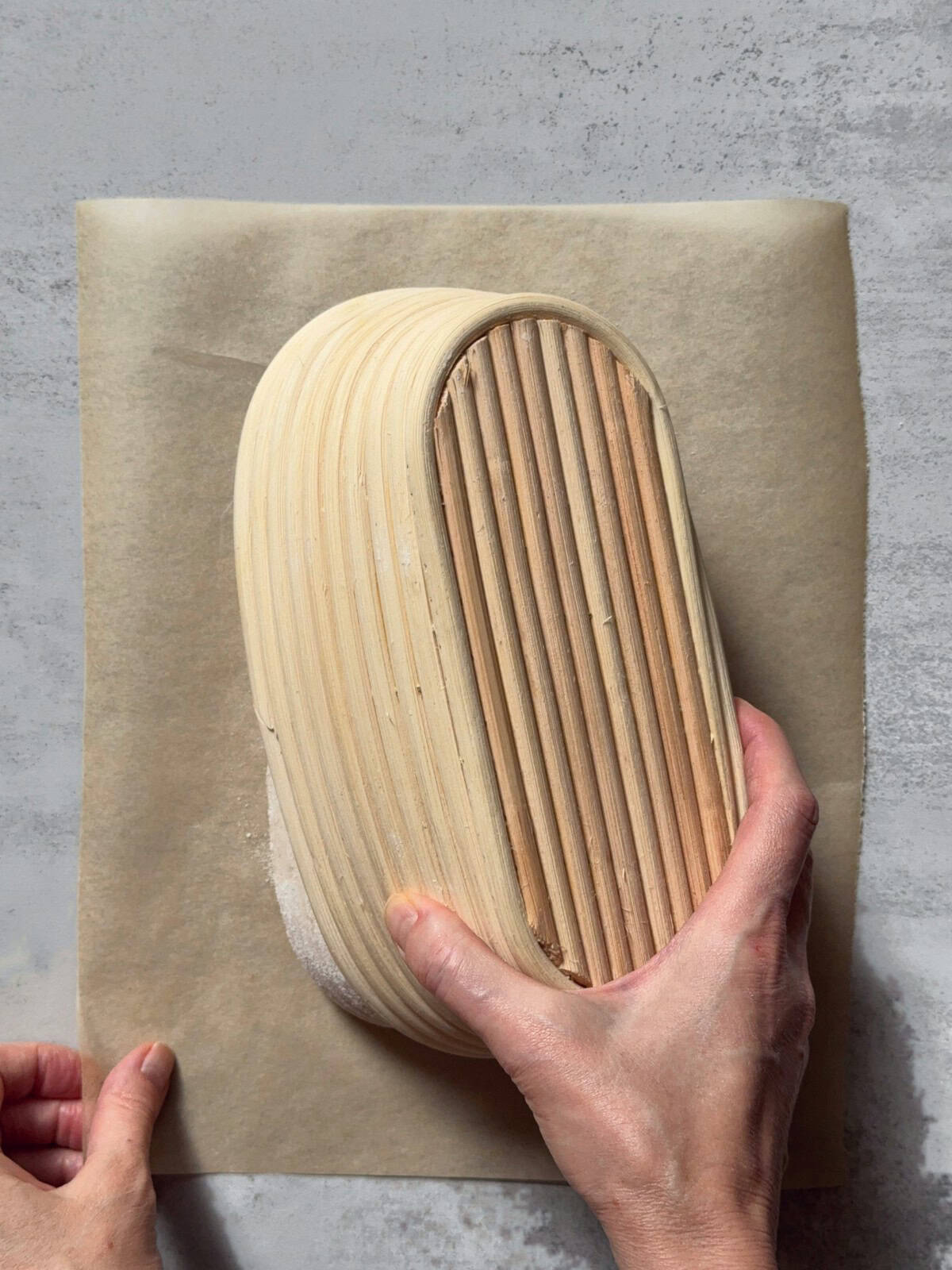
Lay a sheet of parchment over the banneton and flip the dough out onto it. Lift the banneton off slowly.
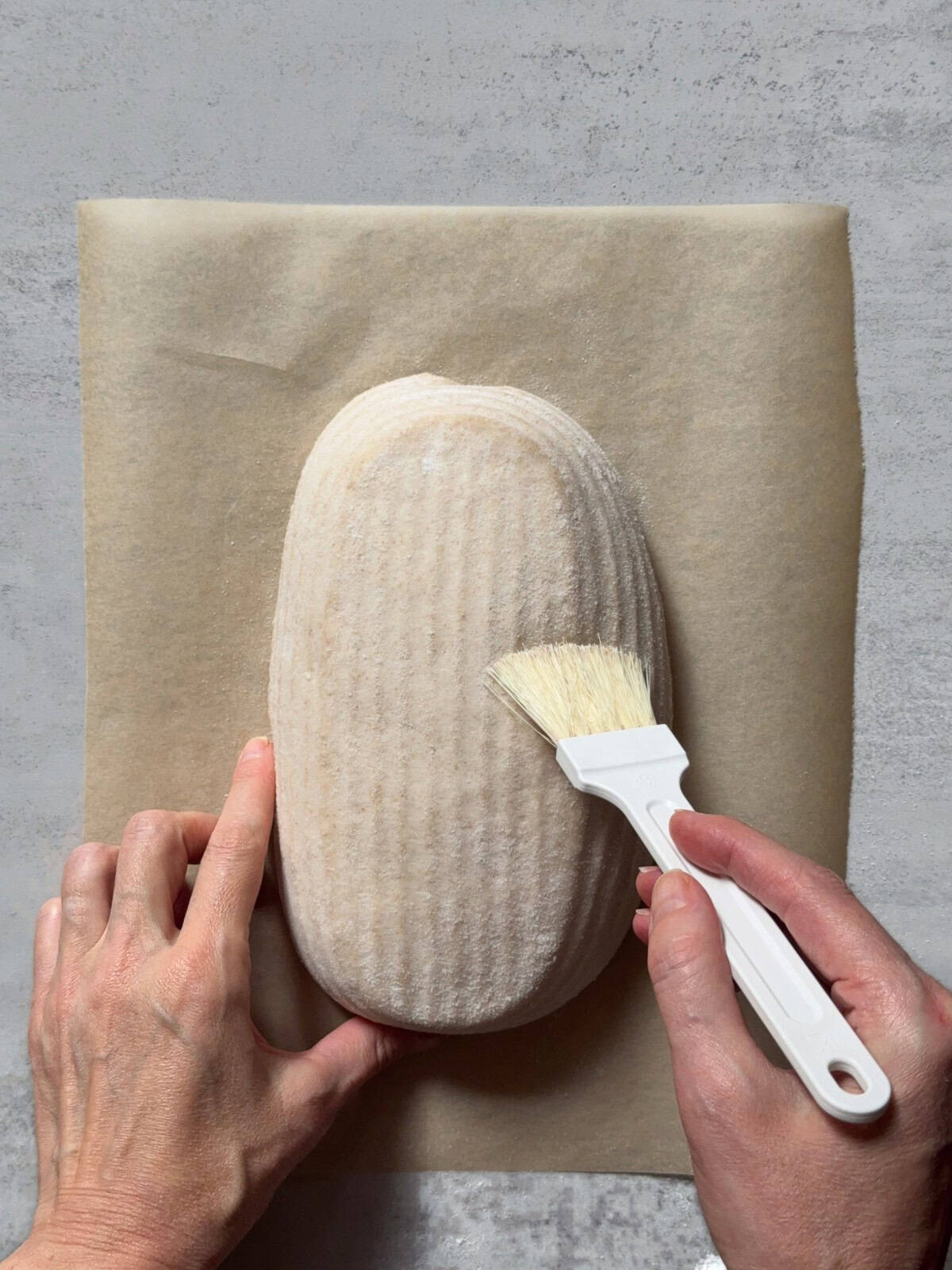
With a pastry brush, brush off the rice flour. Do not dust the dough with more flour. You want the surface to stay slightly sticky, so the drumsticks and wings stick to the body.
8. Shape the Drumsticks
Turn the parchment so the batard lies lengthwise in front of you. You make the drumsticks from the top end and the wings from the sides.
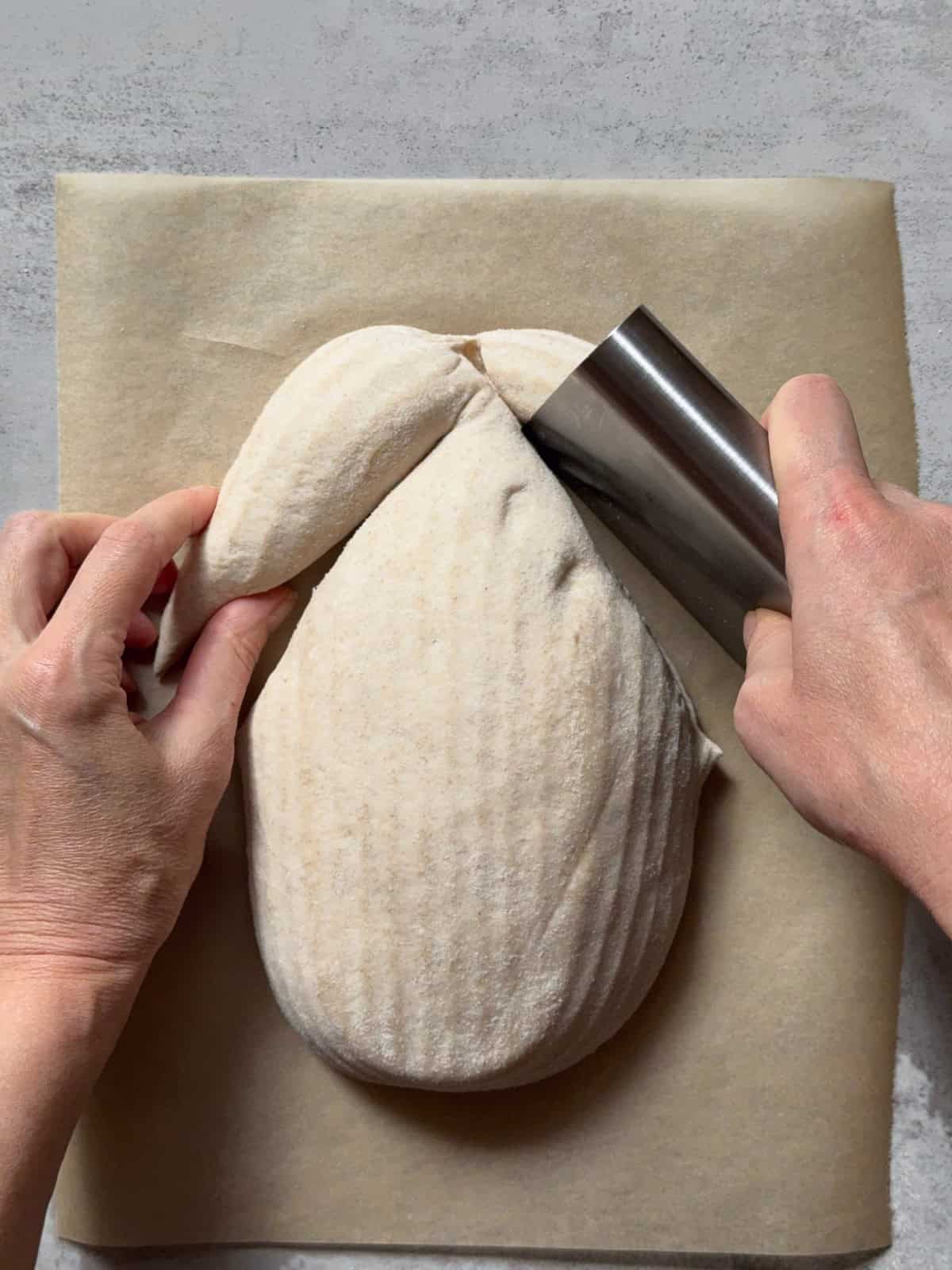
With a bench scraper, cut a strip on each side of the top end, about 2 to 3 inches (5 to 7 cm) long. Leave each strip attached to the body. Lift one strip and fold it toward the center, so it curls into a rounded drumstick. Repeat with the other strip.
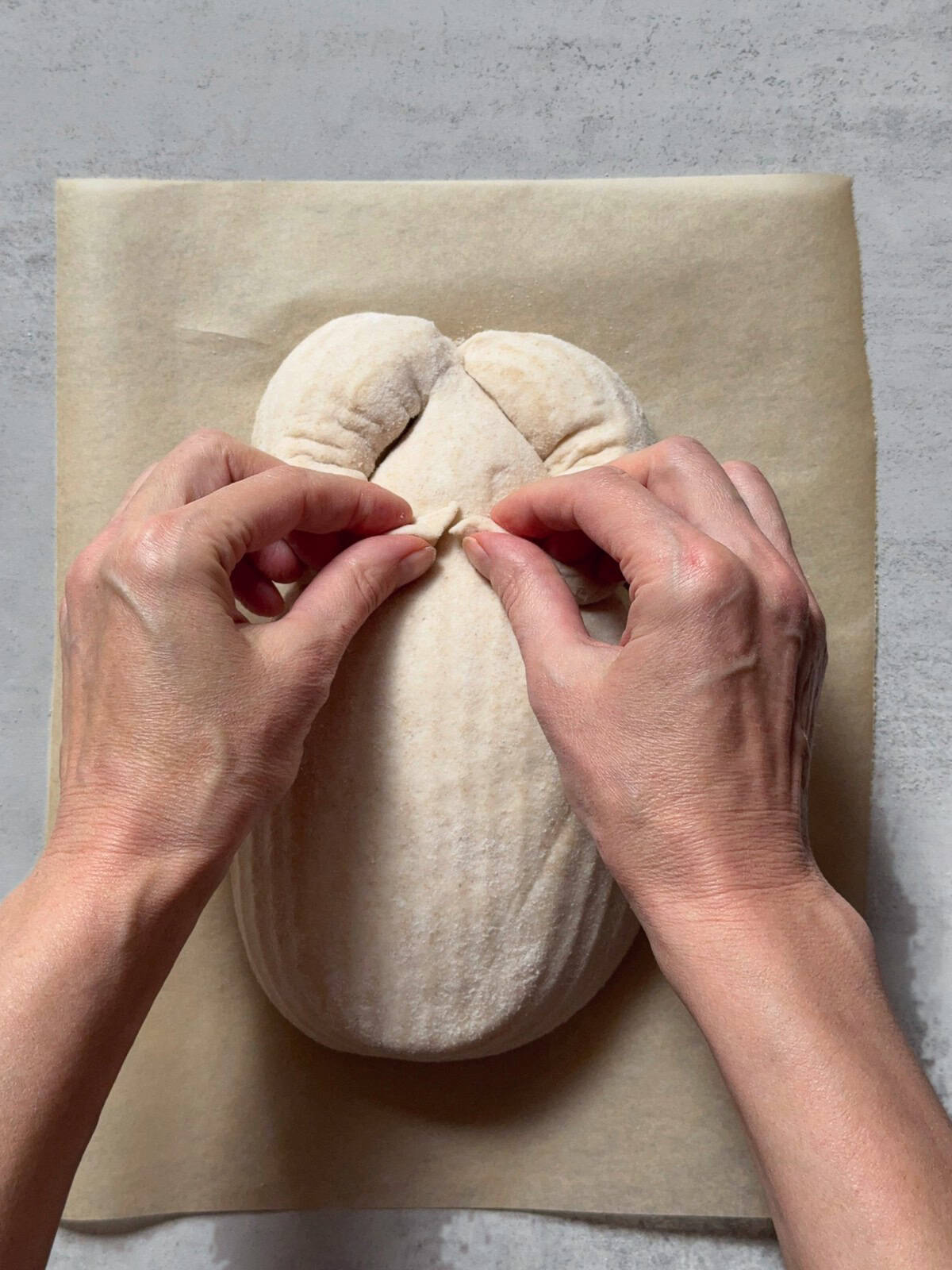
Bring the ends of the two drumsticks together in the middle and pinch them. If they do not stay together, tie them loosely with a short piece of twine.
9. Shape the Wings
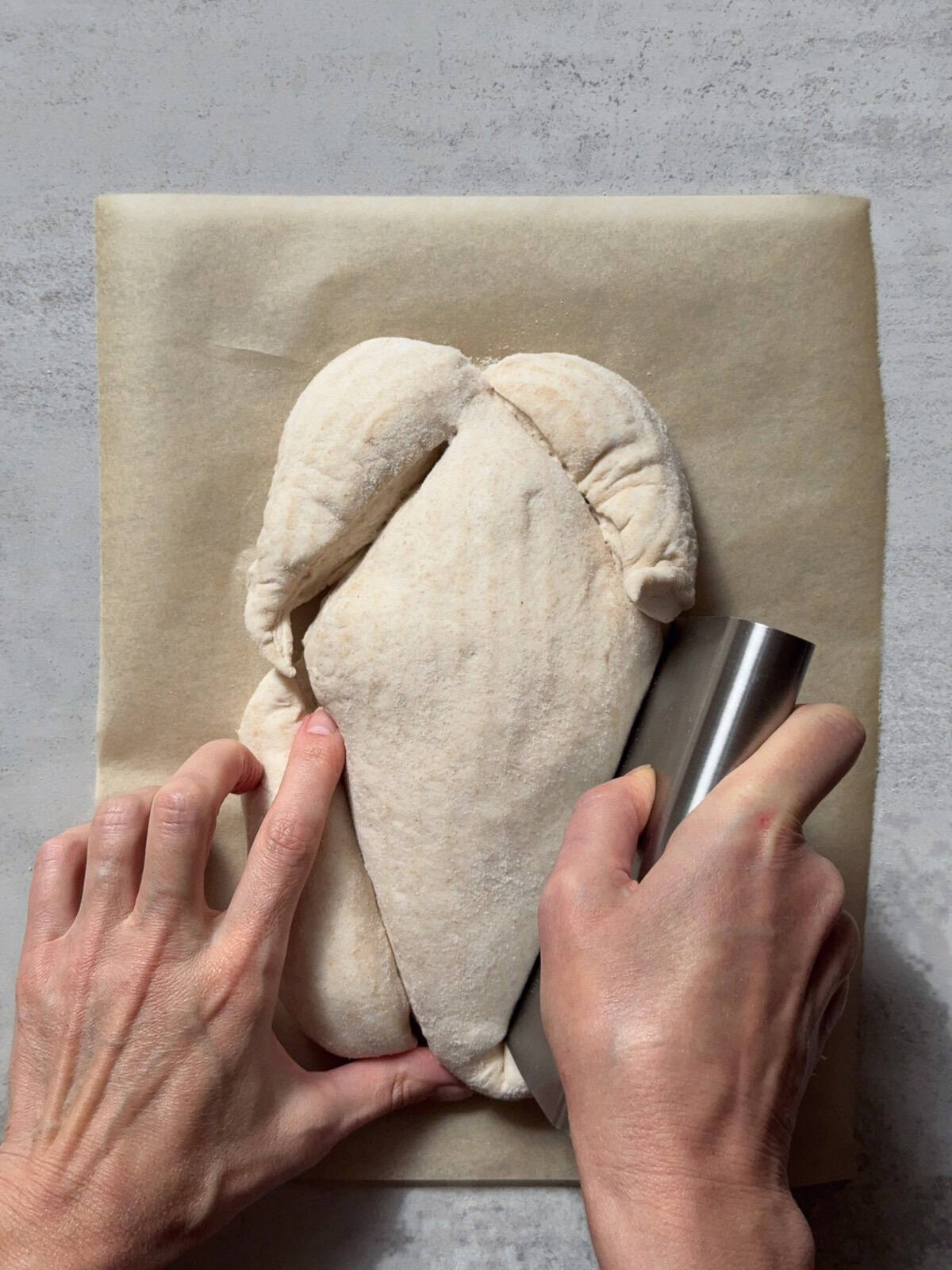
With the bench scraper, cut a strip along each side of the lower half. These strips become the wings.
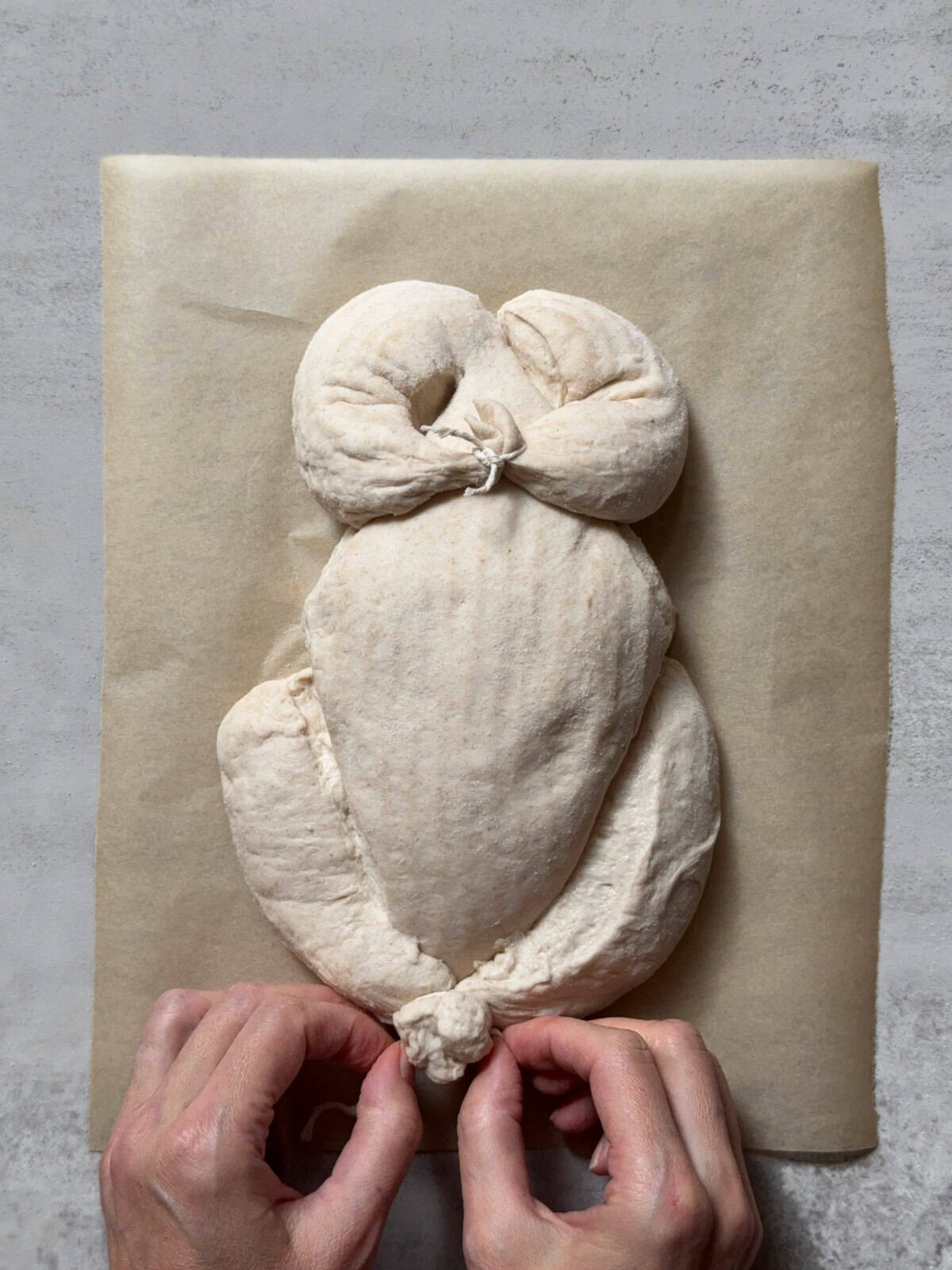
Bring both wing strips down to the bottom end and twist the ends together into a small knot. You can tie the knot with twine to keep the wings in place. Leave a little slack, because the dough grows in the oven.
Instead of twine, you can pin the wings to the body with toothpicks. Remember to remove the toothpicks before serving.
10. Score
Keep the scoring simple. Score two small wheat patterns down the breast. If you like, you can add a delayed slash down the middle during baking (see step 11). The cuts open in the oven and give the turkey a roasted look. Too many cuts can pull the shape apart. See my guide to scoring sourdough bread.
11. Bake
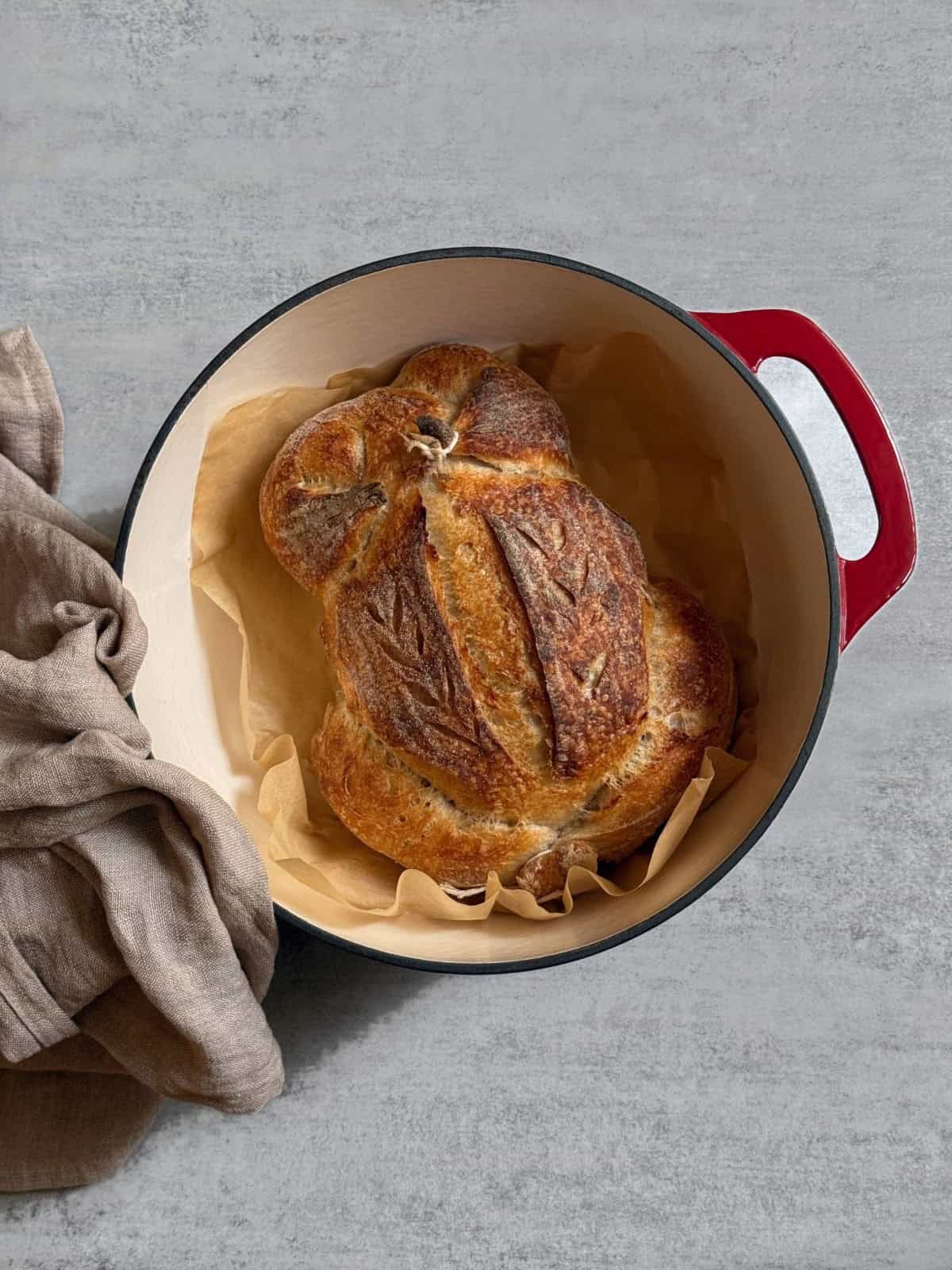
Wearing oven mitts, lift the lid of the Dutch oven. Lower the turkey on the parchment into the pot and cover it. Reduce the oven to 450°F (230°C). Bake with the lid on for 20 minutes in total. (Optional: I made a delayed slash down the middle after 6 minutes.) Then, wearing oven mitts, remove the lid and bake 15 to 20 minutes more, until deep golden brown.
If you don't have a Dutch oven, read my post on baking sourdough without a Dutch oven.
12. Brush with Garlic Parsley Parmesan Oil
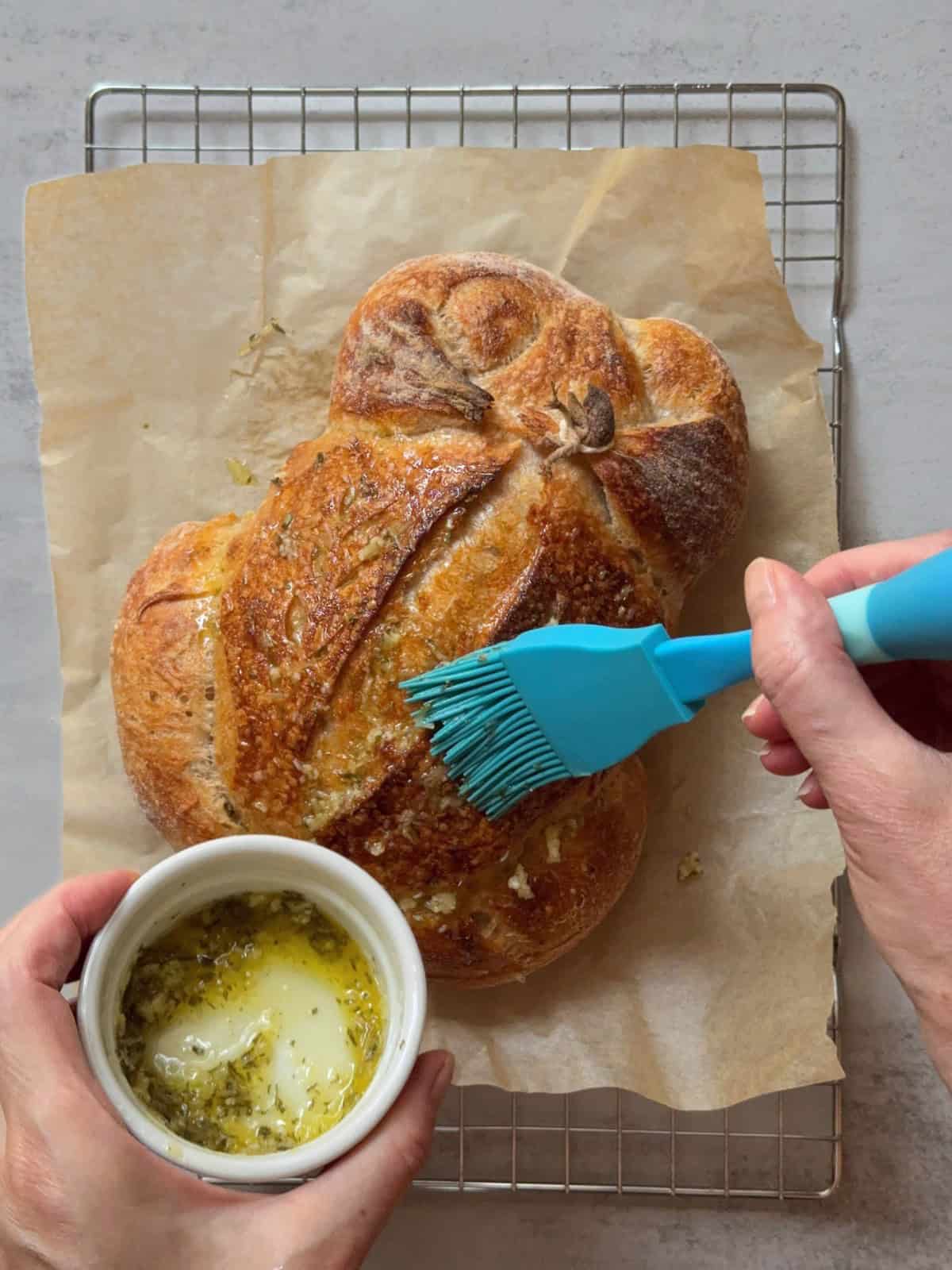
Mix the olive oil, garlic, parsley, and Parmesan while the bread bakes. Wearing oven mitts, take the turkey out of the oven and lift it out of the pot by the parchment. Brush it all over with the oil right away. The hot crust soaks up the oil and the garlic flavor.
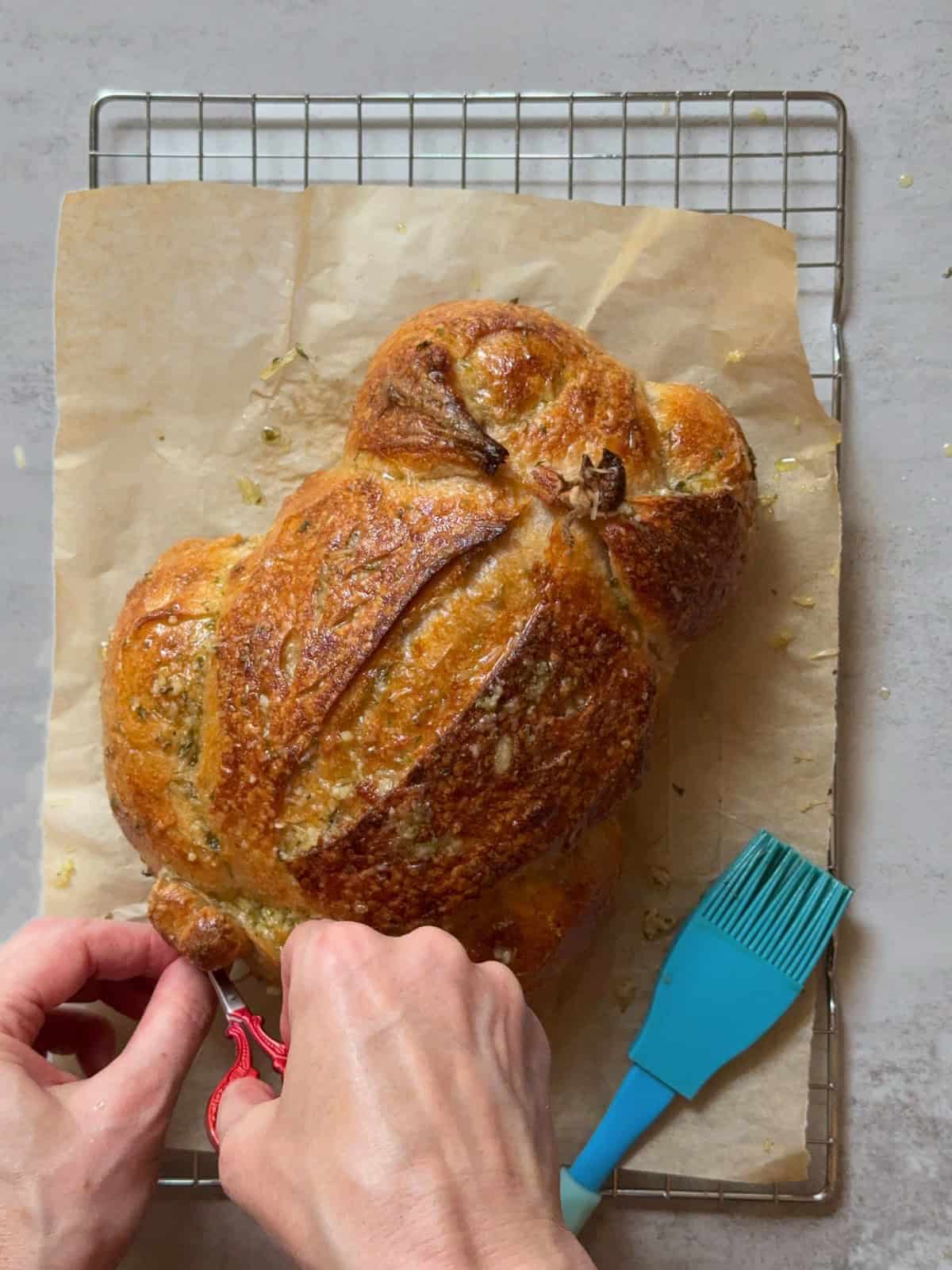
Let the turkey cool on a wire rack for about 10 minutes. Then snip the twine with scissors and gently pull it out.
Why Did My Turkey Lose Its Shape?
Most shape problems come from one of these causes:
- The wings opened up: The dough surface was too floury, so the flaps did not stick. Brush off the rice flour and do not dust again. You can add a little water under each wing or tie it with twine.
- The drumsticks pulled apart: The ends did not stay together in the oven. Next time, tie them in the middle with a short piece of twine before baking.
- The turkey spread flat: The dough was overproofed, or the hydration was too high. Keep your hydration at 70 to 75%, and shape the turkey straight from the fridge.
- The sides got squashed: The Dutch oven was too small. Use a large one, so the wings and drumsticks do not touch the pot.
- The twine stuck to the crust: Use oiled twine, or let the bread cool for a few minutes before you remove it.
Turkey Sourdough Variations
Play with Seasonings
Add herbs and spices to the oil. Try fresh thyme, rosemary, or sage. You can also add a pinch of smoked paprika for a roasted color.
Season Before or After Baking
You can season the turkey two ways. Before baking, lightly mist the dough with water and sprinkle it with dried herbs, flaky salt, or everything bagel seasoning. After baking, stir the seasoning into the oil and brush it over the hot bread.
Butter Finish
You can skip the oil and rub a piece of cold butter over the hot turkey right out of the oven. The butter melts into the crust and makes it shine, just like a roasted bird.
Herb Garnish
After brushing the hot turkey, lay a sprig of fresh rosemary or thyme down the middle of the breast and tie it with kitchen twine. Your turkey will look dressed for the table, and the herbs add a lovely smell. You can tuck a few small sprigs around the drumsticks too.
How to Make Mini Sourdough Turkey Loaves
Mini turkey loaves are a fun way to give each table its own turkey. You use the same dough and the same cuts, just smaller.
- After bulk fermentation, divide the dough into three equal pieces, about 300 g each.
- Shape three small, tight batards. Place them on a tray lined with parchment and dusted with rice flour. Cover and cold proof them overnight.
- Brush off the rice flour. Cut each turkey the same way as the large one, with smaller cuts about 1 to 1½ inches (2.5 to 4 cm) long.
- Tie the drumstick ends with a short piece of twine if they do not stay together on their own.
- Score one short slash down the middle of each turkey.
- Bake the mini turkeys on a parchment-lined baking sheet, and use oven mitts to move the hot sheet. They bake faster than the large loaf, so start checking them early. They are done when golden brown and 205°F (96°C) inside.
- Brush them with the garlic oil or melted butter, and add a small sprig of thyme.
Bulk Fermentation Expectations
This dough is 100% bread flour at 75% hydration. White flour ferments a little slower than whole grain flour, so bulk can take longer than with my artisan sourdough bread.
Don't push bulk too far. Overfermented dough is slack, and your turkey spreads instead of holding its wings and drumsticks.
Sample Baking Schedule
I use this schedule in a 73°F (23°C) kitchen. Watch your dough more than the clock.
Day 1
- Before you start: Build the levain so it peaks when you are ready to mix.
- 9:00 am: Autolyse.
- 9:30 am: Add levain and salt. Bulk fermentation starts.
- 10:00 to 11:30 am: Do two sets of stretch and folds, then two sets of coil folds, 30 minutes apart.
- About 4:30 to 5:00 pm: Bulk ends after 7 to 7 hours 30 minutes, when the dough has grown 75 to 80%. Preshape and rest for 15-20 minutes.
- About 5:15 pm: Shape a batard and place it in the banneton.
- About 5:30 pm: Refrigerate overnight.
Day 2
- Morning: Preheat the oven and Dutch oven to 500°F (260°C).
- While it heats: Cut and shape the drumsticks and wings, tie the twine if needed, and score.
- Bake: With oven mitts on, load the turkey into the hot Dutch oven. Bake 20 minutes with the lid on (optional delayed slash after 6 minutes), then 15 to 20 minutes with the lid off at 450°F (230°C).
- After baking: Brush with the oil, let the turkey cool, and remove the twine.
Expert Tips for the Best Turkey-Shaped Sourdough
- Shape it cold: Cut the dough straight from the fridge. For extra-firm dough, put it in the freezer, still in the banneton, for 20 to 30 minutes first.
- Don't dust with flour: A slightly sticky surface helps the wings and drumsticks stay in place.
- Use a sharp tool: A bench scraper or sharp knife makes clean cuts without dragging the dough.
- Keep scoring simple: Two small wheat patterns down the breast are enough.
- Use a large Dutch oven: Give your turkey room so the pot does not squash the wings and drumsticks.
- Always use oven mitts: The Dutch oven and its lid are extremely hot at 500°F (260°C). Wear oven mitts every time you load the dough, lift the lid for the optional delayed slash, remove the lid, and take the bread out.
- Check for doneness: The bread is done when the internal temperature reaches 205 to 210°F (96 to 99°C). Read more about the internal temperature of bread.
How to Serve Turkey-Shaped Sourdough Bread
Put the turkey on a board in the middle of the Thanksgiving table. Let it be the centerpiece until dinner starts, then tear or slice it.
Serve it with butter, gravy, soup, or a cheese board. The drumsticks are the best part to tear off, so I would not be surprised by a little friendly competition.
Selling Turkey-Shaped Sourdough Bread
If you sell sourdough bread from home, a sourdough turkey makes a great November special. It looks festive, it photographs well, and people order it as a gift or a centerpiece. Read my guide on how to sell sourdough bread from home to get started.
A turkey loaf follows the same sourdough steps as any loaf: an active starter, a well-read bulk, and a tight shape. If you want those steps in order, from feeding your starter to baking, grab my free Sourdough Baking Roadmap.
Turkey-Shaped Sourdough FAQ
Can I make turkey-shaped bread with any sourdough recipe?
Yes, you can use any recipe at 70-75% hydration. Very wet dough will not hold the shape.
Can I use all-purpose flour?
Yes. All-purpose flour has less protein, so the dough is softer and spreads more. Lower the water to about 70% hydration, or 315 g, so your turkey keeps its shape.
Can I use a boule instead of a batard?
Yes. A batard gives you a longer, more turkey-like body, but a round boule also makes a cute turkey. Use an 8-inch (20 cm) round banneton for a boule.
Do I need to tie the drumsticks?
Not always. If the drumsticks stay in place, you can skip the twine. If they start to drift apart, tie the ends together loosely.
Should I shape the turkey before or after the cold proof?
Shape it after the cold proof. You shape a regular batard, proof it overnight in the fridge, and cut the turkey right before baking. Cold dough is much easier to cut.
Can I make it ahead?
Yes. Bake it the day before, cool it completely, and store it in a paper bag. Warm it in a 350°F (175°C) oven for 5 to 10 minutes, then brush it with oil or butter before serving.
How do I make the turkey look roasted?
Bake it until deep golden brown, then brush it with the garlic oil or butter right after baking. You can add a pinch of smoked paprika to the oil for even more color.
Can I make mini turkey loaves?
Yes. Divide the dough into three pieces of about 300 g, shape small batards, and make smaller cuts. Bake them on a baking sheet and start checking them early.
How do I store leftover turkey bread?
Keep it in a paper bag at room temperature for 1 to 2 days. For longer storage, slice it and freeze it.
More Sourdough Recipes to Try
PrintRecipe
Turkey-Shaped Sourdough Bread
This turkey-shaped sourdough bread is a sourdough batard cut into drumsticks and wings and brushed with garlic, parsley, and Parmesan oil. You can tie the drumsticks and wings with cotton twine if needed. It makes a fun and tasty Thanksgiving centerpiece.
- Prep Time: 23 hours
- Cook Time: 40 minutes
- Total Time: 23 hours 40 minutes
- Yield: 1 loaf 1x
- Category: Sourdough Recipes
- Method: Baking
- Cuisine: American
Ingredients
For the levain (an active starter):
- 35 g sourdough starter
- 35 g bread flour
- 35 g water
For the dough:
- 450 g bread flour (I use King Arthur bread flour)
- 338 g water (75% hydration)
- 90 g levain (active starter at peak)
- 9 g fine sea salt (I use Redmond fine sea salt)
- Rice flour, for dusting
For the garlic parsley Parmesan oil:
- 3 tablespoons olive oil
- 1 small garlic clove, minced
- 1 tablespoon chopped fresh parsley (or 1 teaspoon dried)
- 1 tablespoon finely grated Parmesan
For shaping (optional):
- 100% cotton kitchen twine, a few short pieces
Instructions
- Autolyse: Pour the water over the bread flour and mix until all the flour is wet. Cover and leave until the dough looks smoother and stretches a little.
- Add levain and salt: Pinch the levain into the dough with wet hands and fold until you see no streaks. Bulk fermentation begins. Mix in the salt, cover, and let the dough relax.
- Fold the dough: Do two sets of stretch and folds, then two sets of coil folds, about 30 minutes apart.
- Finish bulk fermentation: Let the dough rise until it has grown 75 to 80%, about 7 to 7 hours 30 minutes at 73°F (23°C). The dough should be domed, bubbly, and jiggly.
- Preshape and shape: Turn the dough onto a counter dusted with rice flour. Preshape into a round, rest 15 to 20 minutes, and shape into a tight batard. You can shape a boule instead.
- Cold proof: Place the batard seam side up in a 12-inch (30 cm) oval banneton dusted with rice flour. For a boule, use an 8-inch (20 cm) round banneton. Cover and refrigerate overnight.
- Prepare for shaping: Preheat the oven to 500°F (260°C) with a large Dutch oven inside. Always use oven mitts when you handle the hot pot and lid. Flip the dough onto parchment and brush off the rice flour. Do not add more flour.
- Shape the drumsticks: Turn the batard lengthwise. With a bench scraper, cut a strip on each side of the top end, about 2 to 3 inches (5 to 7 cm) long, leaving it attached. Fold each strip toward the center into a rounded drumstick, and pinch the two ends together in the middle. Tie them loosely with twine if they do not stay together.
- Shape the wings: Cut a strip along each side of the lower half. Bring both strips down to the bottom end and twist the ends into a small knot. You can tie the knot with twine, leaving a little slack.
- Score: Score two small wheat patterns down the breast.
- Bake: Wearing oven mitts, lift the lid of the Dutch oven. Lower the turkey on the parchment into the pot and cover it. Reduce the oven to 450°F (230°C). Bake with the lid on for 20 minutes in total. (Optional: I made a delayed slash down the middle after 6 minutes.) Then, wearing oven mitts, remove the lid and bake 15 to 20 minutes more, until deep golden brown.
- Brush and cool: Mix the olive oil, garlic, parsley, and Parmesan. Wearing oven mitts, take the turkey out of the oven and brush the oil over the hot bread right away. Let it cool about 10 minutes, then snip off the twine.
Notes
- Equipment: You need a 12-inch (30 cm) oval banneton, 100% cotton kitchen twine, a large Dutch oven, oven mitts, parchment paper, a pastry brush, a bench scraper or sharp knife, a bread lame, and scissors.
- Hydration: Keep the dough at 70 to 75%. Wetter dough spreads and loses the turkey shape.
- All-purpose flour: If you use all-purpose flour, lower the water to about 70% (315 g).
- No extra flour: Brush off the rice flour and do not dust again. A slightly sticky surface helps the wings and drumsticks stay in place.
- Shape it cold: For firmer dough, freeze it in the banneton for 20 to 30 minutes before shaping.
- Twine or toothpicks: Tying is optional. If the wings do not stay in place, you can pin them with toothpicks instead. Remove the toothpicks before serving.
- Oven mitts: The Dutch oven and lid are extremely hot. Wear oven mitts every time you load the dough, lift the lid for the optional delayed slash, and take the bread out.
- Large Dutch oven: Give your turkey room so the pot does not squash the wings and drumsticks.
- Variations: Add thyme, rosemary, sage, or smoked paprika to the oil. You can also sprinkle seasoning on the misted dough before baking, or rub cold butter over the hot turkey instead of oil.
- Garnish: Lay a sprig of fresh rosemary or thyme down the breast after brushing.
- Mini turkey loaves: Divide the dough into three pieces of about 300 g. Make smaller cuts, bake on a baking sheet, and check them early.
- Doneness: The bread is done when it reaches an internal temperature of 205 to 210°F (96 to 99°C).
- Nutrition: Nutrition is for the whole loaf and includes the levain and the oil. It does not include the rice flour.
Nutrition
- Serving Size: 1 loaf
- Calories: 2171
- Sugar: 1.6g
- Sodium: 3574mg
- Fat: 50.3g
- Saturated Fat: 7.7g
- Unsaturated Fat: 38.7g
- Trans Fat: 0g
- Carbohydrates: 360g
- Fiber: 12g
- Protein: 61.4g
- Cholesterol: 4mg
Comments
No Comments