

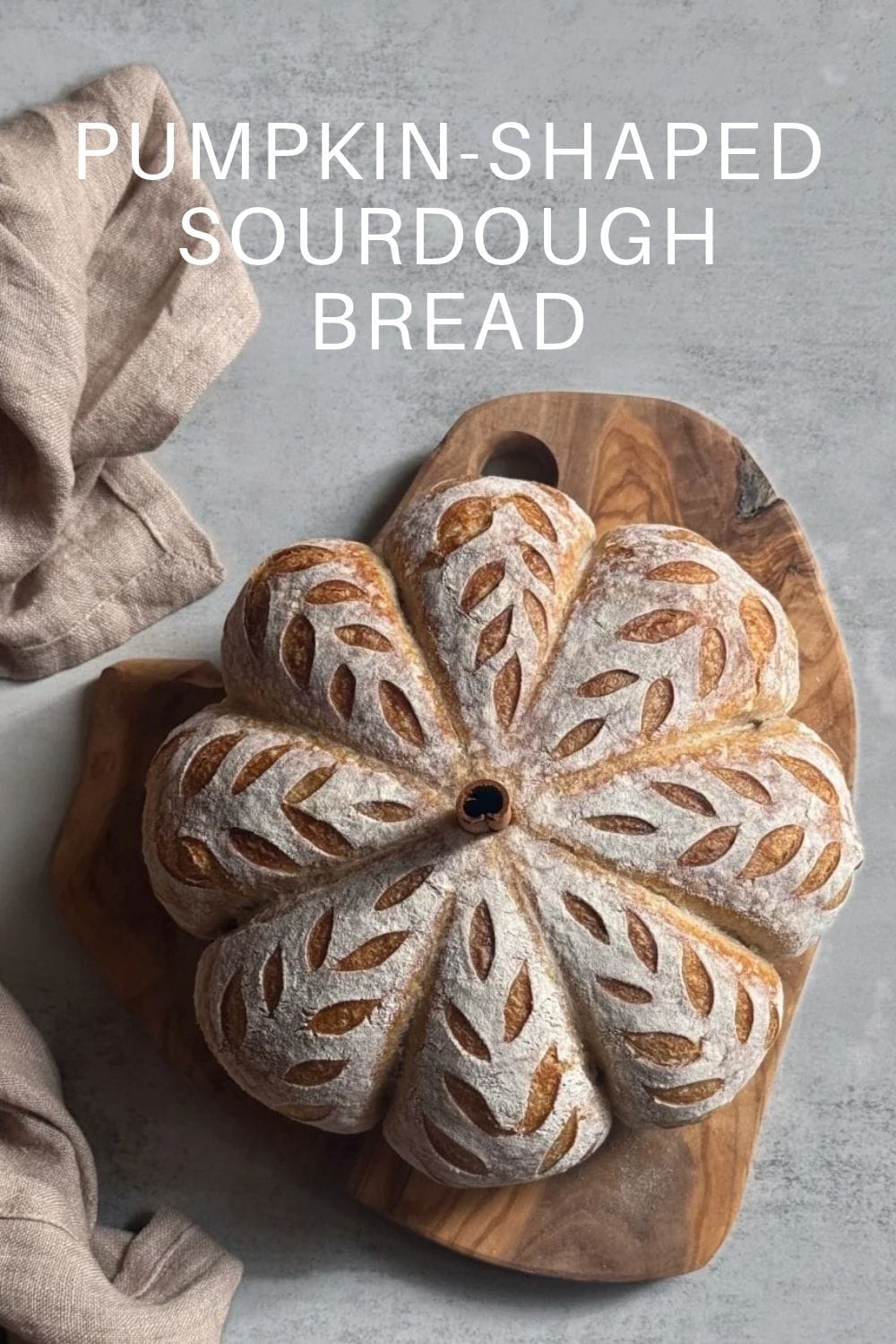
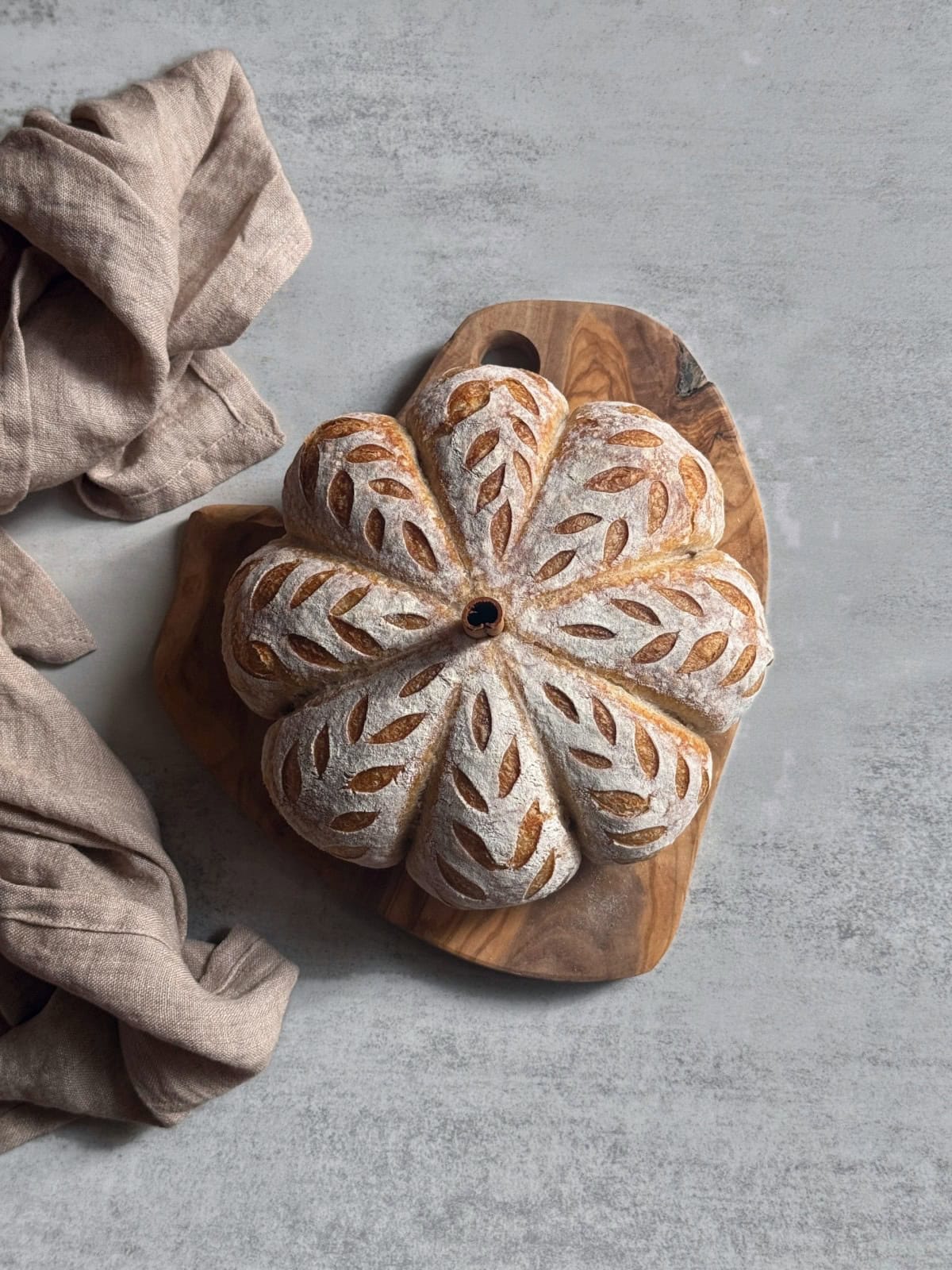
Pumpkin-shaped sourdough bread is a round sourdough loaf tied with kitchen twine before baking. During baking, the twine gently presses into it, creating sections that give the loaf its pumpkin shape. Add a cinnamon stick on top for the stem, and you have a bread that makes a lovely fall centerpiece.
It seems like a lot of work, but it is just a regular sourdough boule with a bit of kitchen twine. It's perfect for Thanksgiving and always the first thing people want to take pictures of.
Quick Summary
- What it is: a sourdough boule tied with twine into pumpkin sections
- Flour: 450 g King Arthur bread flour
- Hydration: 78%
- Banneton: 8-inch (20 cm) round
- Twine: 100% cotton kitchen twine, used dry, soaked in water, or soaked in oil
- Sections: 6, 8, or 10 (3, 4, or 5 pieces of twine)
- Bake: in a Dutch oven at 450°F (230°C), lid on, then lid off
- Stem: a cinnamon stick, added after baking
Note: This dough is 78% hydration, so it is soft and a little sticky. If you are new to sourdough, start with my Beginner's Sourdough Guide and my Beginner's Sourdough Bread recipe. You will also need an active starter. My Beginner Sourdough Starter recipe shows you how to make one.
What Is Pumpkin-Shaped Sourdough Bread?
Pumpkin-shaped sourdough bread is not a special dough. It is a regular sourdough boule shaped like a pumpkin with kitchen twine. Some bakers call it a sourdough pumpkin loaf. The twine wraps around the loaf from the bottom to the top. As the bread rises in the oven, the dough puffs up between the strings and forms rounded sections.
This recipe uses plain sourdough with no pumpkin in the dough. The pumpkin is all in the shape. You can make it look different with flour, cocoa powder, or seeds on top. I show you all of these below.
Ingredients
- Bread flour: I use King Arthur bread flour. Its high protein makes a strong dough that holds the pumpkin sections.
- Water: Use filtered or dechlorinated water.
- Levain (sourdough starter at peak): Use a 100% hydration starter that is active and bubbly. See my guide on sourdough starter peak.
- Salt: Use fine sea salt. Avoid iodized table salt.
- Rice flour: For dusting the banneton.
- Optional toppings: bread flour, unsweetened cocoa powder, or seeds such as sesame, poppy, pumpkin seeds, or sunflower seeds.
- Stem: one cinnamon stick.
Final Bread Formula
| Ingredient | Baker's Percentage | Weight |
|---|---|---|
| Bread flour | 100% | 450 g |
| Water | 78% | 351 g |
| Levain (active starter, 100% hydration) | 20% | 90 g |
| Salt | 2% | 9 g |
- Total dough weight is 900 g. It fits an 8-inch (20 cm) round banneton. To adjust the formula, use baker's percentages or my sourdough calculator.
- My kitchen temperature is 73°F, and the humidity is 46%.
- Bulk fermentation: 7 hours to 7 hours 30 minutes, with a 75-80% increase in dough size
- Proofing: overnight in the fridge.
- Bake in a Dutch oven at 450°F (230°C) with the lid on for 20 minutes, then with the lid off for 15-20 minutes.
Tools & Equipment
You need an 8-inch (20 cm) round banneton, 100% cotton kitchen twine, a Dutch oven, parchment paper, a bread lame, and scissors. A fine flour duster helps if you dust the top with flour or cocoa powder. For everything else I use, see my Essential Sourdough Tools & Equipment guide.
What Twine Should I Use for Pumpkin Sourdough?
Use 100% cotton kitchen twine. It must be unwaxed, undyed, and food-safe. Do not use polyester or nylon string. It can melt in a hot oven.
You can use the twine three ways. Each one works, but they release from the crust differently.
Dry Twine
Dry twine is the easiest to tie because it does not slip. The downside is that it sticks to the dough. The crust can tear a little when you pull it off. Dust the twine lightly with flour to help it release.
Twine Soaked in Water
Soak the twine in water for a few minutes, then squeeze out the extra. Wet twine is less likely to scorch, and it sticks less than dry twine. It still grips the dough, so remove it gently.
Twine Soaked in Oil
Soak the twine in a neutral oil, then wipe off the extra. Oiled twine releases the easiest. It slides out of the crust and leaves clean lines. It is a little slippery to tie, so tie it slowly.
My pick: oiled twine gives the cleanest sections, and water-soaked twine is a good second choice. In the step-by-step photos below, I used dry twine.
How to Make Pumpkin-Shaped Sourdough Bread
1. Autolyse
Add the water to the bread flour in a large bowl. Stir until you see no dry patches. Cover and let the dough sit until it feels smoother and stretches a little. Learn more in my post on sourdough autolyse.
2. Add Levain and Salt
Spoon the levain onto the dough. Wet your hands and squeeze it in, then fold the dough over itself until no streaks of starter remain. From this point, bulk fermentation has started.
Scatter the salt on top and work it in with one of my bread dough mixing techniques. Cover the bowl and give the dough a short rest.
3. Fold the Dough
Build strength with four sets of folds: two sets of stretch and folds, then two sets of coil folds. Wet your hands first so the dough doesn't stick. Rest the dough about 30 minutes between sets, until it relaxes and spreads again.
4. Finish Bulk Fermentation
Once the folds are done, cover the bowl and let the dough rise. Bulk fermentation is done when the dough looks domed, has bubbles on top and along the sides, and wobbles when you shake the bowl. It should feel light and airy.
Note: I allowed the dough to rise about 75-80% at 73°F (23°C). Your target rise will vary depending on your kitchen temperature. Warmer conditions will speed up bulk fermentation, while cooler environments will slow it down.
5. Preshape and Shape a Boule
Tip the dough onto a lightly floured counter (I use white rice flour). Preshape it into a round and let it rest for 15-20 minutes until it relaxes. Then shape a tight boule. A tight surface helps the sections puff up evenly. See my guide to shaping bread dough.
Shape a round boule, not a batard. An oval loaf will not form even pumpkin sections.
6. Cold Proof Overnight
Dust an 8-inch (20 cm) round banneton with rice flour. Place the boule in it, seam side up. Cover it and refrigerate overnight. Cold dough is firm, so it is much easier to tie.
7. Tie the Twine
Preheat the oven to 500°F (260°C) with the Dutch oven inside.
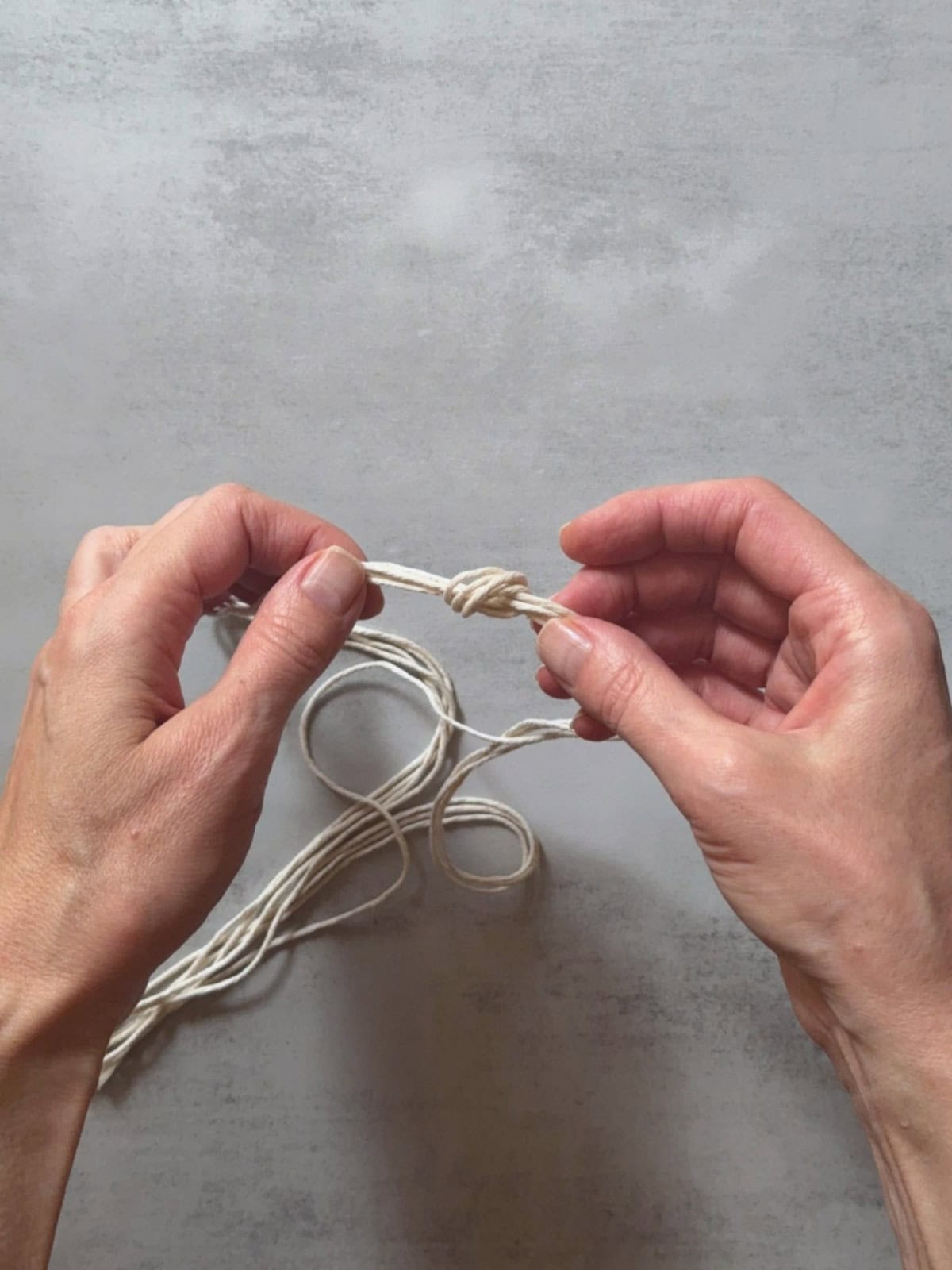
Cut four pieces of twine, each about 36 inches (90 cm) long. This makes 8 sections. Prepare the twine dry, soaked in water, or soaked in oil. Hold the four pieces together and tie one knot in the middle.
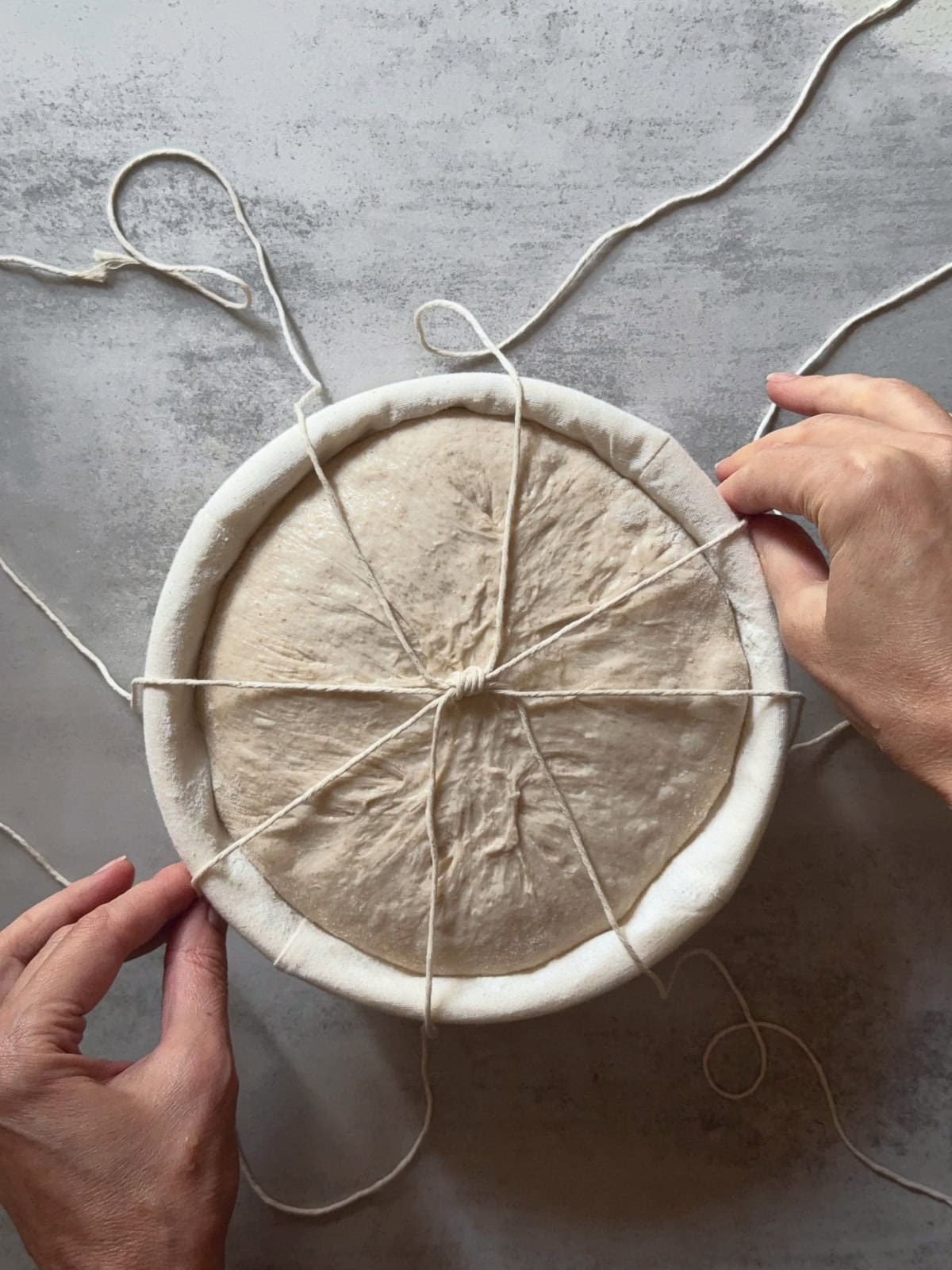
Take the dough out of the fridge, but leave it in the banneton. Lay the twine on the dough in a star shape, with the knot in the center.
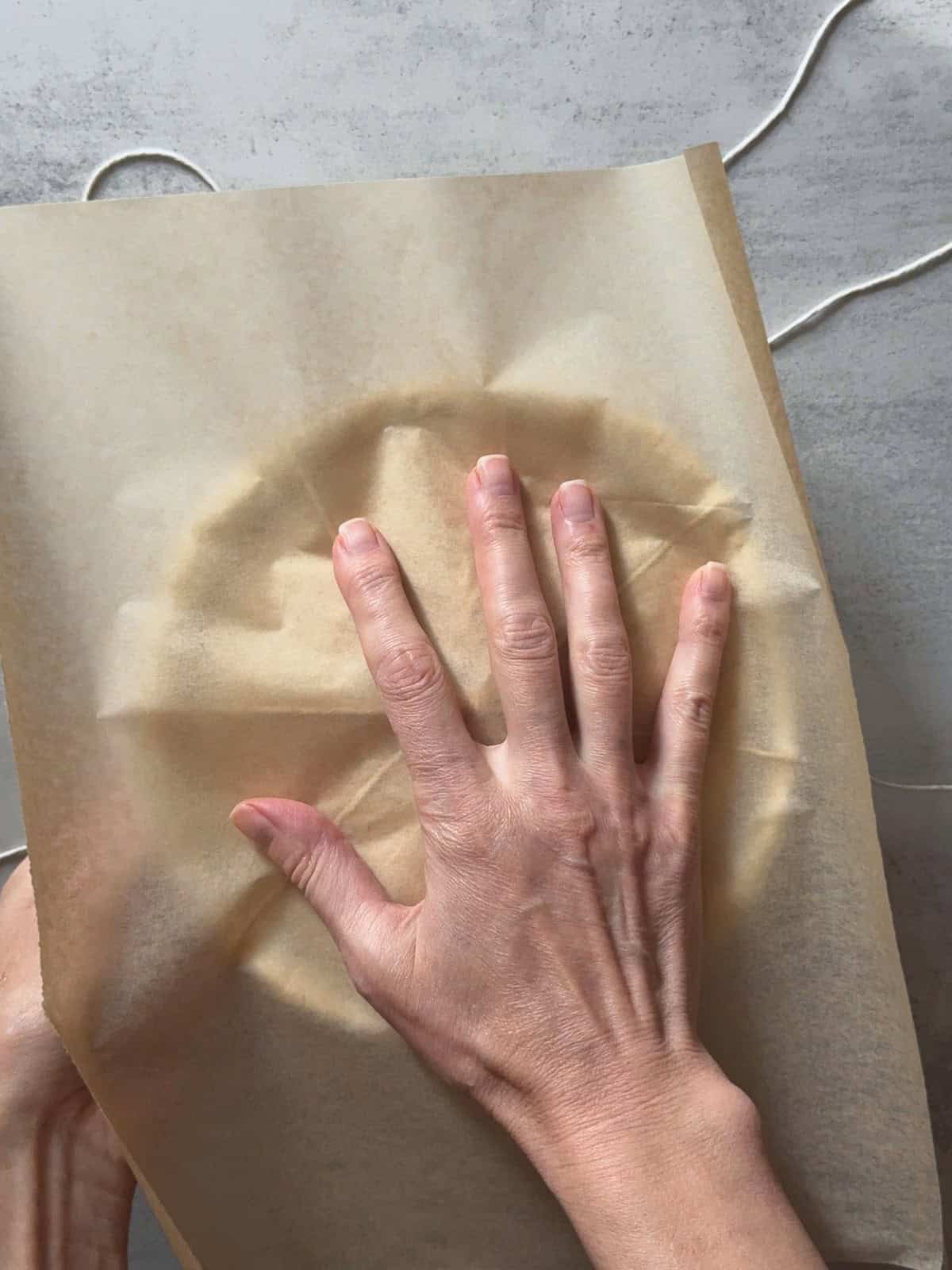
Place a sheet of parchment over the banneton and press it gently against the dough.
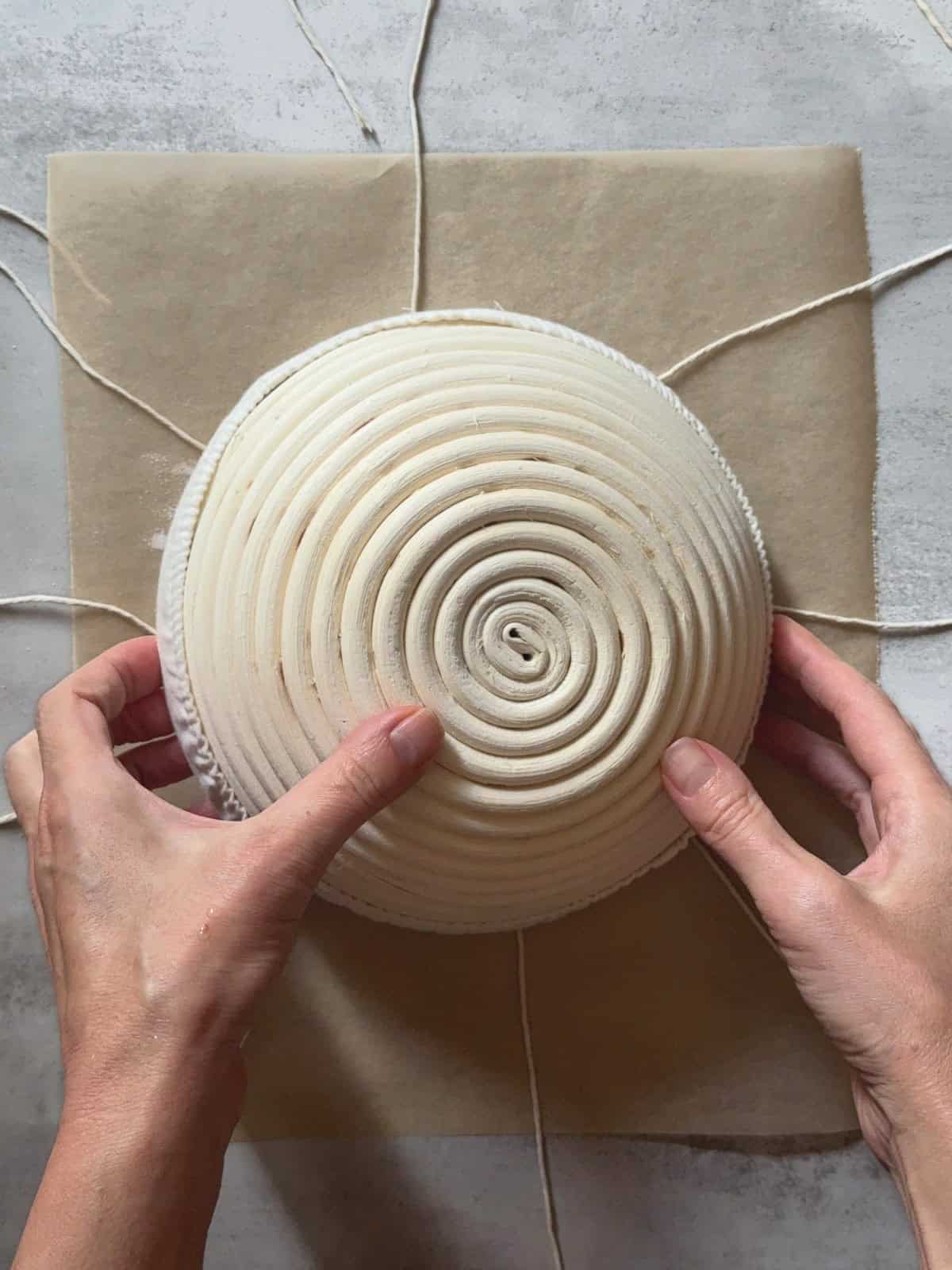
Hold the parchment in place and flip the banneton over onto the counter. Lift the banneton off slowly.
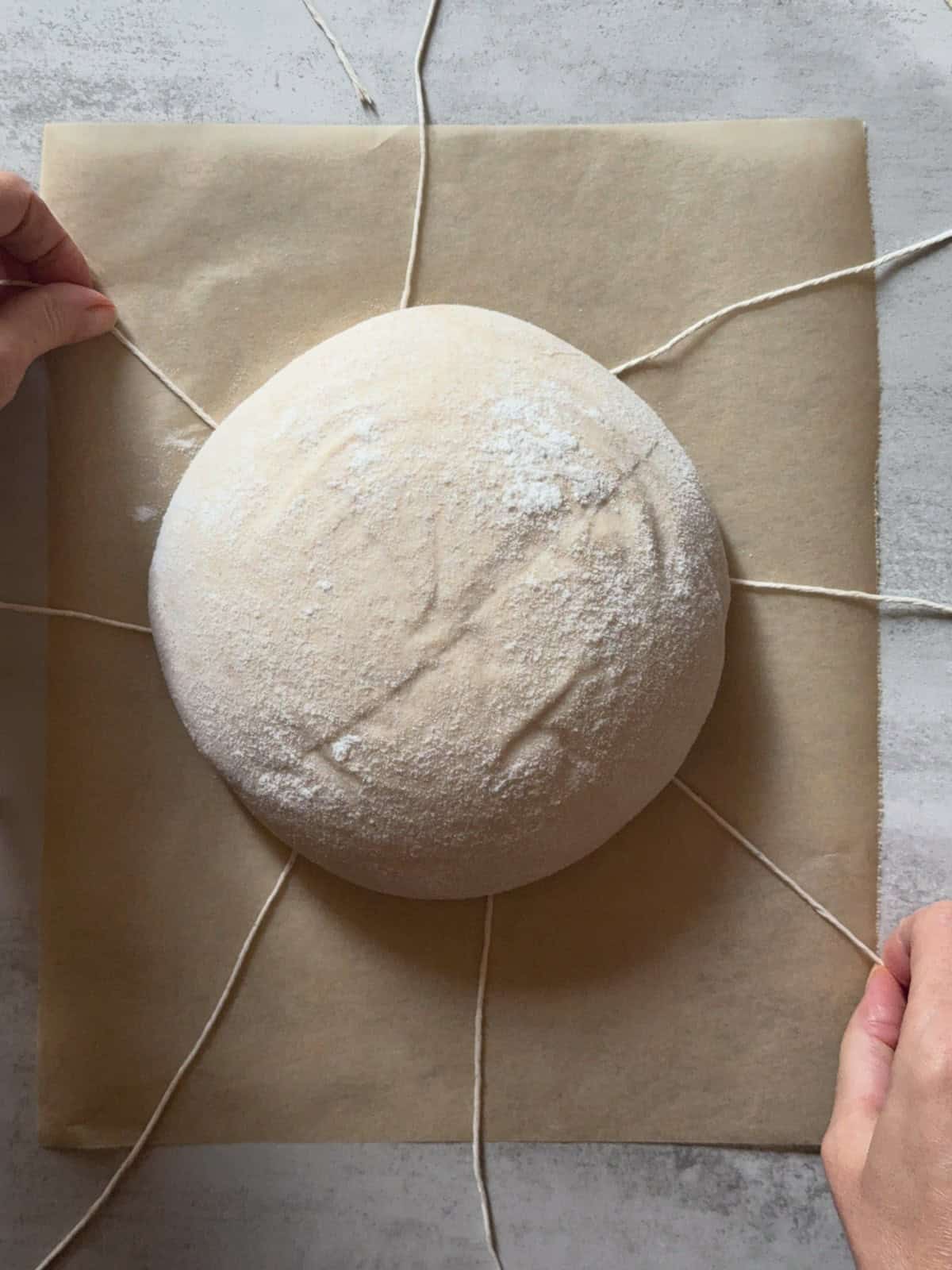
The dough now sits on the parchment, and the knot is under the center of the loaf. The twine strands spread out on all sides.
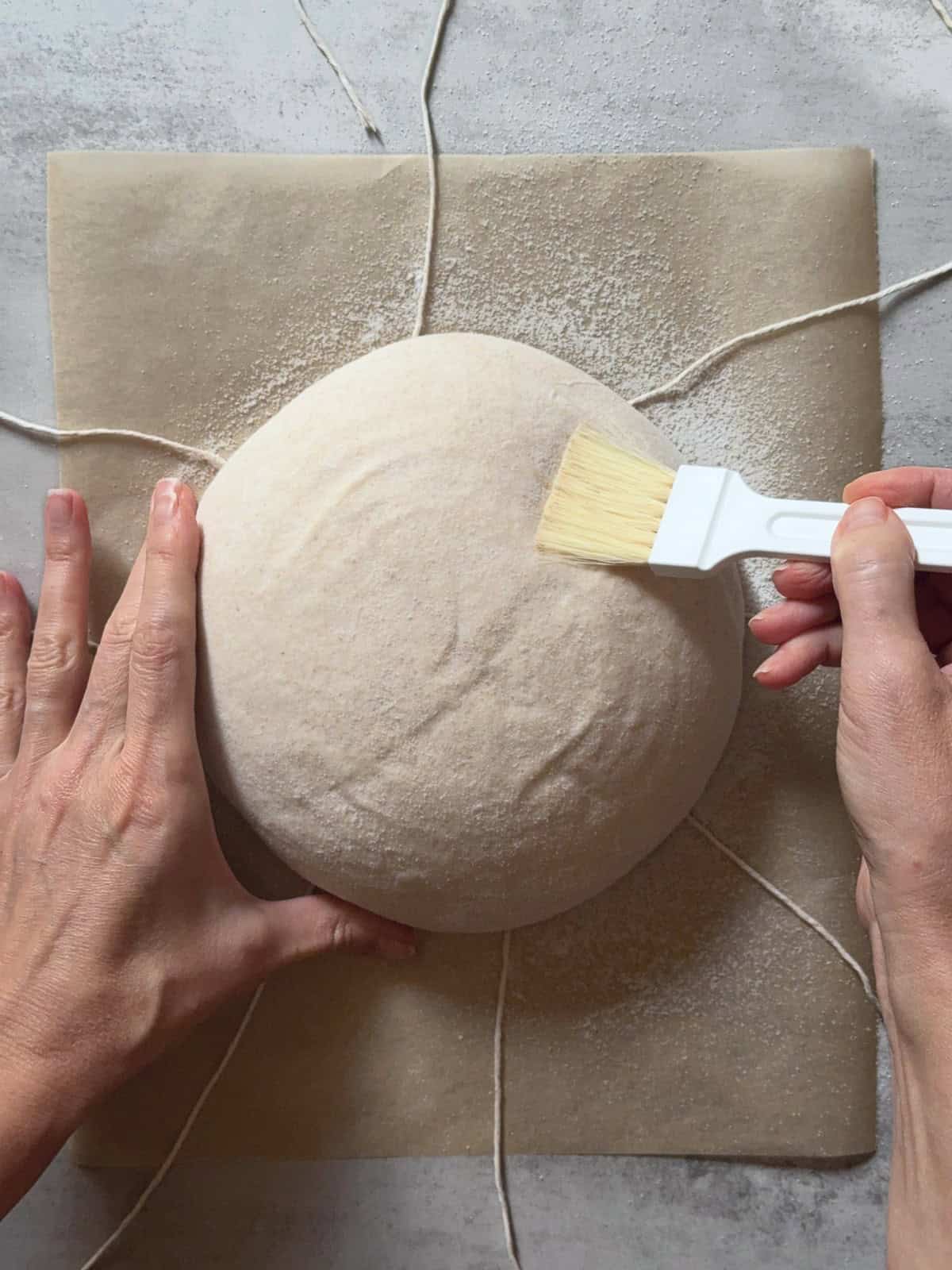
With a pastry brush, brush the rice flour off the top of the dough. Brush away the extra flour from the parchment too.
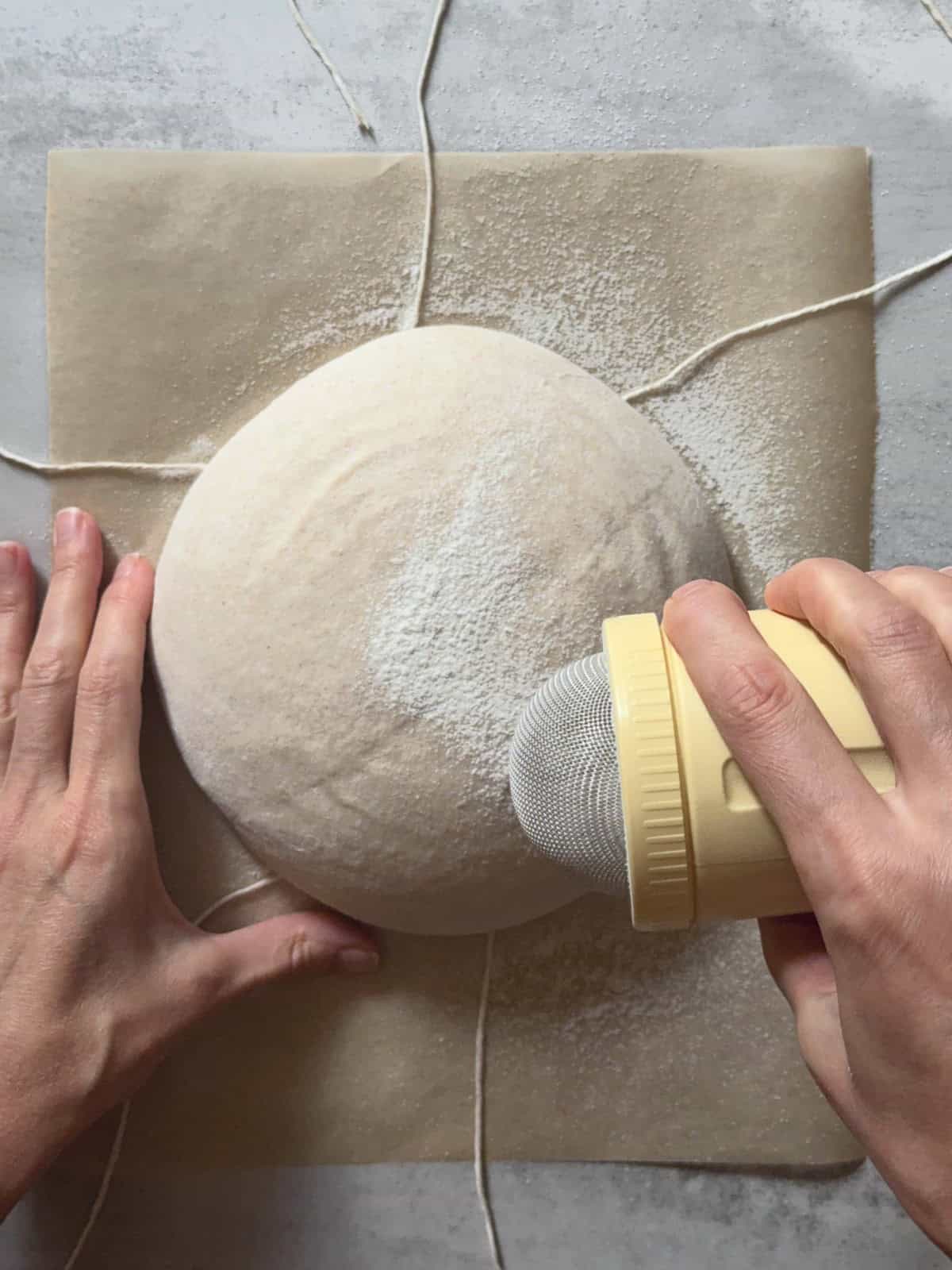
Dust the top with bread flour. For a cocoa pumpkin, use cocoa powder instead. For seeds or alternating sections, skip this step and add them after tying.
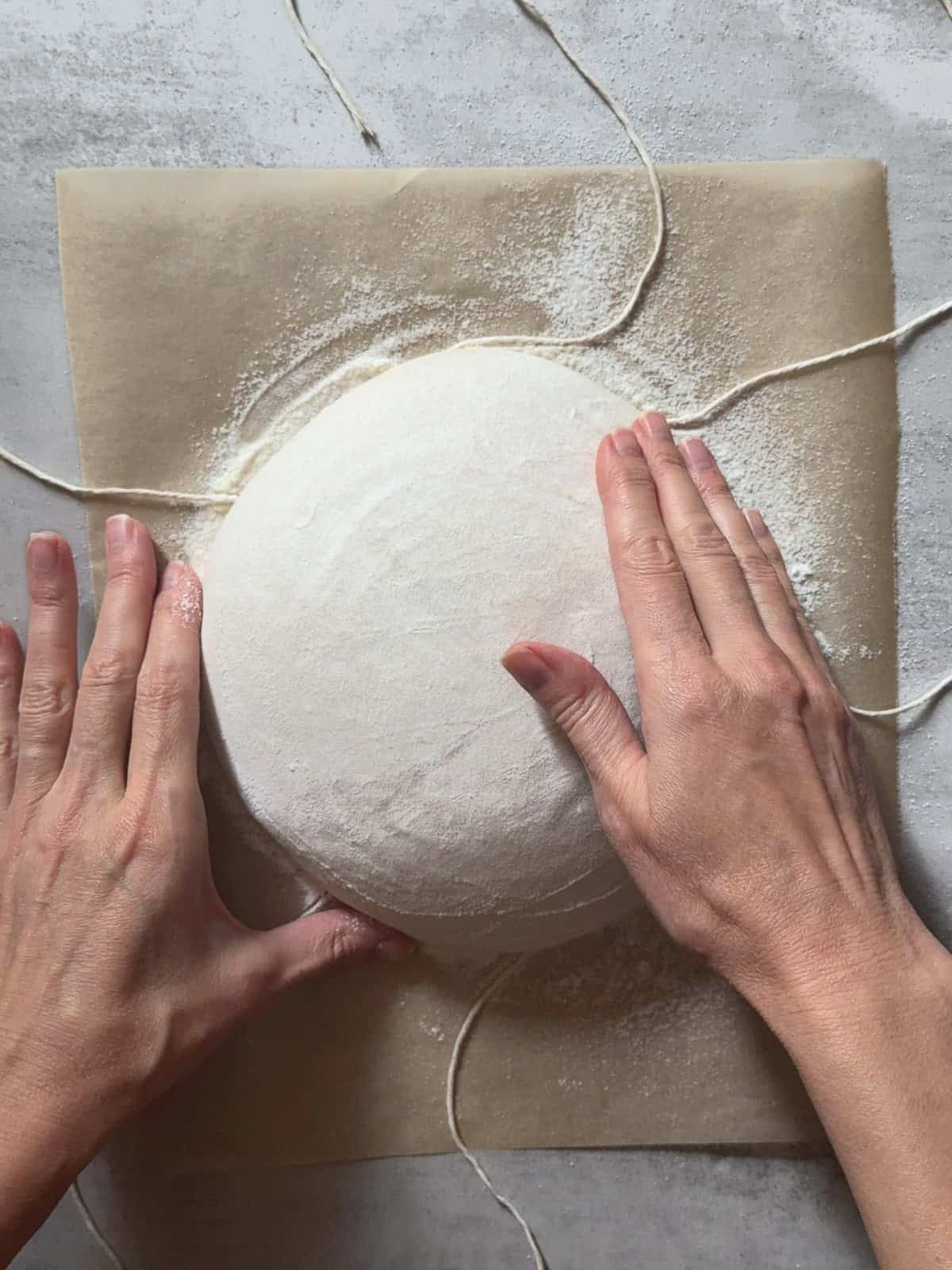
Spread the flour evenly over the dough with your palms.
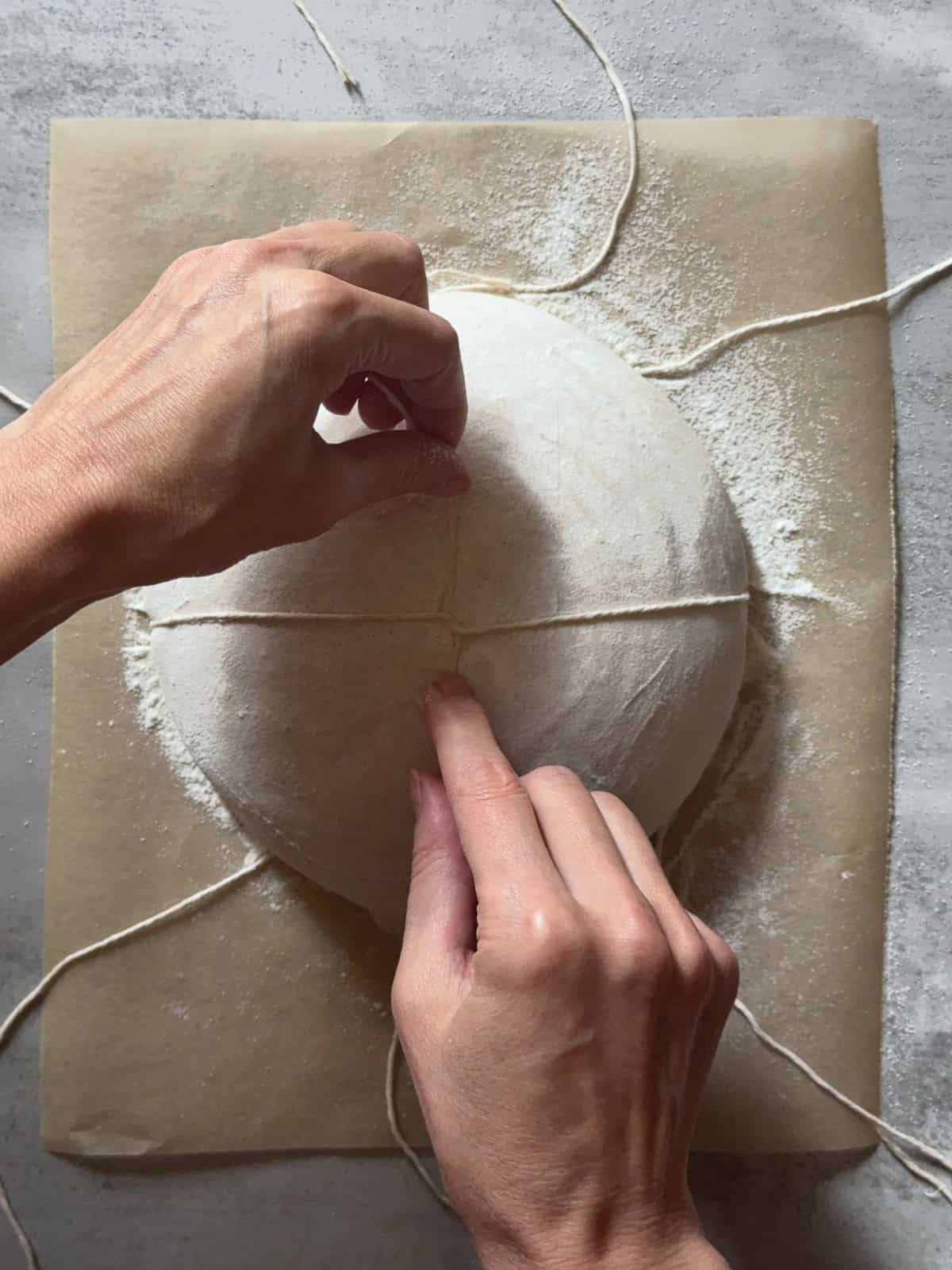
Bring the two ends of one strand up over the top and tie them loosely at the center. Repeat with the other strands, spacing them evenly around the loaf.
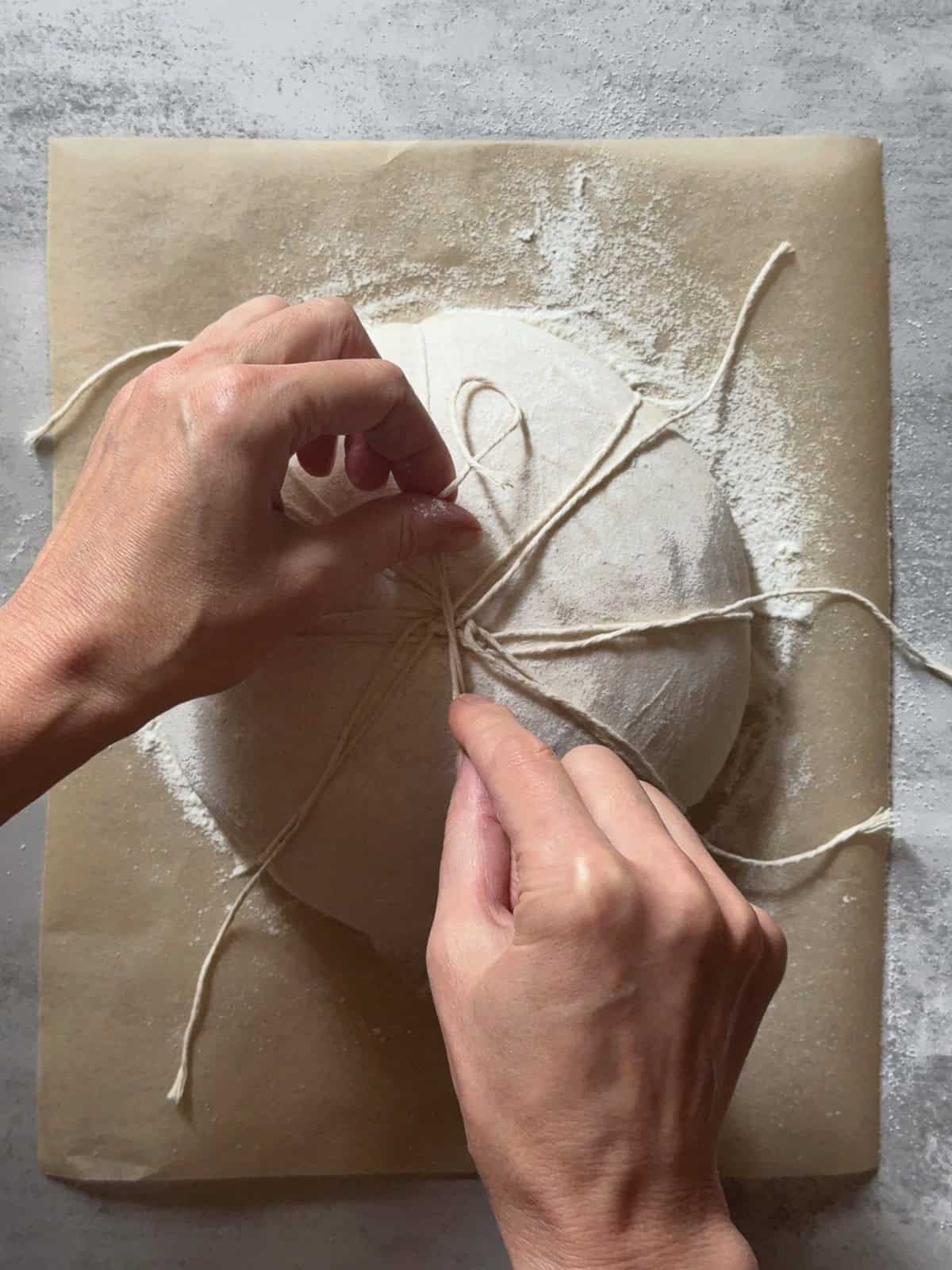
Tie all the ends together at the top. Leave about a finger's width of slack. The loaf grows a lot in the oven, and tight twine can cut into it.
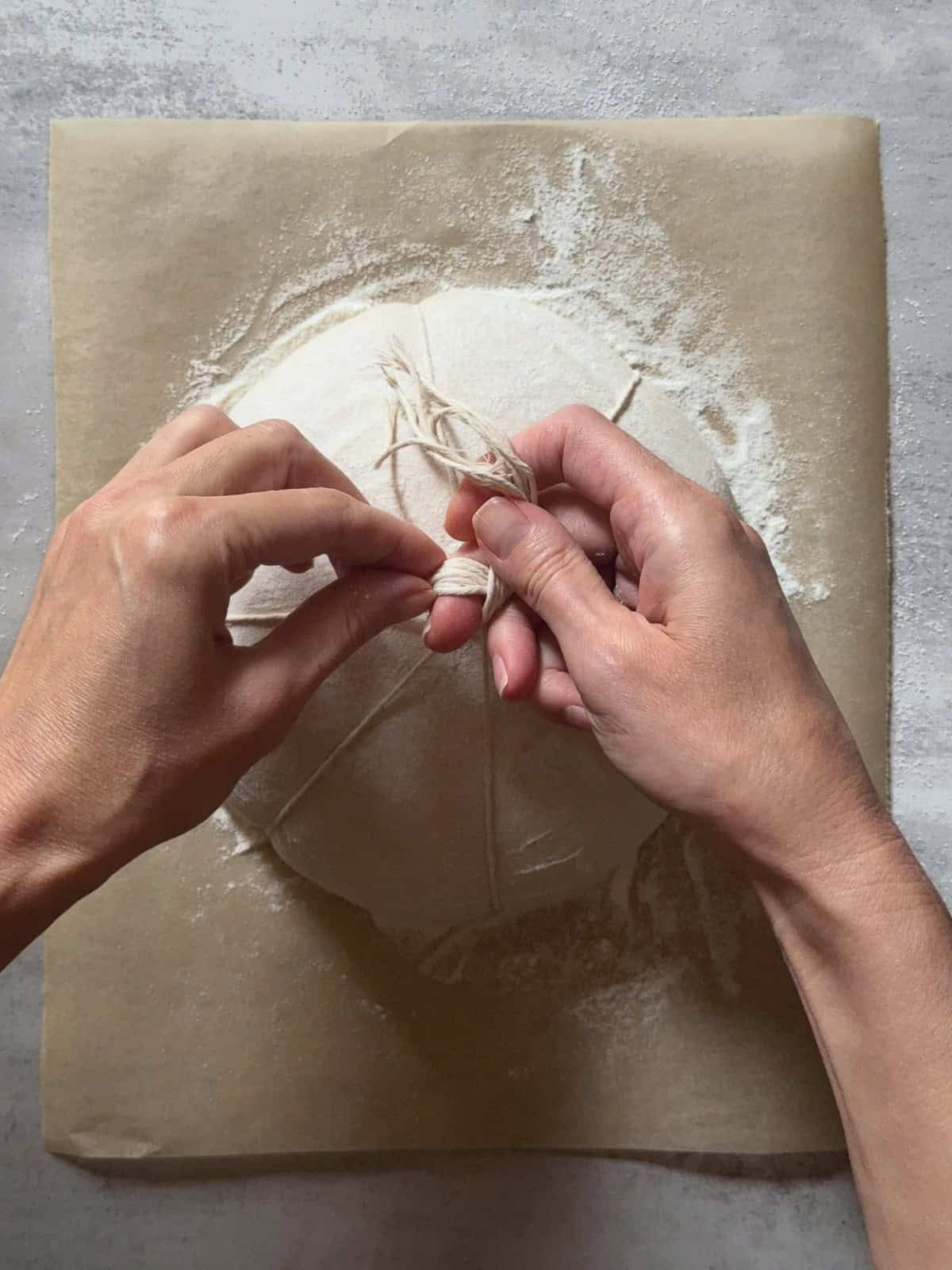
Twist the ends together and tie a final knot at the top. This holds all the strands in place.
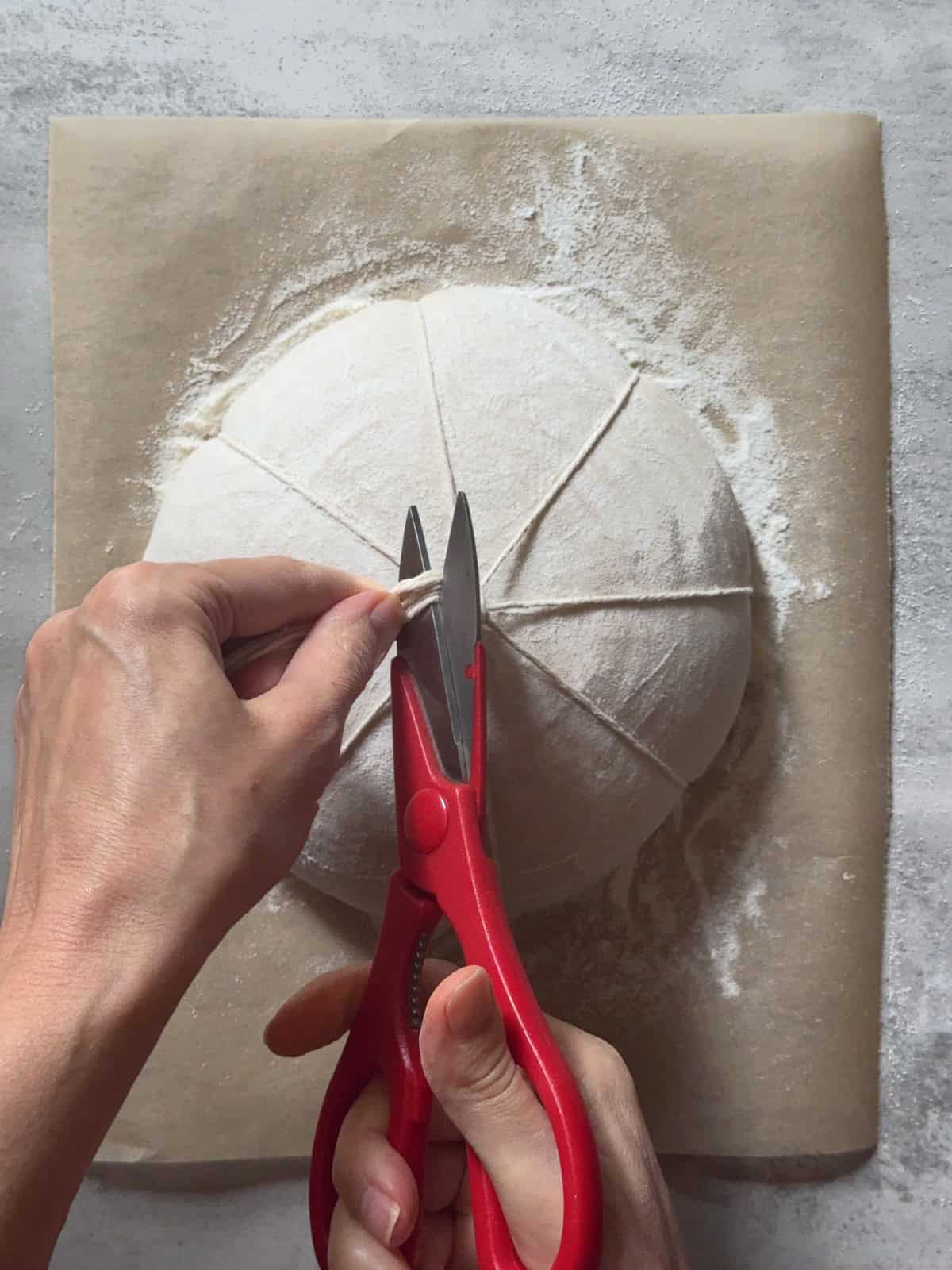
Cut off the extra twine above the knot.
8. Score
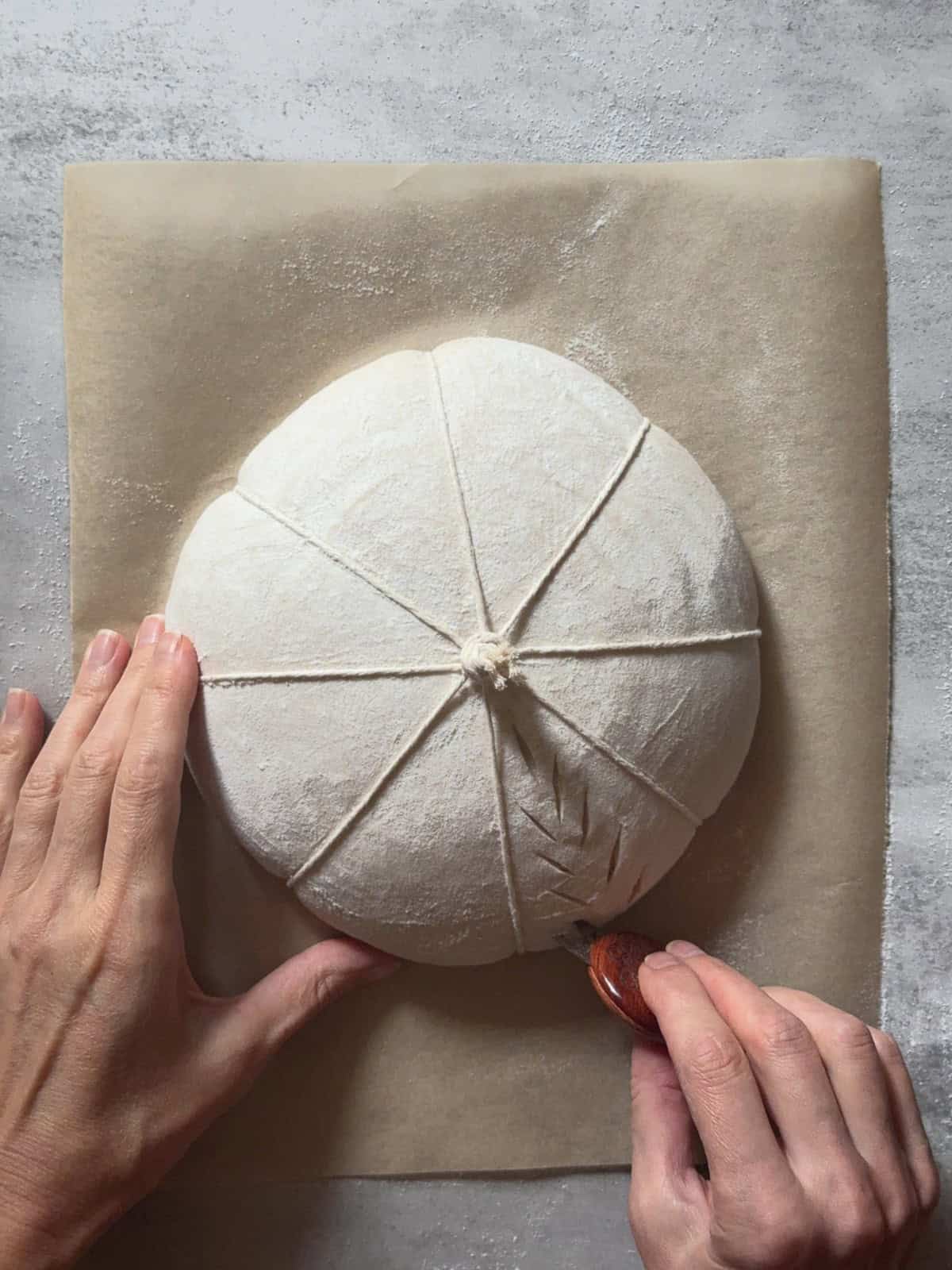
Score a wheat-like pattern in the middle of each section, from top to bottom. You can also score a small leaf or vine on top. Be careful not to cut the twine. See my guide to scoring sourdough bread.
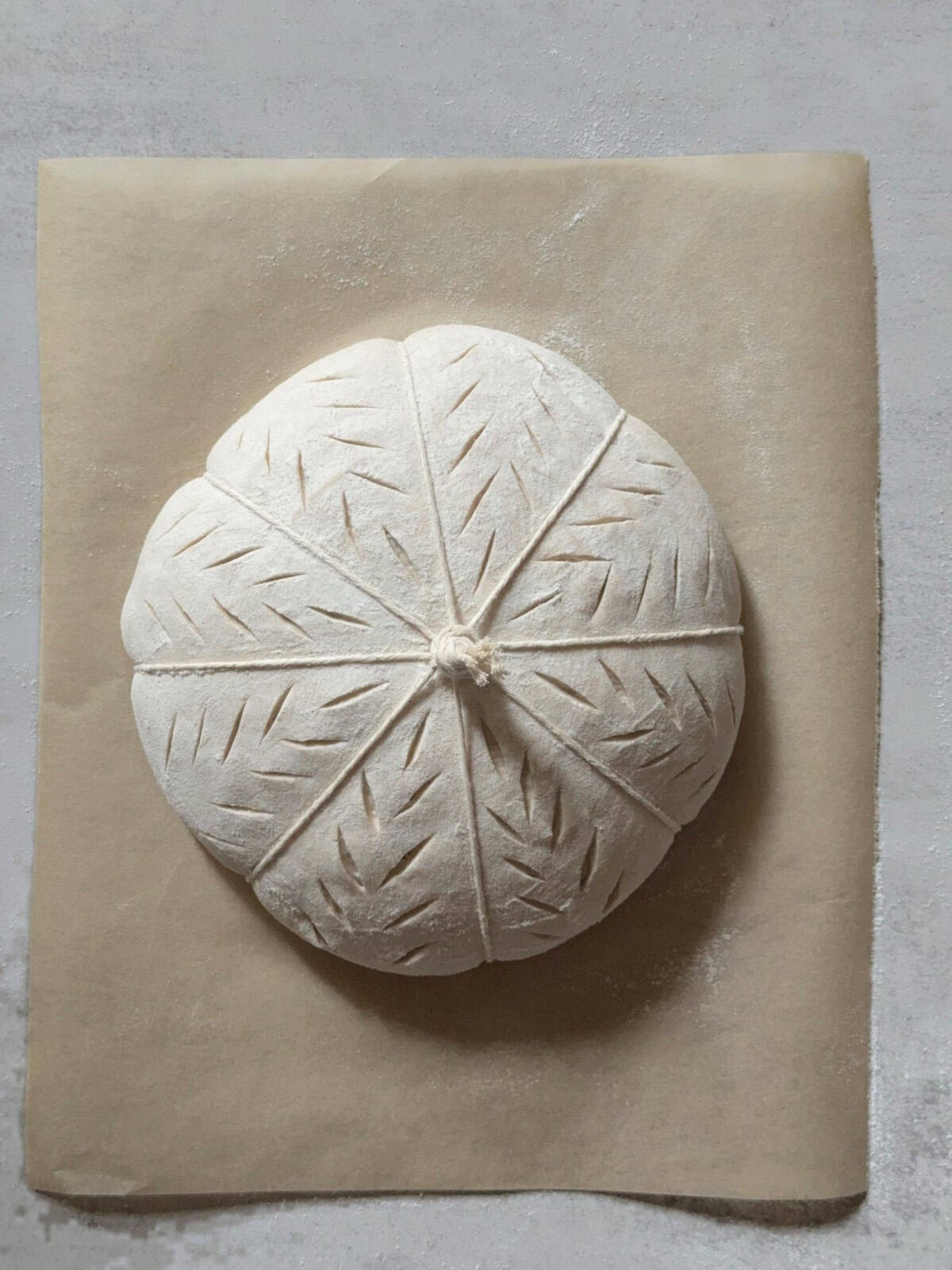
Here is the loaf with all eight sections scored and ready to bake.
9. Bake
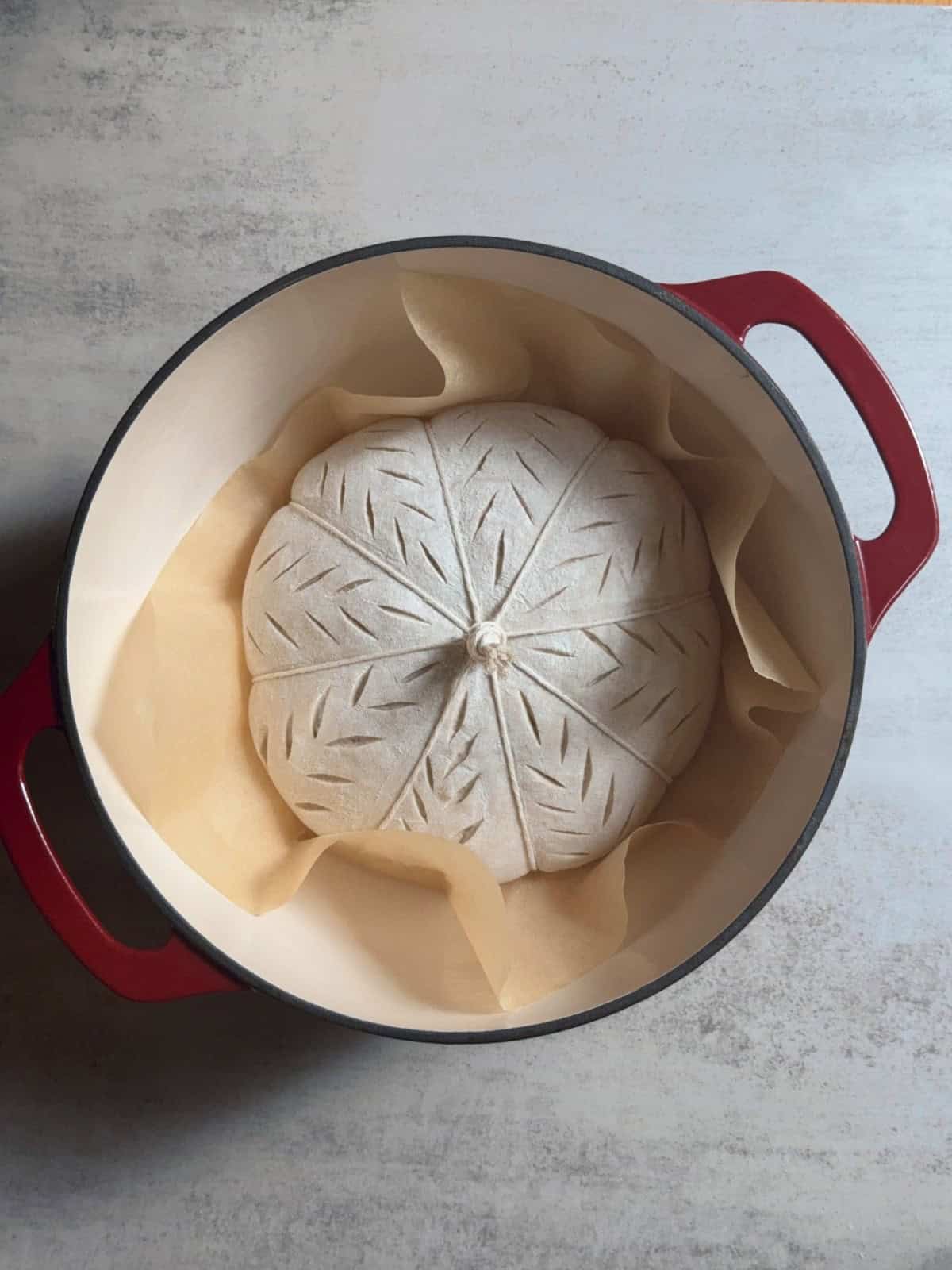
Use oven mitts to open the Dutch oven lid. Lower the dough on the parchment into the hot Dutch oven and cover.
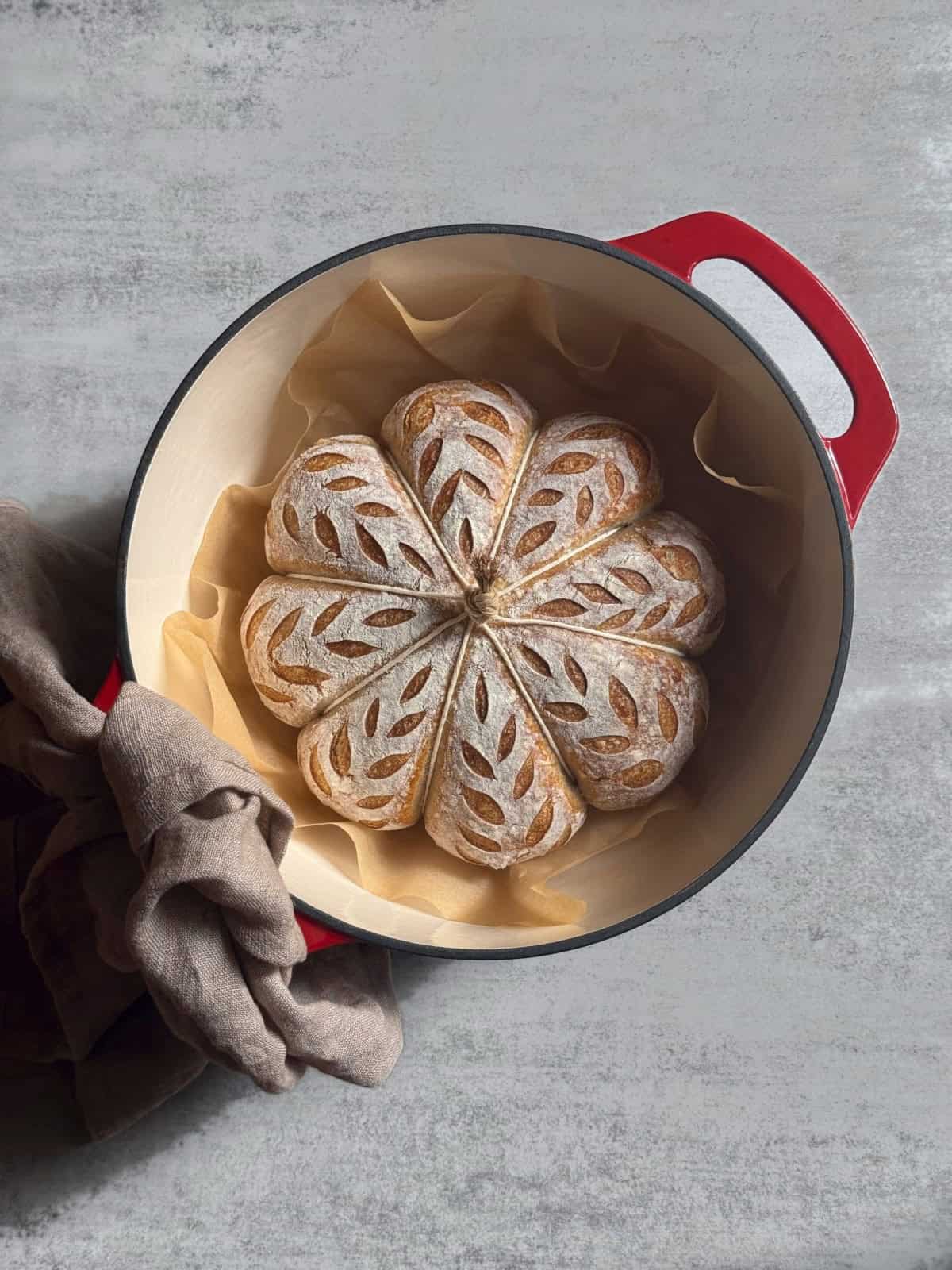
Reduce the oven to 450°F (230°C). Bake with the lid on for 20 minutes. Remove the lid and bake for 15 to 20 minutes more, until deep golden brown.
If you don't have a Dutch oven, read my post on baking sourdough without a Dutch oven.
10. Remove the Twine and Add the Stem
Let the loaf cool on a wire rack for about 10 minutes. Snip the twine at the top knot with scissors. Gently pull each piece out from the bottom. Push a cinnamon stick into the center of the top for the stem. Let the bread cool completely before slicing.
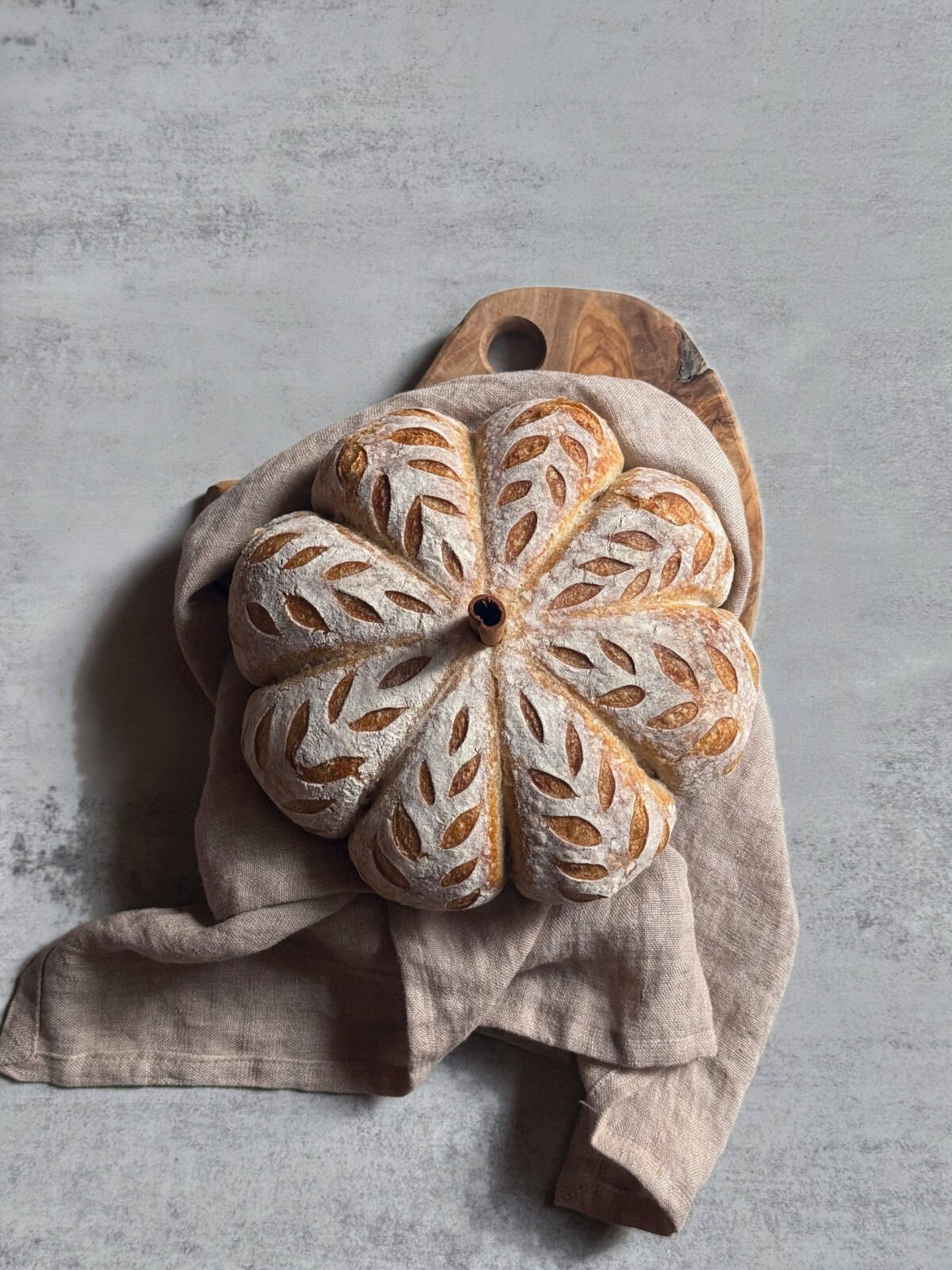
How to Make 6, 8, or 10 Pumpkin Sections
The number of twine pieces sets the number of sections. Each piece crosses the loaf and makes two sections.
- 6 sections: use 3 pieces of twine. The sections are wide and bold. This works well for a small loaf.
- 8 sections: use 4 pieces of twine. This is the classic pumpkin look, and the one I make most often.
- 10 sections: use 5 pieces of twine. The sections are narrow and detailed. Tie it a little looser, since more strings press into the dough.
Lay the pieces in an even star so the sections come out the same size.
Pumpkin Sourdough Variations
Most of these use the same plain dough, and only the topping changes. One uses a naturally colored dough. Apply flour and cocoa powder before you tie the twine. Add seeds and alternate flour and cocoa after you tie it.
Flour on Top
This is the classic look. Before you tie the twine, brush off the rice flour and dust the top with bread flour. Spread it with your palm. The flour stays pale while the score lines bake golden.
Cocoa Powder on Top
For a dark pumpkin, brush off the rice flour and sift unsweetened cocoa powder over the top before you tie the twine. Spread it gently with your palm. The cocoa bakes into a deep brown color, and the score lines show the light dough underneath.
Colored Dough with Cocoa Powder on Top
For a bold pumpkin, color the dough itself. Use the dough from one of my naturally colored loaves instead of the plain dough:
- Carrot sourdough bread for a true pumpkin orange
- Purple sweet potato sourdough bread for a deep purple pumpkin
- Pink sourdough bread with dragon fruit powder
- Spinach sourdough bread for a green pumpkin
- Turmeric sourdough bread for a golden yellow pumpkin
Follow that recipe through the cold proof. Then brush off the rice flour, sift cocoa powder over the top, and tie the twine as usual. When you score, each cut opens through the dark cocoa and shows the bright color underneath.
Each colored dough has its own formula and weight. Check that it fits your banneton before you start.
Alternating Flour and Cocoa Sections
Tie the twine first. The strings show you exactly where each section starts and ends. Then dust every other section with bread flour and the rest with cocoa powder. Hold a piece of paper along the twine to cover the next section while you dust. Work slowly, one section at a time. The result is a striped pumpkin that looks great on a fall table.
Seeds on the Sections
Tie the twine first. Then lightly mist the sections with water so the seeds stick. Sprinkle seeds over every section, or over every other one, and press them in gently. Sesame, poppy, pumpkin seeds, and sunflower seeds all work.
How to Make Mini Pumpkin Sourdough Loaves
Tie mini pumpkin loaves with one piece of twine instead of four. Each loaf gets its own string, wrapped around it like a ball of yarn.
- After bulk fermentation, divide the dough into four to six equal pieces, about 150 to 225 g each. Shape small boules and cold proof them overnight.
- Cut one piece of twine for each loaf, about 36 inches (90 cm) long.
- Place a boule on parchment. Hold one end of the twine at the top center. Wrap the twine down one side, under the bottom, and back up to the top.
- Turn the loaf a little and wrap again, crossing over the top center each time. Three wraps make 6 sections. Four wraps make 8.
- Tie the end to the starting end at the top. Leave a little slack, just like the large loaf.
- Score each section and bake. Small loaves bake faster, so start checking them early.
Bulk Fermentation Expectations
This dough is 100% bread flour at 78% hydration. White flour ferments a little slower than whole grain flour, so bulk can take longer than with my artisan sourdough bread.
For a pumpkin loaf, don't push bulk too far. Overfermented dough is slack. It spreads instead of puffing up between the strings, and the sections look flat.
Sample Baking Schedule
Here is a schedule that works in a 73°F (23°C) kitchen. Watch the dough more than the clock.
Day 1
- Before you start: Build the levain so it peaks when you are ready to mix.
- 9:00 am: Autolyse.
- 9:30 am: Add levain and salt. Bulk fermentation starts.
- 10:00 am to 11:30 am: Two sets of stretch and folds, then two sets of coil folds, 30 minutes apart.
- About 4:30 to 5:00 pm: Bulk ends after 7 to 7 hours 30 minutes, when the dough has grown 75 to 80%. Preshape and rest for 15 to 20 minutes.
- About 5:15 pm: Shape a boule and place it in the banneton.
- About 5:30 pm: Refrigerate overnight.
Day 2
- Morning: Preheat the oven and Dutch oven to 500°F (260°C).
- While it heats: Tie the twine, add toppings, and score.
- Bake: 20 minutes lid on, then 15 to 20 minutes lid off at 450°F (230°C).
- After baking: Remove the twine, add the cinnamon stick, and cool.
Expert Tips for the Best Pumpkin-Shaped Sourdough
- Tie it loose: Leave a finger's width of slack. The dough grows a lot in the oven.
- Tie it cold: Dough straight from the fridge is firm and holds its shape while you work. You can even put the dough (still in a banneton) in the freezer for 20- 30 minutes before tying and scoring.
- Center the knot: An off-center knot makes uneven sections.
- Score each section: A shallow cut in each section helps it open evenly.
- Use a large Dutch oven: Choose one with room around the loaf. If the sides of the pot touch the dough, they squash the sections and the pumpkin loses its shape.
- Check for doneness: The bread is done when the internal temperature reaches 205 to 210°F (96 to 99°C). Read more about the internal temperature of bread.
- Add the stem last: Add the cinnamon stick after baking so it doesn't burn.
How to Serve Pumpkin-Shaped Sourdough
Use it as a centerpiece first. Set it on a wooden board in the middle of the Thanksgiving table. Slice it when dinner starts.
It goes well with butter, soup, or a fall cheese board. You can also hollow it out and use it as a bread bowl for dip.
A pumpkin loaf follows the same sourdough steps as any boule: an active starter, a well-read bulk, and a tight shape. If you want those steps in order, from feeding your starter to baking, grab my free Sourdough Baking Roadmap.
Pumpkin-Shaped Sourdough FAQ
What kind of string is safe for pumpkin sourdough?
Use 100% cotton kitchen twine that is unwaxed and undyed. Do not use synthetic string. It can melt in the oven.
Should I soak the twine in water or oil?
Both work. Oiled twine releases the easiest and leaves clean lines. Water-soaked twine sticks less than dry twine. Dry twine is easiest to tie but can tear the crust when removing it.
Should I tie the twine before or after the cold proof?
Tie it after the cold proof, right before baking. Cold dough is firm and easy to handle.
Why didn't my bread look like a pumpkin?
The twine was too loose, the dough was overproofed, or the boule was shaped loosely. Tie it with a little slack, but not floppy. Shape a tight boule, and end bulk at a moderate rise.
Why did the twine cut into my bread?
The twine was tied too tight. Leave about a finger's width of slack, so the dough can grow.
Can I use a batard instead of a boule?
No. An oval loaf will not form even sections. Use a round boule.
What can I use for the stem?
A cinnamon stick is the easiest. A real pumpkin stem or a small twig also works. Add it after baking.
Can I make mini pumpkin sourdough loaves?
Yes. Divide the dough into four to six pieces and shape small boules. Wrap each one with a single piece of twine, crossing over the top center three or four times. Small loaves bake faster, so check them early.
More Sourdough Recipes to Try
PrintRecipe
Pumpkin-Shaped Sourdough Bread (Easy Twine Method)
This pumpkin-shaped sourdough bread is a plain sourdough boule tied with cotton twine into pumpkin sections and finished with a cinnamon stick stem. It makes a beautiful fall and Thanksgiving centerpiece.
- Prep Time: 23 hours
- Cook Time: 40 minutes
- Total Time: 23 hours 40 minutes
- Yield: 1 loaf 1x
- Category: Sourdough Recipes
- Method: Baking
- Cuisine: American
Ingredients
For the levain (an active starter):
- 35 g sourdough starter
- 35 g bread flour
- 35 g water
For the dough:
- 450 g bread flour (I use King Arthur bread flour)
- 351 g water (78% hydration)
- 90 g levain (active starter at peak)
- 9 g fine sea salt (I use Redmond fine sea salt)
- Rice flour, for dusting
For shaping and decorating:
- 100% cotton kitchen twine, 4 pieces about 36 inches (90 cm) long
- Neutral oil or water, for soaking the twine (optional)
- 1 cinnamon stick, for the stem
- Bread flour, cocoa powder, or seeds, for the top (optional)
Instructions
- Autolyse: Add the water to the bread flour in a large bowl and stir until no dry patches remain. Cover and let it sit until the dough feels smoother and stretches a little.
- Add levain and salt: Squeeze the levain into the dough with wet hands and fold until no streaks remain. Bulk fermentation has started. Work in the salt, cover, and let the dough rest.
- Fold the dough: Do two sets of stretch and folds, then two sets of coil folds, resting about 30 minutes between sets.
- Finish bulk fermentation: Let the dough rise until it has grown 75 to 80%, about 7 to 7 hours 30 minutes at 73°F (23°C). It should look domed, show bubbles on top and along the sides, and wobble when you shake the bowl.
- Preshape and shape: Tip the dough onto a counter dusted with rice flour. Preshape a round and rest 15 to 20 minutes. Shape a tight boule.
- Cold proof: Place the boule seam side up in an 8-inch (20 cm) round banneton dusted with rice flour. Cover and refrigerate overnight.
- Tie the twine: Preheat the oven to 500°F (260°C) with a Dutch oven inside. Cut 4 pieces of twine and prepare them dry, soaked in water, or soaked in oil. Tie them together with one knot in the middle. Lay the twine in a star on the dough while it is still in the banneton, knot in the center. Cover with parchment and flip the dough out. Brush off the rice flour, then dust the top with bread flour or cocoa powder and spread it with your palms. Bring the two ends of each strand up over the top and tie them loosely at the center, leaving about a finger's width of slack. Tie a final knot at the top and cut off the extra twine.
- Add seeds (optional) and score: For seeds or alternating flour and cocoa sections, add them now, after tying. Mist the sections with water before adding seeds. Score a wheat-like pattern in the middle of each section, from top to bottom. Do not cut the twine.
- Bake: Lower the dough on the parchment into the hot Dutch oven and cover. Reduce the oven to 450°F (230°C). Bake 20 minutes with the lid on, then 15 to 20 minutes with the lid off, until deep golden brown.
- Remove the twine and add the stem: Cool for about 10 minutes. Snip the twine at the top knot and gently pull each piece out from the bottom. Push a cinnamon stick into the center for the stem. Cool completely before slicing.
Notes
- Equipment: 8-inch (20 cm) round banneton, 100% cotton kitchen twine, Dutch oven, parchment paper, bread lame, pastry brush, flour duster, and scissors.
- Sections: Use 3 pieces of twine for 6 sections, 4 for 8 sections, or 5 for 10 sections.
- Twine: Use 100% cotton, unwaxed, undyed twine. Oiled twine releases the easiest. Water-soaked twine sticks less than dry twine.
- Tie it loose: The dough grows a lot in the oven. Tight twine can cut into the loaf.
- Tie it cold: For firmer dough, put it in the freezer, still in the banneton, for 20 to 30 minutes before tying and scoring.
- Toppings: Dust flour or cocoa powder on top before tying the twine. A flour duster makes it even. Add seeds or alternating flour and cocoa sections after tying.
- Colored dough: Use the dough from my carrot, purple sweet potato, dragon fruit, spinach, or turmeric sourdough recipe, then dust the top with cocoa powder before tying. The scores show the bright color underneath.
- Mini loaves: Divide the dough into four to six pieces. Wrap each small boule with one piece of twine, crossing over the top center three or four times.
- Large Dutch oven: Use a Dutch oven with room around the loaf, so the sides do not squash the pumpkin sections.
- Shape: Use a round boule, not a batard.
- Doneness: The bread is done at an internal temperature of 205 to 210°F (96 to 99°C).
- Custom formula: Use my sourdough calculator to scale the recipe.
- Nutrition: Nutrition is for the whole loaf and includes the levain. It does not include the rice flour, toppings, or stem.
Nutrition
- Serving Size: 1 loaf
- Calories: 1787
- Sugar: 1.5g
- Sodium: 3498mg
- Fat: 8.4g
- Saturated Fat: 1.2g
- Unsaturated Fat: 4.3g
- Trans Fat: 0g
- Carbohydrates: 359g
- Fiber: 11.9g
- Protein: 59.4g
- Cholesterol: 0mg
Comments
No Comments