

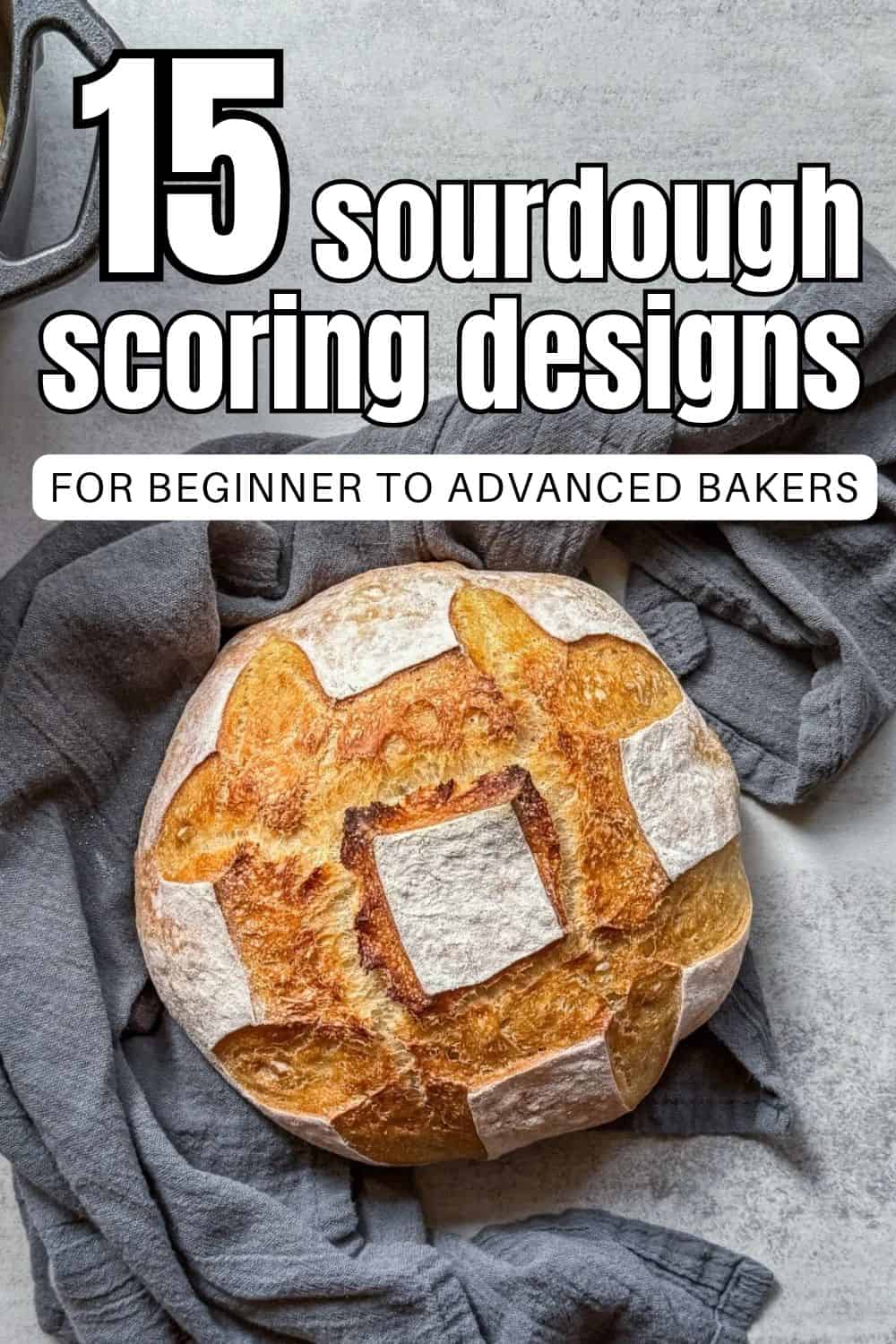
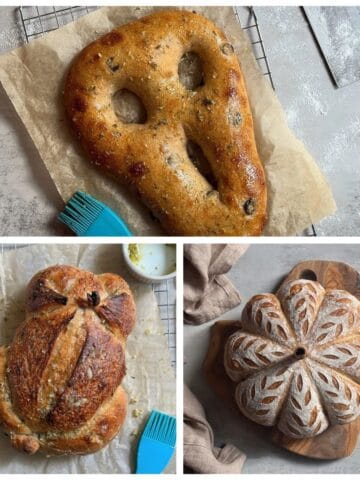
If you are ready to try sourdough scoring designs, you are in the right place. I have put together the most popular bread-scoring patterns, from simple wheat stalks to more detailed artistic designs.
But before diving into intricate designs, I suggest mastering bulk fermentation and shaping sourdough. Without proper proofing and surface tension, even the most creative scoring attempts will not turn out as expected.
Quick Summary
Sourdough scoring designs are decorative cuts you make on the cold-proofed dough right before baking. Dust the loaf with flour, make one deep expansion score so the bread can open, and keep the decorative cuts shallow. Start with simple lines, then move on to leaves, spirals, and flowers.
- Beginner designs: triangle, square, wheat stalk, chevron, zebra, and rose
- Intermediate designs: ric rac, leaf, multiple wheat stalks, spiral, and sunburst
- Advanced designs: feathered leaf, sunflower, swirly leaves, and geometric patterns
- Depth: about ½ inch for the expansion score and ⅛ to ¼ inch for decorative cuts
- Tools: a lame or razor blade, small scissors, a pastry brush, and flour for contrast
Why Try Decorative Scoring?
Decorative sourdough scoring is a creative way to advance your bread-making and turn your bread into a beautiful work of art.
But before picking up your razor lame or tool of choice, consider your skill level and choose a design that matches it.
If you are a novice baker, begin with simple patterns like basic lines or a wheat stalk. As your confidence grows, you can take on more detailed designs. Remember, practice is key, and your skills will improve over time.
Tools for Decorative Scoring
To create stunning designs, here are some tools you might need:
- UFO lame or a curved lame
- Razor blades
- Pastry brush (some bakers use a fan makeup brush)
- Small scissors
- Sewing thread or kitchen twine, to mark straight guide lines
- Cake turntable (optional), for spirals and round designs
How to Score Sourdough Designs
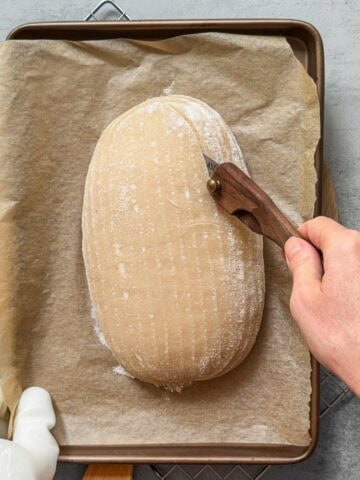
Here is a step-by-step guide to scoring decorative patterns on your sourdough bread.
- Turn the dough out of the banneton onto parchment paper.
- Gently brush off any excess flour from the dough and parchment using a pastry brush.
- Dust the dough's surface with bread or all-purpose flour, then smooth it out with the palm of your hand.
- Use a lame or sharp razor blade to score the dough about ¼ to ½ inch deep.
Scoring Depth and Angle
- Expansion score: cut about ½ inch deep. Hold the blade at a low angle, about 30 to 45 degrees, if you want an ear.
- Decorative cuts: cut only ⅛ to ¼ inch deep, with the blade held straight up. These cuts open slightly and show the pattern.
- Always add one expansion score. Without it, the loaf bursts through your design.
Learn more about angles in my ultimate guide to sourdough ears.
Sourdough Scoring Designs at a Glance
| Design | Best loaf | Level |
|---|---|---|
| Triangle | Boule | Beginner |
| Square | Boule | Beginner |
| Wheat stalk | Batard or boule | Beginner |
| Chevron | Batard | Beginner |
| Zebra | Batard | Beginner |
| Rose | Boule | Beginner |
| Ric rac | Batard | Intermediate |
| Leaf | Boule or batard | Intermediate |
| Multiple wheat stalks | Boule | Intermediate |
| Spiral | Boule | Intermediate |
| Sunburst | Boule | Intermediate |
| Feathered leaf | Batard or boule | Advanced |
| Sunflower | Boule | Advanced |
| Swirly leaves | Boule | Advanced |
| Geometric | Boule or batard | Advanced |
Beginner Sourdough Scoring Designs
Here are some easy designs to try if you are just starting:
Triangle Scoring
Create a simple triangle pattern, ideal for a boule, by making three intersecting slashes to form a triangle. Here is how to do it:
- Start by making a small X in the center of the dough.
- Make a diagonal cut from one side of the dough.
- Make another diagonal cut from the opposite side so the two cuts cross at the top, forming a triangle.
- Add a horizontal or slightly angled cut at the bottom to finish the triangle.
Check out a quick video on triangle scoring by @another_crust_in_the_basket.
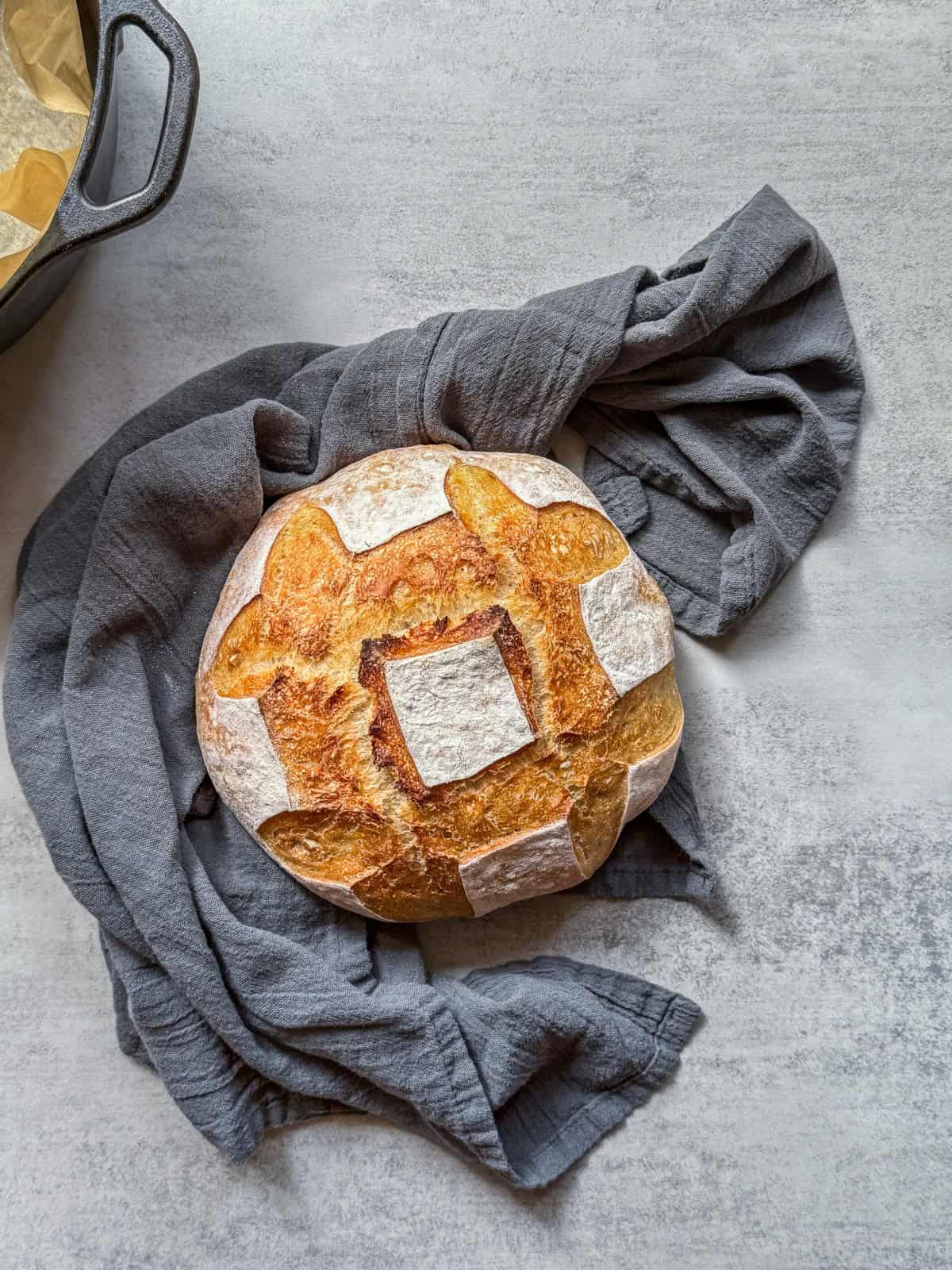
Square Scoring
Square scoring is one of the easiest designs for a boule. Four straight cuts form a box on top of the loaf. In the oven, the center rises up like a lid, and each side can open into a small ear.
- Imagine a square in the middle of the boule, about two-thirds of its width.
- Make the first straight cut along one side of the square, about ½ inch deep.
- Turn the loaf and cut the next three sides the same way. Let the ends of the cuts overlap slightly at the corners, so the square opens fully.
- For ears, hold the blade at a low angle, about 30 to 45 degrees, pointing toward the outside of the loaf.
Leave the center plain, or add a small wheat stalk or cross inside the square for decoration. Check out a square pattern by @stretchfold.
Wheat Stalk Scoring
Wheat stalk scoring is one of the simplest and most beautiful designs, perfect for a batard or boule. Here is how you can do it:
- Use a toothpick or wooden skewer to lightly draw a straight line down about one-third of the dough. This line will serve as the stem of the wheat stalk and help guide your design (this step is optional).
- Make small angled cuts along both sides of the line. Space these cuts evenly and alternate sides to resemble ears of wheat.
- If you like, add a long, shallow slash (about ⅛ inch deep) along the line to enhance the design.
Watch quick videos on wheat stalk scoring for a boule by @another_crust_in_the_basket and for a batard by @danlarn.
Chevron Scoring
Creating chevron scoring involves making a series of V-shaped cuts that resemble a zigzag or chevron design. Here is how you can do it:
- Begin at one end of the dough and make a series of diagonal slashes down its length.
- Then, make another diagonal slash in the opposite direction, forming a V shape.
- Continue this pattern, making sure the tips of the V shapes line up nicely.
Watch a quick video on chevron scoring by @dough_engineering.
Zebra Scoring
Zebra scoring is an easy and eye-catching design, perfect for beginners working with a batard loaf. Here is how to do it:
- Start at one end of the batard and make a series of parallel diagonal slashes across the dough. Keep the cuts evenly spaced and continue until you reach the other end.
- Make a second set of diagonal cuts in the same direction between the initial slashes.
Check out a quick video on zebra scoring by @wayne_caddy.
Sourdough Rose Scoring
Sourdough rose scoring is a design that looks like a blooming rose. It works beautifully on a boule loaf. To create this pattern, start at the center of the dough and extend cuts outward toward the edges, like the petals of a rose.
- Make a small curved cut in the center of the boule.
- Add three or four slightly larger curved cuts around it, overlapping like petals.
- Keep adding rings of petals outward, each a little bigger than the last.
- Keep the petal cuts shallow, and add one deeper curved cut near the edge so the loaf can open.
Check out a quick video on sourdough rose scoring by @joyosity.
Intermediate Sourdough Scoring Designs
For bakers with some experience, try these slightly more detailed designs:
Ric Rac Scoring
Ric rac scoring creates a fun zigzag pattern on the surface of sourdough bread. This design looks like the wavy pattern of ric rac trim often used in sewing.
- Score one deep, straight line down the center of the batard.
- On each side, cut a continuous zigzag line parallel to it, with short, even points.
- Add a second zigzag line farther out if you like.
Watch a quick video on ric rac scoring by @marielesterbaker.
Leaf Scoring
Leaf scoring is a beautiful way to decorate your bread. To create this design, make a series of leaf-like slashes, varying their size and direction for a natural and elegant effect.
- Score a gently curved line for the center vein of the leaf.
- Make short angled cuts on both sides, slanting toward the tip.
- Repeat with smaller leaves pointing in different directions around the loaf.
Watch a quick video on leaf scoring by another_crust_in_the_basket.
Multiple Wheat Stalks Scoring
This design builds on the single wheat stalk. Score several stalks fanning out from one point near the edge of the loaf, like a small bundle of wheat. It looks best on a round boule.
Watch quick videos on wheat stalk scoring by @cananinmutfagindan_ and @another_crust_in_the_basket.
Spiral Scoring
Spiral scoring creates a continuous spiral cut that wraps around the loaf for a dynamic, eye-catching look.
- Place the loaf, on its parchment, on a cake turntable.
- Hold the blade at the center of the loaf at a shallow angle.
- Slowly turn the table while you move the blade outward, toward the edge.
- Stop just before the edge of the loaf.
Check out a quick video on spiral scoring by @barney_desmazery.
Sunburst Scoring
Sunburst scoring is a cheerful and straightforward design. Start with a half-circle cut and add slashes radiating outward to create a pattern that looks like the sun's rays.
Watch a quick video on sunburst scoring by @stella.dekova.
Advanced Sourdough Scoring Designs
If you are ready to try more detailed, artistic designs, advanced sourdough scoring is for you. These patterns, like flowers or geometric shapes, require steady hands and an understanding of how the dough expands during baking.
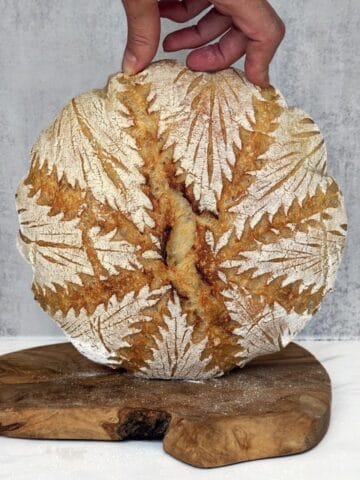
Feathered Leaf Scoring
Feathered leaf scoring is a fancier version of the regular leaf pattern. It uses detailed cuts to add texture and veining, making the loaf look more decorative. For extra contrast, dust your dough with bread flour or cocoa powder before scoring.
Check out quick videos on feathered leaf scoring by @daria_wonderlust_ and @another_crust_in_the_basket.
Sunflower Scoring
Sunflower scoring creates a beautiful design that looks like a blooming sunflower on your loaf.
- Score a small circle in the center of the boule, then crosshatch it to look like seeds.
- Score the petals around it. Each petal is two curved cuts that meet at a point.
- Add a second ring of petals between the first ones for a fuller flower.
Watch a quick video on sunflower scoring by @cananinmutfagindan_.
Swirly Leaves Scoring
Swirly leaves scoring features a swirling or curling effect in the leaf patterns. This design adds layers and movement to your loaf, making it stand out. Watch a quick video on swirly leaves scoring by @stella.dekova.
Geometric Scoring
Geometric scoring involves precise patterns, such as hexagons or interlocking shapes. These designs require planning and careful execution to make your loaf look truly artistic.
Look at quick videos on geometric scoring by @cananinmutfagindan_, @dough_engineering, and @breadjourney.
Top Tips for Decorative Scoring
- Use a sharp blade: A sharp tool, like a razor or bread lame, is key for clean, neat cuts. This helps you create clear and precise designs.
- Chill the dough: Cold dough is easier to score. Score it straight from the fridge after the cold proof, so it holds its shape and the cuts stay clean.
- Freeze the dough: For even firmer dough, put it in the freezer, still in the banneton, for about 30 minutes before scoring.
- Plan your design: Think about or sketch your design before you start. This helps you feel more confident when making cuts, especially for tricky patterns.
- Control depth: Make some cuts deeper and others shallow. Deeper cuts let the bread expand, while shallow ones add decoration.
- Use flour or cocoa powder for contrast: Sprinkle the dough with flour or cocoa powder before scoring to highlight your designs and make them stand out.
- Be confident: Don't hesitate! Make your cuts quickly and confidently to avoid uneven lines.
- Practice: Like any skill, practice makes perfect. Begin with simple designs and, as you gain confidence, move on to more detailed patterns.
- Try the 5-minute score: for very detailed designs, make the deep expansion cut a few minutes into the bake with the 5-minute score, so your pattern stays intact.
Common Scoring Mistakes and How to Fix Them
- The blade drags or tears the dough. The dough is too warm, or the blade is dull. Score the dough cold and change the blade often.
- The design disappears in the oven. The loaf opened through the pattern. Add one deep expansion score, and keep decorative cuts shallow.
- The cuts barely open. The cuts were too shallow, or the dough was overproofed.
- The loaf bursts at the side or bottom. The dough was likely underproofed, or the expansion score was too shallow.
- The flour falls off or looks patchy. Brush off the excess flour first, then dust a thin, even layer of rice or bread flour.
Beautiful scoring starts long before the blade touches the dough. My free Sourdough Baking Roadmap walks you through every step, from feeding your starter to the final bake, so your loaf is ready for your favorite design.
Frequently Asked Questions About Sourdough Scoring Designs
How deep should I score sourdough designs?
Make the expansion score about ½ inch deep. Keep the decorative cuts shallow, about ⅛ to ¼ inch, so they show the pattern without tearing the loaf.
What angle gives sourdough an ear?
Hold the blade at a low angle, about 30 to 45 degrees, and make one confident cut. See my guide to sourdough ears for more.
Which designs work best on a boule or a batard?
Round designs, like spirals, sunflowers, and roses, fit a boule. Long designs, like chevrons, zebra stripes, ric rac, and wheat stalks, fit a batard.
Do I need a lame to score sourdough?
No. A clean razor blade or a very sharp knife also works. A lame is easier to hold, and a curved one makes it easier to get an ear. Read more in scoring vs slashing.
When should I score sourdough?
Score right before baking, while the dough is still cold from the fridge. Cold dough holds its shape and cuts cleanly.
Let's Talk Sourdough
Which scoring design will you try first? Do you have a favorite pattern you keep coming back to? Share it in the comments. I love seeing your loaves.
Ready to Keep Learning?
New to scoring? Start with how to score sourdough bread and the science behind choosing a pattern. Ready for more? Try 3D scoring, the 5-minute score, or holiday scoring ideas. You can also decorate sourdough bread with stencils, paint, seeds, and more.
Comments
No Comments