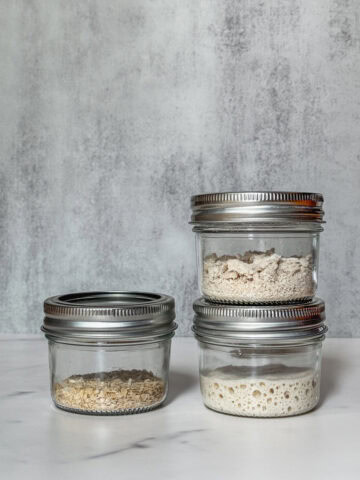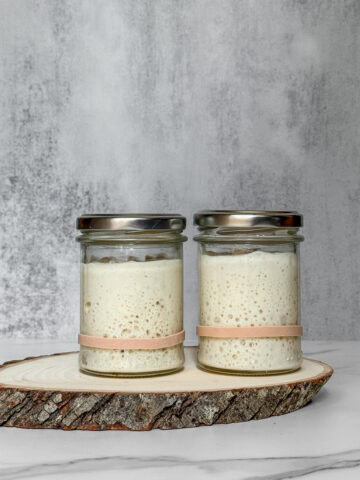

The question "Can I use sourdough starter straight from the fridge without feeding it first?" is the most common among bakers. The short answer is yes.
This method has intrigued many other home bakers and me. It sounds easier and more flexible, but it also challenges the usual way of baking bread.

If you have been making sourdough bread for a while, you can try using a sourdough starter straight from the fridge and see how it works for you.
However, if you are new to sourdough baking, start by making a levain (an active starter at peak) before trying an unfed sourdough starter.
There are two main points to consider when using sourdough starter from the fridge. What really matters is how long ago it was fed and whether it was at its peak before going into the fridge.
What is unfed sourdough starter?
Unfed sourdough starter is the same as sourdough discard. When a starter hasn't been fed for a while, it is called "unfed," and its age has a significant impact on how it behaves in your dough.
- Unfed starter 1-3 days old: The yeast is still fairly active, though the starter may be slightly more acidic than a fresh, fed starter. Lactic acid bacteria (LAB) are already producing acids, mainly lactic acid, which adds a mild tang. Bulk fermentation will be a little slower than with a fully active starter.
- Unfed starter around 1 week old: Yeast activity slows further, while LAB populations take over, producing both lactic and acetic acids. The dough will ferment more slowly, and the flavor becomes tangier.
- Unfed starter older than 1 week: Yeast activity is very low, and the starter becomes highly acidic, which inhibits both yeast and LAB in your dough. Bulk fermentation will be slower, and you may need a longer rise or slightly warmer conditions to get good results.
How to use the unfed sourdough starter
There are two main ways to use an unfed sourdough starter (discard):
1. Use it straight from the fridge to make Unloaf Sourdough Bread.
2. Refresh it first and build a levain before baking.
Using the starter straight from the fridge
Before baking with a starter that has been sitting in the fridge, make sure it is healthy. If you notice discoloration, an unusual smell, or any sign of mold, don't use it.
If there is a layer of liquid (called hooch) on top, it indicates that the starter is hungry and acidic. In that case, revive the sourdough starter before adding it to your dough.
In general, I don't recommend using the unfed sourdough starter (aka discard) that is more than about 1 week old if you want a good rise. But you are always free to experiment.
The fresher the starter, the better it will perform. A starter that has been in the fridge for 2-3 days will always be more active than one that has been sitting for two weeks.
Bulk fermentation with unfed starter depends on the starter's health, how long it has been refrigerated, and your dough temperature.
Refreshing sourdough starter before using
Once again, if you notice hooch sitting on top of your starter, refresh it with a few regular feedings. Read about how to deal with sourdough starter hooch.
If your starter smells strongly of alcohol, use one of the starter-strengthening methods to restore balance.
Even if your starter is healthy but has been in the fridge for a week or more, try to refresh it before making bread. Feedings rebuild the yeast and help the starter regain its normal balance of yeast and LAB.
Here is how to revive it:
- Remove your unfed starter from the fridge and let it sit at room temperature for a few hours. I like giving it extra time (longer than the quick warm-up many bakers mention) so it can rise as much as it can.
- Once it rises, discard everything except 10-20 g of starter.
- Feed it using your regular feeding ratio. For example, my usual feeding ratio is 1:4:4 twice a day at 75°F (using the Brod & Taylor Sourdough Home), so that is how I refresh it.
- Don't feed again until it reaches its peak. The first rise after refrigeration often takes longer than expected, and this is completely normal.
- Once it peaks, feed it again. Repeat this process a few times. When your starter consistently doubles (or even triples) between feedings, it is ready to bake with. Read about when the sourdough starter is ready for baking.
Unfed sourdough starter: Pros and cons
Using an unfed sourdough starter changes how your dough ferments and how your baking day flows (think of it as adjusting your baking schedule). Here are the main benefits and challenges of this approach:
Pros
- Saves time: You can mix your dough right away without building a levain first, which streamlines your baking day.
- Less discard waste: Using unfed starter directly helps reduce food waste and makes your sourdough routine more sustainable.
- Adds deeper flavor: Older discard brings more acidity, especially if it has been in the fridge for several days. This gives your bread a pleasant tang.
Cons
- Reduced rising power: As the starter ages, yeast activity naturally declines. A discard that is a week old or older doesn't have enough strength to reliably rise bread dough.
- Harder for beginners to judge fermentation: An unfed starter means bulk fermentation is slower and less predictable. If you are still learning dough cues, it becomes trickier to tell when bulk fermentation is done.
- Risk of too much acidity: Very old discard tends to become overly acidic, which will tighten the gluten, slow bulk fermentation, and lead to a dense loaf.
- Requires a healthy starter: If there is hooch, refresh it before using it in your dough.
Using unfed starter can work well, but it asks for good dough awareness and a healthy, reasonably fresh discard. For beginners, it takes practice to get consistent results.
Using a cold starter at peak
Here, we are talking about a very specific type of starter: one that was fed, allowed to reach its peak on the countertop, and then placed in the fridge.
This is often called a "hybrid starter" because it lives part of its life at room temperature and part in cold storage. And it is perfectly fine to use it in dough.
This method isn't just convenient; it is backed by science. In Tom Cucuzza's long-term experiment comparing a daily-room-temperature starter to a hybrid starter (fed, peaked, then refrigerated until the next day), the results were surprisingly positive.
The experiment showed that after 19 days of testing, the hybrid starter had no loss in yeast activity. In fact, after two room-temperature feedings, it produced about 20% more CO₂ than the always-warm starter. That means the yeast remained active, healthy, and highly productive.
As for acidity, for about the first 7-10 days, both starters behaved almost identically. Around Day 14, the hybrid starter became slightly more acidic and slowed down a bit, which is normal when a starter spends more time at cold temperatures. But with two regular countertop feedings, it bounced right back to full strength.
As a result, the rise time doesn't suffer. Both starters doubled in volume in about 6 hours and peaked around 8 hours (at 74°F / 23.5°C). Their pH curves were nearly identical as well.
Intermittent starter refrigeration: Pros and cons
Using a starter that has been fed, allowed to peak, and then refrigerated (the "hybrid" method) makes sourdough maintenance much easier. But like any method, it has its strengths and limitations.
Pros
- Fewer feedings, less discard: Since the starter rests in the fridge between peaks, you cut your discard and keep your routine simple.
- Strong, reliable yeast activity: Based on Tom Cucuzza's testing, intermittent refrigeration doesn't weaken the yeast population. In fact, some starters come out of the fridge even stronger, producing more CO₂ than the same starter kept at room temperature.
- Flexible baking schedule: If you know you don't have time for mixing bread dough and bulk fermentation, you can safely refrigerate the starter at peak without worrying about harming its performance. This gives you more control and less stress.
- Consistent performance: When refreshed at room temperature, the hybrid starter rises at the same rate and reaches the same peak height as an always-countertop starter.
Cons
- Acidity can build over time: After about 10-14 days of repeated refrigeration cycles, the starter can gradually drift toward higher acidity. This may show up as a slightly slower rise. Thankfully, a few room-temperature peak-to-peak feedings bring it right back into balance.
- Not entirely hands-off: Although maintenance is reduced, you will still need to monitor the starter and adjust with countertop feedings if you notice slower activity or sharper aromas.
- Individual variation: Every starter is different. Your starter might respond slightly differently to intermittent refrigeration, so some experimentation is needed to find the rhythm that fits your kitchen.
Overall, intermittent refrigeration is a beginner-friendly, time-saving method that offers flexibility in your daily routine. It is a practical choice for busy bakers who want reliable performance without regular daily feedings.
Final thoughts
If you are already getting good results with your current sourdough process, keep doing what works for you. If you are just starting out, stick with the traditional method of regularly feeding your starter and making levain before baking.
But if you are curious and want to experiment, feed one starter as normal before baking, and use the hungry one from the fridge. Bake and compare the results.
Let's talk sourdough
What are your thoughts on using an unfed or "hybrid" starter? Have you tried either of these methods in your baking? Share your thoughts in the comments below.
Ready to keep learning?
Now that you know when and how to use your refrigerated starter, it is time to learn about the liquid vs. stiff sourdough starter and how they behave in your dough.